
Join the discussion
Write your take first — we'll ask for email only when you're ready to publish.
- Hacker News
- How does it compare to direct solar cooking?by nashashmi
- With the panels I have on my balcony I get about 200 watts even on overcast days. I would love to have appliances that were optimized for lower peak consumption. But many appliances like the fridge have low average consumption but high peak consumption so that while the panels on average produce about as much as I consume per day in reality I still have to buy power from the grid.by adrianN
- batteryhookup is a great source for used batteries, it's pretty affordable to build your own setup to run stuff like a fridgeby electroglyph
- > But many appliances like the fridge have low average consumption but high peak consumption
You need an “inverter drive” fridge. It’s effectively soft-start and stays on continuously instead of justt a binary on/off.
Many options available at the consumer level.
Dunno if it gets angry if it senses that it’s browning out its own circuit or just reduces its draw (vs increasing current draw). But does mean it can dial up and down its draw on a continuous basis.
by Scoundreller - I wonder, how hard would it be to make a vacuum insulated oven like a big thermos flask?
I know this is “low-tech” but still think it might be possible to fabricate something even if it means spending some of your power budget maintaining the vacuum with a pump.
by Lio - maybe vacuum insulated panels.
A big thermos would be much more challenging, though there are already long vacuum bottles/tubes used as solar cookers.
by jacknews - Very neat. I guess what you cant do is cook a lot of food. The food needs to be in there a while and adding cold food takes energy out of the system which is say 0.8kwh per day. So like 20 minutes of microwaving a day of power. You probably need 2 or 3 for a family.by hshdhdhehd
- Even if insulated, isn’t this setup always heating the home? The insulation slows down the heat transfer but if I’m following correctly it’s basically running the heat element anytime the sun is up. I think this would be counterproductive in my climate as I’m cooling the home most of the year which is an even more energy intensive processby conductr
- Stick it in the balcony then?by hshdhdhehd
- All cooking appliances are heating the home if you view it in that lens. Fridge, normal cooktop, oven, airfryer, dishwasher.
- I think some simple MPPT circuitry would be a smart investment for this, rather than a fixed resistance connected directly to a solar panel.by oritron
- An MPPT would double the cost of this setup.by buckle8017
- It's from Low Tech Magazine. A low tech solution is not surprising. Chasing 20 or 30% solar generation efficiency gains isn't really something all that relevant when you're building an oven that you're going to leave switched on all the time whether you're cooking or not.by bigiain
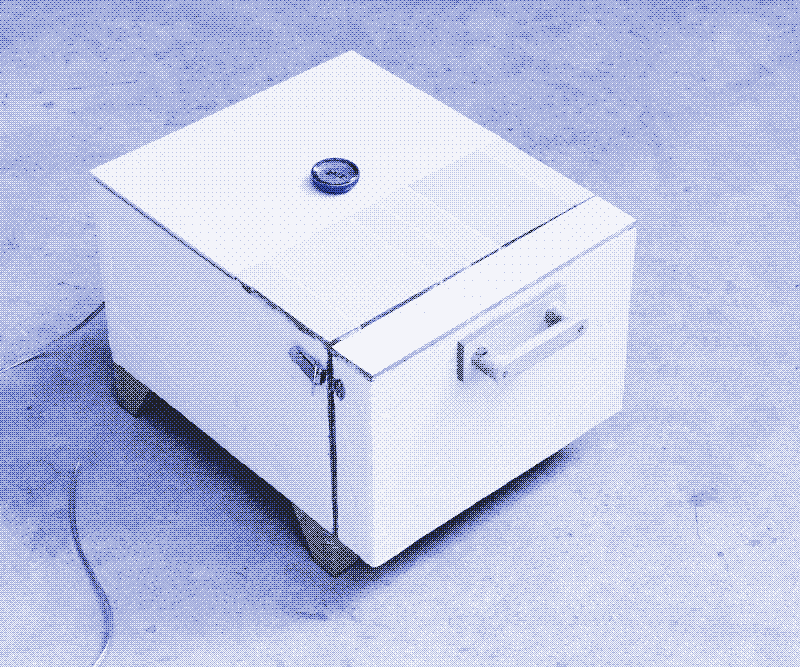
- Why do the images look like someone took pictures of dotmatrix printer output?
---
Update: for whatever it's worth, I just asked the Magic 8 Ball (Perplexity):
Low-tech Magazine uses the option to display images as dithered primarily to reduce the energy consumption and data load of their website. Dithering is an old image compression technique that reduces the number of colors in images to just a few shades of gray (black and white with four levels of gray), which dramatically decreases the file size. The black-and-white dithered images are then recolored via the browser’s CSS, which adds no extra data load.
This approach makes images roughly ten times less resource-intensive than full-color high-resolution images, which supports the magazine’s goal of having a low-energy, solar-powered website. However, some images, such as graphs or those with crucial color information, may become less clear under dithering, so the website offers the option to turn off dithering for individual images to reveal the original, heavier images. This balances energy efficiency with the need for clarity when visual information depends on color or detail.
Thus, the dithered image feature is both an energy-saving measure and a distinct stylistic choice that aligns with the philosophy of reducing the environmental impact of web usage while maintaining visual storytelling appeal.
by wopwops - There is a button under the image that will show you the color version. As others mentioned, the site's about page explains the rationale.by two_handfuls
- It would seem strange if that was the purpose since the first photo on the website is ~40kbby kamranjon
- You can also find this information in the web site itself: https://solar.lowtechmagazine.com/about/the-solar-website/#h...
- This feels (needlessly) performative. I get the idea, but the low quality images make it harder to understand what they are showing in the photos, which makes it harder to then reproduce their work.
I suppose the vast majority of users will not need the higher resolution, so perhaps have it be a toggle to get the higher-resolution when needed.
by 3D30497420 - Probably best to read the Low-Tech Magazine site About page explaining what they do as a solar-powered site:by NaOH
- Great project and build. I wonder if using a small fan would not help energy transmission, which is eventually the goal of cooking. It may also make the oven work like it’s at higher température while not consuming much energy. It would discharge energy from the walls faster using convection in addition to radiation.
Plus, you can experiment with tray materials depending on what you want to cook.
Suggestions inspired by my experience with convection/classic oven and copper pizza plates
https://www.italiancookshop.com/products/hammered-copper-rou...
by 0wis - Just as a note pressure cookers like the Instapot are rated at 1000wh but they don't use that all the time IIRC — only initially when building the pressure. In simple terms it's like using 1kw for 10 - 15 mins and not an hour. So on average very efficient.
Has someone measured the time for max usage and average usage? Could be a good alternative with a 1kwh lfp battery with a lot of juice left over after pressure cooking(no pun intended)
by ghm2180 - I used my Instapot ONE time as a hotpot thing, keeping a broth hot, almost cooking, for 2 hours with no lid. It died that day (thermistor).by thenthenthen
- Rated at 1000 watt hours?by kragen
- This is fun, I'm curious to try it.
An alternative that I experimented with and found to be very usable is one solar panel, a small camping battery ("portable power station"), and an Instant Pot. The total cost is not super high. The Instant Pot is power efficient and can cook a lot of food at once. Since it's battery powered you can start any time the battery is charged.
by nwhitehead - There are now commercial ovens with LiFeO4 batteries in then that do basically just that.
Except they're stupid expensive.
by buckle8017 - I had fun doing this over the summer with a 100W panel, a 1kWh battery (1500W max output), and various cooking appliances: rice cooker, hot water kettle, instant pot, induction cooktop. On a sunny Pacific Northwest day I could charge the battery around 50%, more if I rotated the panel diligently. Rice cooker and hot water kettle (5L) would use about 40-50% of it per usage. So during the summer it was handling all of my power needs for those two appliances. It was always fun getting to full charge and frantically finding novel ways to "not waste" the sunlight. Charging my power tool batteries, etc. One time I even charged my EV 1% but that wasn't very practical.
Some other interesting things I learned: the battery passively eats about 5-10W, and on a cloudy day the solar panel would only get 10W during the day. So in the cloudy PNW winters it can't even maintain the battery let alone charge it. The inverter eats another 30-50W or so, so you have to turn it off when you're not using the AC outlets. My battery lets me separately power AC and DC (USB-A and USB-C) so I was charging devices via USB and not wasting energy powering the inverter.
by qwerpy - >lower cooking temperature of about 120°C
At what point is it easier to just use a microwave? For all the effort to biuld an insulated box, a small microwave consumes maybe 600w, easily doable with batteries and an inverter. Microwaves also get hotter (useful if you want to do more than poach food at 120c).
Actually, forget the inverters. It turns out loads of 12v/24/48v microwave ovens exist for the RV market.
by sandworm101 - >useful if you want to do more than poach food at 120c
Slow cooking almost always gives you excellent results with vegetables, meat or fish. There is already a market of crokpots, sous vide and steamers, that I wouldn't dismiss as "poach food".
And for things like a pizza or crispiness in general, that need higher temperatures, I doubt you can get decent results with a microwave.
The usual 180°C / 350°F set has more to do with convenience (highest temperatures that doesn't burn the outside before the core is cooked) for cooking things as quick as possible, than tastiness of the food.
by otherme123 - This article references a 2023 article about lithium battery costs with price at 750 EUR per kWh (approx 12V 100Ah) for 30 years life couting 3 replacements if I read correctly note 5:
https://solar.lowtechmagazine.com/2023/08/direct-solar-power...
These days 1 kWh of LFP battery is 70-150 EUR depending on the brand, so far lower than referenced. And LFP cell lifetime is probably 20 to 30 years.
In a system it means that 1 kW of solar PV panels is about the same price as 1 kWh of battery, and similar lifetime.
by guerby - Storage is booming in my very much coal-powered country with residential storage going from 115MWh to 670MWh over the course of 2024.
As it stands it's enough to power the country for about two minutes, but that's two minutes gained in a year.
In the commercial space there's a total of 4.3GW of peak output commissioned to be deployed before 2030. That will greatly help in shaving the afternoon increase in electricity usage.
by Tade0