
Join the discussion
Write your take first — we'll ask for email only when you're ready to publish.
- Hacker News
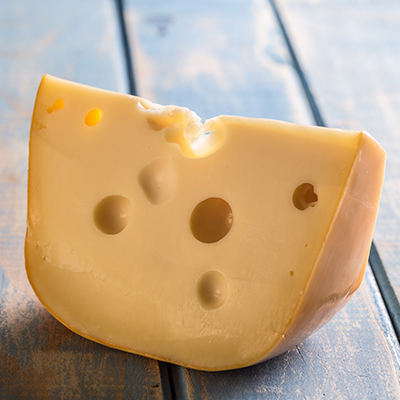
- It's because of bacterial farts.by zombot
- As a kid, I was told it was due to rats and other critters getting into the cheese.
I’d then proceed to wonder why no adults thought to throw it out, much less eat the stuff.
by not4uffin - For those who are interested, Taste Atlas has a very huge list of cheese.by sixtyj
- From the linked page:
> With your agreement, we and our 937 partners ...
937? That is insane. That is basically spyware.
by timeon - Having experienced several of the cuisines rated by Taste Atlas, I would not trust a comma out of their reviews :Pby ricudis
- We add holes for USA only, because 39% of taxes on our exportations.by SamLeBarbare
- Because the damn swiss folks really want to sell more cheese, without actually producing more cheese!
So the proper way is to cut half the cheese out, say that holes are NECESSARY and IMPORTANT - and then sell twice as much as before. They are a genius people.
by shevy-java - Like a White Castle burger!by mattmaroon
- Fun fact - in Switzerland the holes are not permitted. Bonus fact - Switzerland imports more cheese than it exports.by rootusrootus
- Isn't cheese usually sold by weight? So your theory, erm, has holes in it.by mark-r
- I believe one of the first publications explaining the phenomenon dates back to 2015. https://www.sciencedirect.com/science/article/pii/S095869461... It details the formation of the holes, their size, etc. I remember sending it at the time as a contribution here, thinking the topic was worth interest. Unfortunately, it fell through the cracks. I had also submitted it for approval to the Ig Nobel committee (it diverges somewhat, strictly speaking, from the philosophy of the prize). I received a reply saying it would be reviewed.by pythg
- But ... why only a few big holes? Sometimes "fresh cheese" develop a lot of small holes (and a strong flavor), but no big holes. Why big holes?by gus_massa
- Baby Swiss and Lacey Swiss are small hole varieties.by ofalkaed
- Havarti has a lot of small holes, but its a different kind of cheeseby TheAdamist
- Many small holes collapsing into a few large ones, perhaps? You can sometimes see where two holes merged.by riffraff
- TIL "Swiss cheese" is apparently a specific brand of cheese in the US and not just cheese from Switzerland.by xg15
- > "Swiss cheese" is apparently a specific brand of cheese in the US
Type. And there are lots of non-Swiss Emmantaler producers.
- I love that the first sentence of the article has the simple answer, and as you read more, you get more detail. The opposite of the "click bait" trend.by joncrane
- The term "Swiss cheese" is a constant source of amusement for people from Europe... you know, like, there is only one type of cheese made in Switzerland...by kleiba
- It usually means Gruyère cheese.
- As is "American cheese"by paradox460
- There is more than one kind of cheese in America, but only one is called "American cheese" (and it isn't actually, legally cheese, BTW...).by IAmBroom
- It's like British English, or Chinese cuisine.by eru
- "Today, cheese dairies and mountain pastures in Switzerland produce nearly 500 varieties of cheese, not counting fresh cheeses."
https://en.wikipedia.org/wiki/Swiss_cheeses_and_dairy_produc...
by kleiba - In the UK it's fairly common to use the term "Swiss cheese". Most people would know you are talking about Emmental or Gruyere and it would have the bubbles/holes in it.
Although they are not the same cheese, they are quite close in texture and flavour and are fairly interchangeable to the point where I don't think a significant number of people could tell you which was which.
There is also the Swiss Cheese Model which is when several unfortunate events all line up to cause a major incident.
by Steve44 - Well of course not, but at some point it became an icon. Similar to eating a Danish pastry, like the Danish only made one type of pastry...
Of course cheese with holes in it isn't the only type of cheese they make
by NoPicklez - In German, "Swiss cheese" is a term that's well known, and doesn't count that kind of amusement.
For example, you could say that something "looks like swiss cheese" when it has a lot of holes in it, like very old clothing. It's often used slightly ironic, but that's not due to what you state.
by criemen - > Properly formed eyes are a mark of quality.
Except when I asked someone who makes cheese in Switzerland, they told me almost the opposite (and mostly that they export the junk cheese to the US and keep the good stuff).
As an aside, what are the odds this article was written by AI? It has that feel (minus random bolding and bullet points).
by chris_va - I have heard that Denmark exports their best pigs and leaves the second best for home. Not sure why that should be any truer than what you heard regarding Switzerland and their strategy, but they seem to represent two differing strategies about how to best profit from strong points, it would be nice to figure if either is the dominant one.
Perhaps we can ask Italy what they do with tomatoes and parmigiano.
- I presume you mean Emmental, the term "swiss cheese" doesn't exist or more precisely has no meaning, its like saying "american car" for example, what do you want to discuss with such a vague term.
Switzerland produces up to 1000 varieties of cheese (still nothing compared to what France produces but its a tiny country comparatively), and literally 1 semi famous variety has holes. Its not what most Swiss folks buy most of the time, that would be ie well aged AOP Gruyere or Appenzeller for example (much much better taste experience than even best Emmental can ever produce).
by kakacik