
Join the discussion
Write your take first — we'll ask for email only when you're ready to publish.
- Hacker News
- btw... some urls in this image contains js with vulnerabilities https://eaton-works.com/cdn-cgi/imagedelivery/VwwCqBIYNXeyNQ...by guluarte
- I'm just trying to understand, how is finding keys in plain sight termed as hacking?by faridv
- I'll just leave this here:
> September 1, 2023: Tata Motors shared with CERT-IN (who then shared with me) that the issues are remediated. September 3, 2023: I confirm only 2/4 issues were remediated and the AWS keys were still present on the websites, and active. October 22, 2023: After no updates and finding the AWS issues still not remediated, I send over some more specific steps on what must be done. October 23, 2023: They confirm receipt and are working on taking action. After this date and up until January 2, 2024, there were various back and forth emails trying to get Tata Motors to revoke the AWS keys. I am not sure if something was lost in translation, but it took a lot of pestering and specific instructions to get it done.
Stay classy TCS.
by fakedang - This is a pessimistic comment.
I'm a cofounder of a data and identity security startup operating specifically in APAC. Data security in india a joke.
I would argue even with DPDPA, RBI C-Site and cyber resilience framework from SEBI, it is just going to not happen here.
The list PAN card the blog is taking about is probably already leaked by some other services.
The recent flipkart cash on delivery scams [1] are example of how your personal information is just out there in wild in india, open for exploitation.
There are lot of who do security in good faith (often driven by compliance) and lot of them are our customers too but I hope to see rest of indian tech ecosystem take security seriously.
[1] https://www.reddit.com/r/FuckFlipkart/comments/1hhrw9w/what_...
by debarshri - I've dealt with Indian companies for security sales and I'd say the newer generation of companies like Razorpay (YC W15) are decent at SecOps, but the older and more established companies suck at it and will continue to suck at it until there is a tangible regulatory incentive to enhance security postures.
It also appears to be a side effect of compensation - why would mid-career security professional want to earn ₹15 LPA TC working for a legacy corporation if they have the skills to land at a security MNC that can afford to pay ₹35-50 LPA in TC.
Ofc, it's us foreign investors who are able to afford those higher TCs ;) - especially if we can convert someone who was mid-career in the US but had to return to India due to family or visa issues.
It reminds me of how the Israeli security scene was 10-15 years ago, with similar problems around compensation and brain drain to MNC offices.
by alephnerd - If there any any TCS employees on Hackernews, please show this post to your management. This is beyond embarrassing on so many levels.by pkphilip
- So the author got nothing but a thank you out of it? That's a shame.by ksynwa
- Typical 'payout' for ""responsible"" disclosure.by DaSHacka
- At least there was a "thank you".
Some go on to sue such researchers.
by tehlike - This shouldn't be a surprise for anyone who has worked with TCS contractors in the past.by paxys
- Security for most Indian companies - even conglomerates is a joke.
Look at the websites - most look like they've not been upgraded since the 90s, with endless popups
by sharadov - > endless popups
Ypu get popups? What are you using to browse? IE5?
I sometimes get 'this site is trying to open another window -allow/ block?': answer is always 'No'.
by Ylpertnodi - The customer portal of India's largest insurer with a marketcap of $63B has literally not changed even once in the 14 years that I've been using it to pay my policy premiums
- It's a side effect of pay. Like every other company, you get what you pay for, and for organizations that view web security as a [edit:] Cost Center (eg. Tata Motors) there's no incentive to pay market rate for a Security Engineer - who in India can now demand $60k-100k TCs.
Heck, firms that provide offensive security capabilities to Indian PDs can pay $40k-50k after poaching a junior pentester or exploit developer from a PD.
by alephnerd - The fact that they put their AWS secret keys on their website is incredible.by speckx
- If you’ve ever worked with Indian outsourcing firms it’s notby horns4lyfe
- Sending it with AES encryption(with the key that the client has access to) makes it even worse, as someone knew this shouldn't be shared to client yet they shared it anyway.
- Even more importantly, why do the root keys expose EVERYTHING? Do they just have one account for all of their infra?
- The fact that it's nicely commented is even more so. Check out the other environment configs commented out, are they doing this by hand? Wild.by Linkd
- That’s exactly the kind of work I’d expect from TCS, I’m not sure why you are surprised.
- > October 23, 2023: They confirm receipt and are working on taking action. After this date and up until January 2, 2024, there were various back and forth emails trying to get Tata Motors to revoke the AWS keys. I am not sure if something was lost in translation, but it took a lot of pestering and specific instructions to get it done.
Wow, they had to go out of their way and plead with Tata Motors to fix their own shit. I can only admire their patience. Can't say I would be that patient.
by rdtsc - Related: Jaguar Land Rover hack cost UK economy an estimated $2.5 billion, report says: https://news.ycombinator.com/item?id=45668008
The 'tech' for both these is by guess who? TCS!
Edit: For those who don't know the relation. Tata[1] is a conglomerate, which owns both Tata Motors (Jaguar, Land Rover) and also TCS (Tata Consultancy Services)
- Very realistically, why shouldn't these developers be replaced by AI? The anti-AI argument I've always seen here is that AI is bad at security. But human developers at orgs like TCS don't seem...any better?
- TCS also contracts for Marks & Spencer, and the Co-op, both of which were also taken offline by hacking earlier this year.by cjs_ac
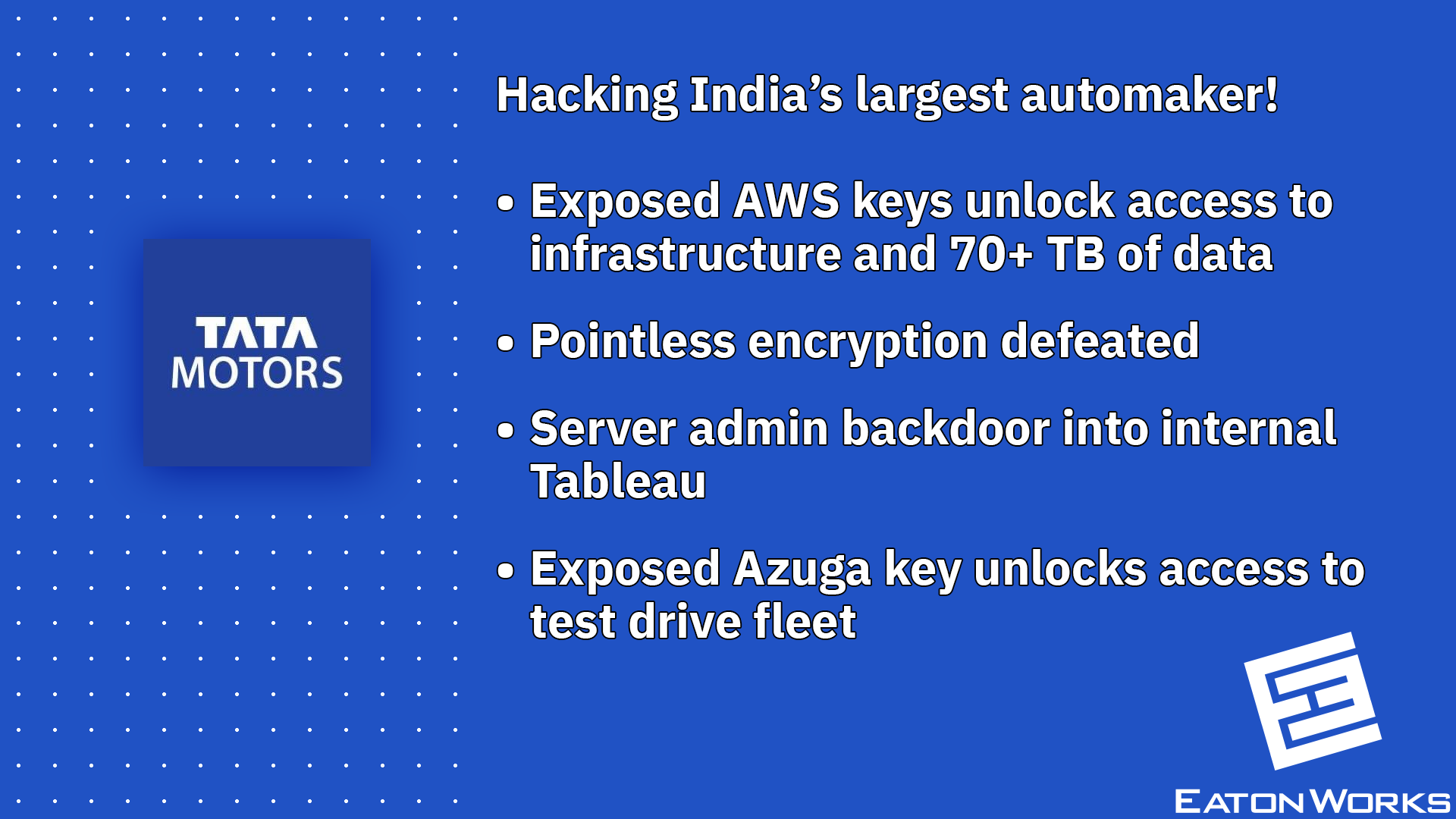
- > As recently seen with Intel, there seems to be a trend where developers will do this pointless client-side decryption. When the client has the key, it’s strange that anyone would think that would be secure.
I stay and work in India. Yesterday, as part of a VAPT audit by a third party auditor, the auditors "recommended" that we do exactly this. I wonder if this directive comes as part of some outdated cyber security guidelines that are passed around here? Not entirely sure.
When I asked them about how I'd pass the secret to the client to do the client side encryption/decryption without that key being accessible to someone who is able to MITM intercept our HTTPS only API calls anyway, the guy basically couldn't understand my question and fumbled around in his 'Burp' suite pointing exasperatedly to how he is able to see the JSON body in POST requests.
Most of the security people we've met here, from what I can tell are really clueless. Internally, we call these guys "burp babies" (worse than "script kiddies") who just seem to know how to follow some cookie cutter instructions on using the Burp suite.
by hannofcart - lmao
burp suite babies is crazy work
by tonyhart7 - Appreciate the insight!by EatonZ
- Assuming that youve been mitm'd is a different violation of trust. And when you break your own assumptions, well of course nothing makes sense. Were i the burp baby i would've asked why you think we should not defend against literally any other side channel because maybe they broke tls.by halJordan
- You’re right, of course, but this reminds me of when Chrome didn’t obscure your passwords when looking at its autofill settings. The developers argued that it would just be security by obscurity -- if somebody has access to your computer when it’s unlocked, they can do anything they want, so obscuring your passwords does nothing.
The counter-argument is, even if it’s not perfectly secure, that extra bit of friction before you can see the passwords is useful, and may just save your bacon if a casual thief has access to your computer for a few seconds.
The Chrome team eventually saw sense and added some client-side password protection.
As long as you don’t only have client-side protections, of course (and maybe your clueless auditors were making that mistake).
by iainmerrick - I am a pretty cookie cutter developer. We just make glorified CRUDs and I have tried to convince the engineering director hundreds of times that "There is no use of encrypting and decrypting localstorage with a key thats sitting right inside the client code." Yet they keep insisting on it in the code-quality checklist.by sayamqazi