Join the discussion

Write your take first — we'll ask for email only when you're ready to publish.

  • Hacker News
  • One thing I didn’t understand: it uses an UDP port of my choice. What IP is it using? Everything via the tailnet or do I need to open this port to the internet?

    If only available via Tailscale/tailnet - how is connectivity better since if two devices can connect to each other via Tailscale we are already on the direct connection route instead of a relay / derp connection?!

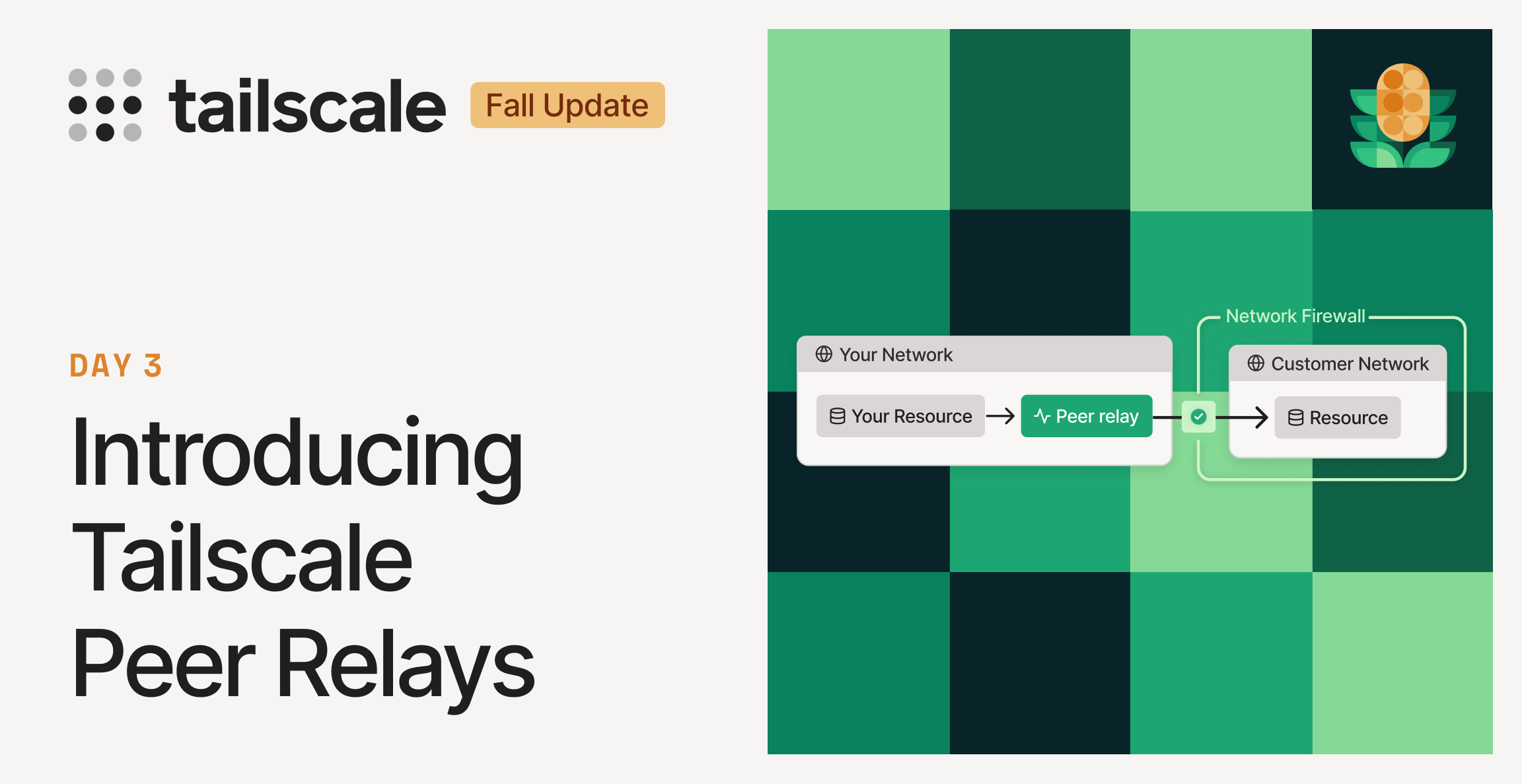
  • > It allows customers to make just one firewall exception for connections only coming from their tailnet.

    You'll need to open a single UDP port on your firewall, so it's your public facing IP address. You don't need an entire VM somewhere, just a single port.

    Regarding the speed question. You'd use the derp when it's not possible to make a peer to peer connection, which limits your speed to derp server's speed and load. Which the peer relay, you can practically use the entire bandwidth you have between your devices.

  • What's the use case for this? It seems to be for situations where you might have a SaaS product, but there is some data required from a customer system. You'd expose the customer data using this relay and integrate into the SaaS. Is that the gist of it? Integration would still likely involve you giving the customer some software to expose a limited API and handle auth, logging, etc.
  • Tailscale is a few things. It might be fair to say that it is mostly a software platform with a web frontend that allows orgs (and individual users alike) to easily create secure VPNs, so their various systems can have a secure, unfiltered virtual private network on which to communicate with eachother even if they're individually scattered across the four corners of the Internet.

    The usual (traditional) way to do VPN stuff is/was hub-and-spoke: Each system connected to a central hub, and through that hub each system had access to the other systems.

    But the way that Tailscale operates is different than that: Ideally, each connected system forms a direct UDP/IP connection with every other system on the VPN. There is no hub. In this way: If node A has data to send to node F, then it can send it directly there without traversing through a central hub.

    And that's pretty cool -- this peer-to-peer arrangement is gloriously efficient compared to hub-and-spoke. (It's efficient enough that a person can get quite a lot done with Tailscale for free, with no payment expected ever.)

    But we don't live in an ideal world. We instead often live in a world of NAT and firewalls -- sometimes even implemented by the ISPs themselves -- that can make it impossible for two nodes to directly send UDP packets to eachother. This results in unreachable nodes, which is not useful.

    So Tailscale's workaround to that Internet problem is to provide Designated Encrypted Relays for Packets (DERP). DERP usually works, and end-to-end encryption is maintained.

    DERP is also not at all new. It brings back some aspects of hub-and-spoke, but only for nodes that can't communicate directly; DERP behaves in a way akin to a hub, to help these crippled nodes by relaying traffic between them and the rest of the VPN's nodes.

    But DERP is a Tailscale-hosted operation. And it can be pretty slow for some applications. And there was no way, previously, for an individual user to improve the performance of DERP: It simply was whatever it was -- with a collection of DERP servers chewing through bandwidth to provide connectivity for a world of badly-connected VPN nodes.

    But today's announcement brings forth Tailscale Peer Relay.

    > What's the use case for this?

    The primary use case for this is simple: It is an alternative to DERP. A user can now provide their own relay service for their network's badly-connected peers to use. So now, rather than being limited to whatever bandwidth DERP has available, relaying can offer as much bandwidth as a user can afford to pay for and host themselves.

    And if a user plans it right, then they can put their Peer Relay somewhere on the network where it can help minimize inter-node latency compared to DERP.

    (It's not for everyone. Tailscale isn't for everyone, either -- not everyone needs a VPN at all. I'd never expect a random public customer to use it knowingly and directly.)

  • They are an alternative to the tailscale operated DERP servers, which are cloud relays.

    Even with the much touted NAT punching capabilities of tailscale, there are numerous instances where tailscale cannot establish a true p2p connection. The last fallback is the quite slow DERP relay and from experience it gets used very often.

    If you have a peer in your tailscale network that has a good connection and that maybe you can even expose to the internet with a port forward on your router, you now have this relay setting that you can enable to avoid using the congested/shared DERP servers. So there is not really a new use-case for this. It's the same, just faster.

  • Hard to parse the networking jargon, but does this enable offline connections?

    If I have two devices on my local LAN (both connected to a Tailnet) and my home internet goes, currently the devices disconnect from each other. I have been looking for a way to prevent that, so that the all devices connected to the same WiFi network on a tailnet can find each other even if the internet connection to the wider world is broken.

  • that already works
  • That'd be easy if only wireguard supported multiple endpoints per peer, then one could add the ULA address of the local devices in addition to the external one.
  • > my home internet goes, currently the devices disconnect from each other.

    You might be able to solve this by hosting your own control plane such as Headscale. Instead of having Tailscale manage/coordinate all the nodes on tailnet.

    https://github.com/juanfont/headscale

  • I was literally looking for a solution for this over the weekend and ended up with a very quirky setup for my Kubernetes Operator.

    Now I can rip all that out and use this! Bravo!

  • Man K8s is my nightmare haha. 100% agree
  • You can use Tailscale to connect services together (not just someone's laptop to a service, replacing OpenVPN), but what if Tailscale has an outage? Will my services not be able to find each other anymore?
    by depr
  • The tailscale login servers had an issue last week. My local network had an issue at the same time and all connections dropped. Then none of my stuff could reconnect because I couldnt connect to tailscale :(

    Looking into setting up my own headscale instance now. This is the first issue I’ve had with tailscale but seems dumb that my local lan devices couldn’t even talk to each other.

  • Wow! I just spent a good chunk of time last week setting up headscale and split horizon SSL behind my network, and I expected I was going to just expose a Wireguard UDP port, but discovered no, it’s DERP or nothing. DERP has been OK, but I think just exposing a UDP port on my local network is better.

    If we’re really confident in the security of that UDP client, that is. I feel very comfortable exposing a Wireguard bastion, time will tell how secure whatever protocol tailscale is serving, here, will be.

  • mind developping on the "it's DERP or nothing"? Have you been trying to expose a direct wireguard port of your own, or the Tailscale?
  • Main downside I see compared to DERP is there's no way for this to work in the browser since it's native UDP. I wonder if it'd be possible to make it work over WebTransport in the future.
  • (Tailscalar) I'm very bullish on WebTransport in the future, but, it doesn't solve for NAT traversal. I'm watching keenly as well how Iroh gets on with QAD, relatedly.

    If it all comes together this may well become more magic :D

  • Is it possible to specify the external ipv4 and ipv6 address? There are scenarios where the eggress traffic uses a different address to ingress, or the host has multiple internet-connected addresses but only one has a firewall permitting traffic to the nominated port.
  • I wonder if the next step could be to have all tailscale clients automatically able to accept forwarding requests between any two machines within the tailnet, so that the mesh seamlessly auto-routes around any breaks within the mesh?
  • Yeah, such extension is natural and it comes up frequently in the context of overlay networks. The defining question here is if you are OK with relaying other people's CP traffic.
  • Since the latency would be higher due to the additional hops or distance, I wonder if it's not better to make the request crash so that the issue is clearly detected rather than to continue in a degraded but "invisible" state.
  • > We believe our new Tailscale Peer Relays connectivity option—unique to Tailscale—gives customers the best performance and flexibility.

    Seems pretty similar to some of the stuff ZeroTier was doing years ago. Hard to claim it's unique to Tailscale. Charging for it above and beyond the per user costs seems overboard as well.

  • I've used ZeroTier in the past and I don't recall a feature similar to this being part of their offering. What I do remember is home brewed crypto, incredibly poor single threaded performance, and a glacial development pace. Any thread about Tailscale inevitably brings up alternatives, but having tried many of them in the past, I've yet to find one that actually competes across all the features and performance. The comparisons to other solutions tend to give me "why do you need Dropbox when FTP exists?" vibes.
  • This was better solved by tinc about 20 years ago. All tinc nodes can work as relays (but you can disallow that if you want), it does not rely on a centralized server, and works fine without access to the internet. It is a true mesh. The world would be better served by porting tinc to wireguard and some memory safe language instead of reimplementing parts of its functionality from scratch.
  • Wireguard can do what you're describing.
  • I remember using Tinc a lot and really liking it. But as 1gbit+ speeds became more common, tinc struggled to maintain that much throughput on lowend hardware.

    I also didn't know that tinc was still around, I might give it a try again just to play around with it and see what's changed.

  • Heh. I have a 30-nodes Tinc network over the internet but some hosts are behind a NAT. It keeps randomly losing routes between these nodes. It even has the infuriating behavior that often it loses the route a few seconds after I successfully established a SSH connection.

    Also, traffic seems to be decrypted and re-encrypted by relaying nodes. For end-to-end encryption, you need "ExperimentalProtocol = yes" added by Tinc 1.1, which was never formally released.

    I'd like to rewrite something like it in a language I'm familiar with (perhaps based on cjdns' protocol which is better documented than Tinc's) but it's not easy.

  • Great! This feature made a lot of sense, and it took a long time.

    It’s like falling back to hub and spoke, except that the traffic is end to end encrypted, and the middle node is used only when direct connection is not possible, and for some clients. It’s also similar to running your own derp server (which works also in TCP), but without the hassle of doing so, and perhaps without having to open ports to the internet (needed in derp) so long as the relay is reachable by peers.

    The derp servers have low throughput. Another option could be a pay-as-you-go derp service.

    They might also be on their way to remove the need for reverse proxies, with the recent announcement on Tailscale services.

    BTW, why could it be paid for more than two relays? You are using just your own devices and bandwidth :)

    It actually lower the bandwidth bill for Tailscale by reducing the usage of their own relays. Ideally, by default the software will find whatever nodes could help with direct connection. It’s just routing within your own network.

  • > It’s also similar to running your own derp server (which works also in TCP), but without the hassle of doing so, and perhaps without having to open ports to the internet (needed in derp) so long as the relay is reachable by peers.

    I think most folks will need to open a port to the internet, because otherwise you wouldn't need the tailscale to begin with. e.g. connecting your cloud network to your on premise network etc.

    Of course exceptions apply, like both clients can reach the peer relay, but not each other directly.