Join the discussion
Write your take first — we'll ask for email only when you're ready to publish.
- Hacker News
- I maintain my own library too where I spent a while ripping my CD collection back in the early 2000s (and then again maybe 6 years ago when storage was cheaper to a lossless format). The CDs are all boxed up safely for archival storage, and most of my recent music has been purchased from wherever I can get DRM-free stuff. I fiddled with various self hosted servers but I’ve mostly stuck with iTunes Match since it lets me access it all from my phone, and then I just back up the library from my Mac to my NAS. I just don’t have the time or patience to play sysadmin at home anymore. I use Apple Music streaming for stuff I don’t care about potentially vanishing, but for the stuff that I really love and would be sad to lose, I buy it and put it in the archive. It does happen occasionally that stuff I don’t own that I found on Apple Music disappears, which can be annoying.
I think for most people this is overkill, but for music nerds like me where the collecting and curation is a big part of the enjoyment, maintaining your own library makes sense.
by porcoda - I have a music folder 45000+ tracks and counting dating from as far back as 2003. I sync this 450 GB folder to two computers using syncthing and then use rsync to synchronize a subset of these albums (folders by format) to SD Cards inside iPod's. I use Strawberry player for listening (a fork of Clementine) and a combination of beets and MusicBrainz for tagging. Then, I scrobble my listens on ListenBrainz. When I'm in the car or on mobile, I use YouTube Music and it scrobbles to ListenBrainz as well.
I probably should use navidrome or a similar technology to serve the files. I already do this for audiobooks and podcasts and use Tailscale to access it when I'm not on my local network.
by _-_-__-_-_- - Nice to read, nice to see this message going out more.
I'm old enough (61) that owning music is what I've known most of my life. I have to say I've never not owned my own music. I went from vinyl to CDs—and then ripped the CDs digitally. The ripped tracks I have kept on hard drives, in the cloud. (I am continually adding music as I discover it so that it grows.)
Even though I eschew CDs these days for new music, I buy the digital tracks of the highest quality from Band Camp and add them to my storage locations.
For really top-notch albums, I still buy vinyl as a way of supporting the artist, I guess. I do infrequently put on vinyl (although I still think it is better than CD—it took The Muffs to convince me of that).
by JKCalhoun - I see this sentiment a lot, and I appreciate it. However personally the fewer things I own the better. The thought of having these things that I bought and have to remember I bought and then keep track of them brings me more anxiety than joy. I'm 64 and I grew up when music was scarce and options were limited. The only thing I want to own now is a playlist that points to songs I like. I'll then move to whatever service I like best and has most of the songs I like. Streaming services should cost much more than they do today so that artists can get compensated.by doug_durham
- Call me boring, but for almost 20 years, my music library has been simply a NFS share on a generic PC host running Debian. I've never seen a need to complicate it further with iTunes-this and Jelly-that and Plex and radarr and sonarr and all the blah, blah, blah modern new software that keeps coming out to solve problems I don't seem to ever have.by ryandrake
- Tangential point: The song Terryfold has been removed from Spotify.
It's still available on Youtube if I want to listen to it, but the point is that it's not in the same place, if you're a Spotify user, as all the other music you listen to.
Yes, there's a whole thing with Justin Roiland that's controversial (putting it lightly, maybe he should be in jail, but that's not for me to decide), and that song has obvious elements that relate to the controversy, but, dammit, I like the song for the song.
The point this article is making, and the reason for the author's decision ten years ago, is still relevant and I can't ever see it being irrelevant.
by BLKNSLVR - I’ve recently begun the same journey, except I skipped sync and went straight to Jellyfin (open source Plex) with the files stored on a home NAS. With Tailscale it means I can stream from anywhere. I’ve even been working on a native Linux client written in Rust and Gtk [1] which has been an absolute blast. I expect to have it on Flathub by the end of the month.
The whole process has made me more excited about music again. Part of that is listening to entire albums, another part is the feeling you get from directly supporting an artist when you purchase from Bandcamp.
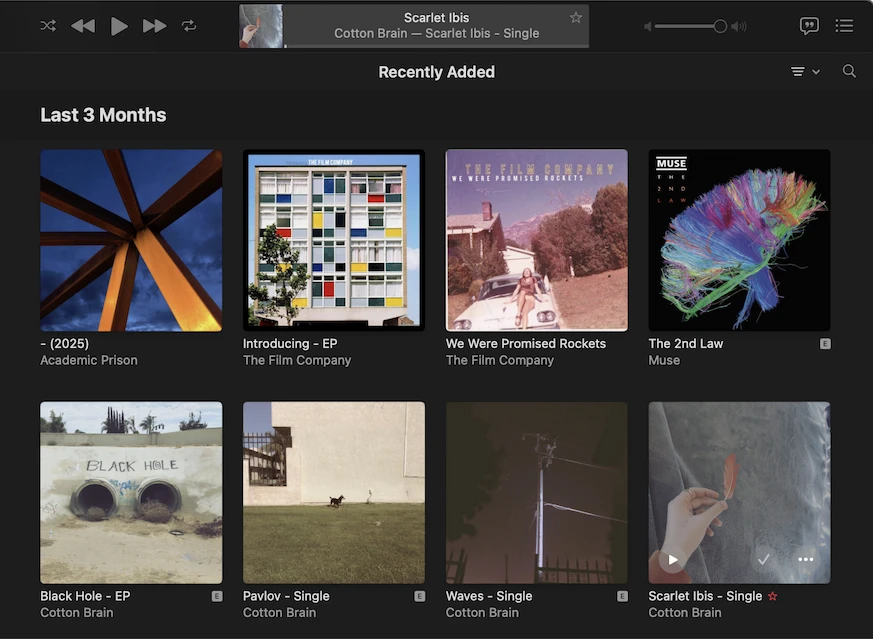
by WD-42 - I've had the same iTunes (now Music.app) library since 2004, with only one botched library migration with an iTunes update in like 2013. It has 40,000 MP3s or so. I still keep it on my boot drive too.
It's a treasure. I understand why most people don't do this, but I will probably forever.
A really significant amount of it isn't otherwise available on streaming services. While I'm an Apple Music subscriber, I still acquire my own mp3s for most of the new music I listen to.
iCloud Music Library is an immense value here as well. Rarely it will sync the wrong version of something in my library, but usually it's on the money. The fact that it doesn't cost anything extra on top of an Apple Music subscription is a huge boon, and it doesn't count against my iCloud data either.
by skrrtww