Join the discussion
Write your take first — we'll ask for email only when you're ready to publish.
- Hacker News
- Hobbyists hacking around and sharing their art, best part of the Internet!by orzig
- I don't care about the math, the computation, the physics. This is just by far the most beautiful thing(s) I have ever seen.by aniijbod
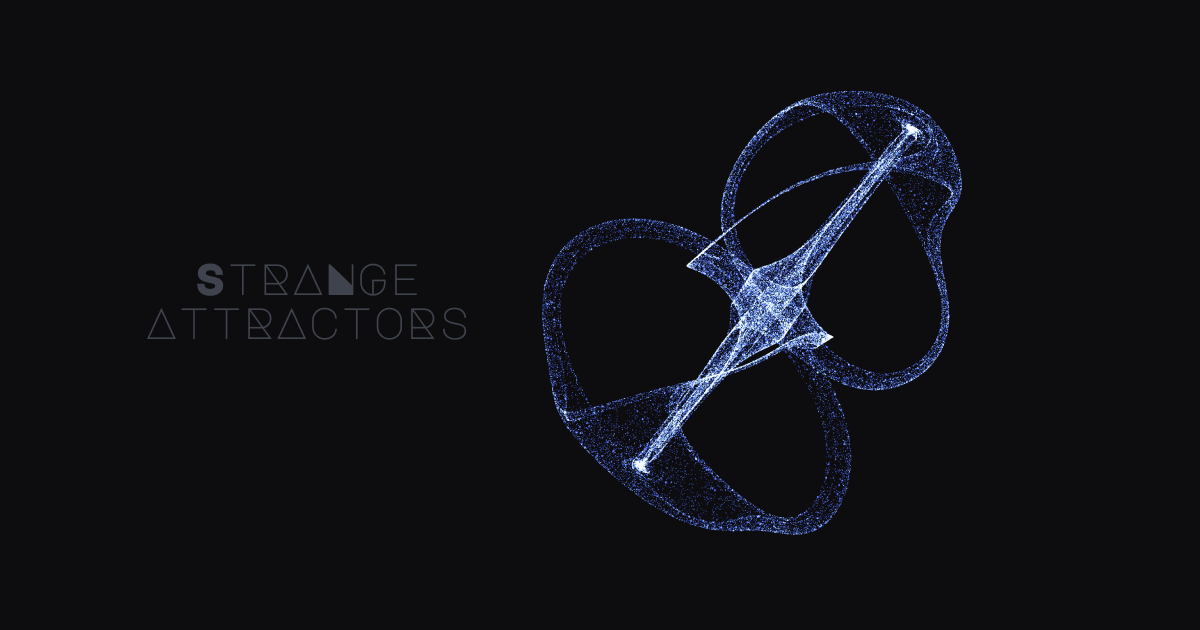
- > A small change in the parameter a can lead to vastly different particle trajectories and the overall shape of the attractor. Change this value in the control panel and observe the butterfly effect in action.
I think this is slightly inaccurate. The butterfly effect is about the evolution of two nearby states in phase space into well-separated states. But the parameter a is not a state. To see the butterfly effect by changing a we would need to let the system settle down, give the parameter a small change, and then change it back. The evolution during the changed time acts as a perturbation on states.
Instead, showing that the attractor changes qualitatively as a function of the parameter is more akin to a phase transition.
by evanb - "not sure if it’s mathematically correct,"
There isn't always "a" correct extension into higher dimensions. There may be many, there may be none, and either way something "close enough" may well be interesting in its own right.
If you'd like something concrete to poke at you can try searching around for people's adventures in trying to make a 3D Mandelbrot. I've seen a couple of good write-ups on those adventures. I don't know if anyone has ever landed on a "correct" solution, it's been years since I last looked, but certainly some very interesting possibilities have been found.
by jerf - This is so cool. Back in highschool during the Jurassic age I used ti play with attractors a lot. Unfortunately on a 486 it took 20-30 minutes to draw one even at low resolution. This renders in realtime and in 3D. Great work!
Still they've had a strong impact in how I see systems - orbits, instability, etc.
by Grosvenor - I bought "Strange Attractors: Creating Patterns in Chaos" (1993) by J. C. Sprott recently, which is a fun book about these kinds of attractors. The whole book can be downloaded online [1] from the author's web site [2].
It's such a typical object of its time. Garishly colored cover, comes with a floppy disk (!) and there are even 3D glasses to view some of the stereoscopic color plates (unfortunately these were missing from the used copy I got). I was surprised to find that most of the programs are in BASIC (maybe easier to do graphics on Windows back then?), though a small number of them are in C.
It's a nice book, and the author seems to have a lot of publications about chaotic systems. Anyone know him? He seems to still be teaching at the University of Wisconsin - Madison.
[1] https://sprott.physics.wisc.edu/fractals/booktext/SABOOK.PDF
by atombender - Neat :) When I was a teenager, some 25+ years ago, I wrote a chaotic attractor visualiser like this — but only in 2D — and it occurred to me, “What if instead of visualising it, I rendered it to audio?” I don’t remember the details: I think frequency was correlated with polar angle and amplitude to magnitude. It forced me to learn how to write WAV format — which was my first introduction to endianness — but the result wasn’t completely inaudible! A bit like the sound effects for computers in old sci-fi movies; random(ish) but not discordant beeps and boops!by Xophmeister
- Visualizations like this truly highlight how much there is to be gained from viewing the 3D phase space, but also how much richness we miss in >3D!
(I wonder if there are slick ways to visualise the >3D case. Like, we can view 3D cross sections surely.
Or maybe could we follow a Lagrangian particle and have it change colour according to the D (or combination of D) it is traversing? And do this for lots of particles? And plot their distributions to get a feeling for how much of phase space is being traversed?)
This visualization also reminds me of the early debates in the history of statistical mechanics: How Boltzmann, Gibbs, Ehrenfest, Loschmidt and that entire conference of Geniuses must have all grappled with phase space and how macroscopic systems reach equilibrium.
Great work Shashank!
by cableclasper