
Join the discussion
Write your take first — we'll ask for email only when you're ready to publish.
- Hacker News
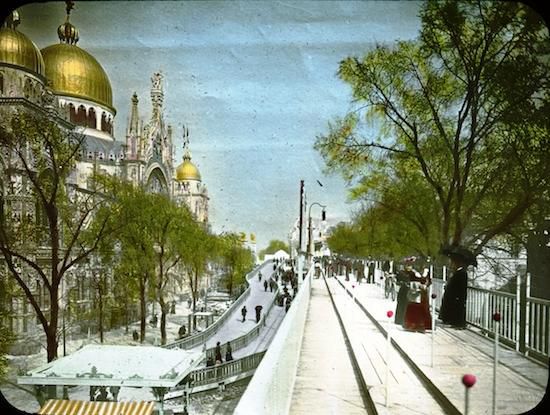
- Filmed by James Henry White. https://en.wikipedia.org/wiki/James_H._Whiteby djmips
- Does anyone know why we don't have these anymore, except in buildings like airports and shopping malls?by randomtoast
- They're very unreliable because of the constant wear, slow compared to other modes, and dangerous for crowds and demographics with limited mobility.
Outdoor variants don't protect riders from weather, and having to deal with extremes of cold, damp, and heat makes them even less robust.
- Maybe because in airports people are sometimes required to walk long distances to go from one point to another, while in a city there are public transport, bicycles, taxis, etc. plenty of other options so walking long distances is usually not required.
- Probably because for most locations, they are actually not very useful, but quite expensive and just cumbersome. They take up space, and create artificial travel-zones, and at the same time they don't even enhance the flow, because most people tend to stand still on them. For safety-reasons (and probably costs) they are usually just around walking speed. So it's overall just a fancy gadget which is only beneficial for heavy luggage or people with special demands. For those situations, we often have better and cheaper solutions.by slightwinder
- ZZ Top's name before it was ZZ Top was Moving Sidewalksby tomcam
- In Hong Kong, public outdoor escalators like the Central–Mid-Levels Escalator are a big part of public transport. They go one way - down from 6am-10am, otherwise up. They’ve regenerated/gentrified a whole area of town that was previously hard to get to. Few cars = people travel differently.by TomWhitwell
- Modern urban car infrastructure is neither space- nor energy-efficient, but urban planning is long-term, and decisions shift all efficiency considerations in the long-term in a way that's hard to undo.
For example, transportation of people with the modern extensive net of streets would be most convenient and efficient if there was some kind of public transportation in small buses, available on demand and price being determined by regular market mechanisms. The difference between what I imagine and things like Uber would be a strong integration with existing train and bus lines, and public funding and legislation. Maybe self-driving will get us there, but there are also many political hurdles that make the less efficient option (high coefficient of cars pp) more attractive than the alternative that could provide better efficiency (and, ideally, also great user experience).
- > available on demand
This doesn't work in cities. The vast majority of peoples movement are not immediately necessary. They can wait 10-15 minutes (or plan ahead) for efficiency. This also cuts down on costs for everyone.
by cguess - I think citymapper tried to execu this as a pivot. They had an idea to do it in London and other countries and did trial it for a while. Not sure why it (presumably) failed.
I'd note that startup money of the is much harder to get in London, so a US startup might be able to force the idea from experiment to profitability.
by shubb - As far as I'm concerned, transportation is solved. I live in Paris, there are 14 (soon to be 15) metro lines covering the city in a dense underground mesh, and you never have to wait more the 5 minutes to hop into one.by thrance
- Efficiency should not be pursued to the exclusion of everything else. As the article itself says:
transportation should be about more than just getting from A to B; it should be a pleasure as well
by userbinator - On demand is bad! People have places to be and they need to be able to depend on arriving on time. on demand means they can't be sure when the transport will detour to pick someone else up thus making them late. what we need are reliable fixed routes that are predictable.
making on denand reliable means that there are more vehicles driving around than we now have cars - as empty vehicles reposition just in case someone else wants to go someplace right after you.
by bluGill - I like that the fence moves with it. It seems like more of a complete vision than the moving sidewalks we have today, which always look like they were just dropped into a hallway.
We also seem to be unable to perfectly match food and hand speed these days. I’m not sure if this is a “feature” somehow, but it bothers me a lot. They didn’t seem to have this issue with the floor and fence, as far as I could tell.
by al_borland - I believe it's to allow room for the handrail belt to wear down, which brings its speed closer to the stairs until it starts de-syncing in the opposite direction. If it started perfectly, you'd have to replace the belt more frequently to maintain the same level of tolerance.by ItsHarper
- That’s because the systems are designed to be dropped into a hallway. In modern moving walkways and escalators, the treads and handrail belt return on the underside.
The system used in Paris requires a giant bulb shape to turn around the fence, which is generally a lot harder and more expensive to accommodate.
by bobthepanda - It reminded me of those Asimov worlds where everything moves by machine and nobody really walks anymore. It sounds futuristic, but also a bit depressing. Sure, it’s more efficient but life feels flatter somehow.by atbvu
- Time traveler: "No, in 120 years we won't have moving sidewalks almost anywhere"
Tech enthusiasts: "Oh what a luddite, didn't you see the demo? This is the future!"
by bofadeez - Cars really messed a lot of that up.
In the 1900s every city was walkable. Most cities had trains of some sort for the majority of transport and bikes or horses for the last mile.
It really makes me sad to see even old cartoons showing off the tram systems of the day. Those all got pulled up for "progress" thrusting us all backwards into bumper to bumper traffic.
Whats incredible is that happened almost immediately after expansion of personal vehicles.
by cogman10 - Wikipedia has a nice page about it : "Rue de l'Avenir" (Street of the future)by mlok
- Scroll down to the photos and be momentarily surprised at the fact that some are in colour.by userbinator
- The article nicely points out that New York City also had an elevated sidewalk (or plans) in the late 1800s!
Here are the designs and sketches. It sounds so reasonable. I am curious why they didn't keep it.
https://culturenow.org/site/a5883d3d-b1fa-4cb1-a6ca-a3a692e5...
https://www.6sqft.com/in-1872-broadway-almost-became-a-giant...
Then the car industry got rid of the idea (along with the trams).
https://www.boweryboyshistory.com/2016/06/a-city-of-bridges-...
https://www.nytimes.com/1915/05/06/archives/elevated-sidewal...
https://www.archpaper.com/2015/11/long-history-tall-sidewalk...
by initramfs - I love the kid who is hamming it up at the bottom of the frame. I've been a photographer/videographer for my entire professional career and have run into this kid many, many times. Adults exhibit this behavior too but it is usually much more moderated.
This kid had to know what a camera was, which end was filming (some early film cameras appeared to be simple boxes), and wanted to make his mark on the final product.
- Some guy smacks the kid with a light left hook at about 1:14.
- It’s crazy to me watching this and thinking that if that kid lived to 100 he would’ve died 30+ years ago. That unknown child will be forever captured on this film.
Every time I watch old films with children in them I always think about how they’ve been dead, hopefully of old age, for a long time already.
by illusive4080 - I'd guess that Heinlein was aware of it and scaled it up in his imagination.
https://ia601208.us.archive.org/32/items/calibre_library_178...The Roads must roll — they are the arteries of the nation. When they stop, everything stops. Factories idle, food rots, men starve. The nation cannot live without its Roads. A thousand feet wide, level as a floor, strip after strip moving past in ordered procession. The slow strips on the outside moved at five miles an hour; the inner ones faster and faster, until the express strip in the center rushed past at a hundred miles an hour. -- The Roads Must Roll, Astounding Science Fiction, June 1940.by delichon - They have an inner and outer set of moving sidewalks as the loading area for one of the Harry Potter Universal Orlando rides (the one in Hogwart's Castle.) It's extremely disorienting at first but they have lots of staff moving people into the seats, so no one ends up hitting the walls.
We were casually waiting in line for a while, then suddenly we were led into the area to get onto the ride and had a 'holy shit, they're serious about this one' moment.
Edit: the Universal Hollywood ride doesn't seem to have this (as of 2024), so I'm not sure if the Orlando one still does.
- This somehow feels like the horizontal equivalent of a Pater Noster elevator. But probably with even worse error modes if it stops working at 100mph.by eCa
- Yeah, love that idea of progressive velocities. I ant someone to at least build a short test track like this so we can play with it.
Seem to recall they were called "slidewalks" by some Sci-Fi author—probably Heinlein, eh?
by JKCalhoun - I think about this every time I get on a moving walkway and wish it had a few more speeds.by comrade1234