Join the discussion
Write your take first — we'll ask for email only when you're ready to publish.
- Hacker News
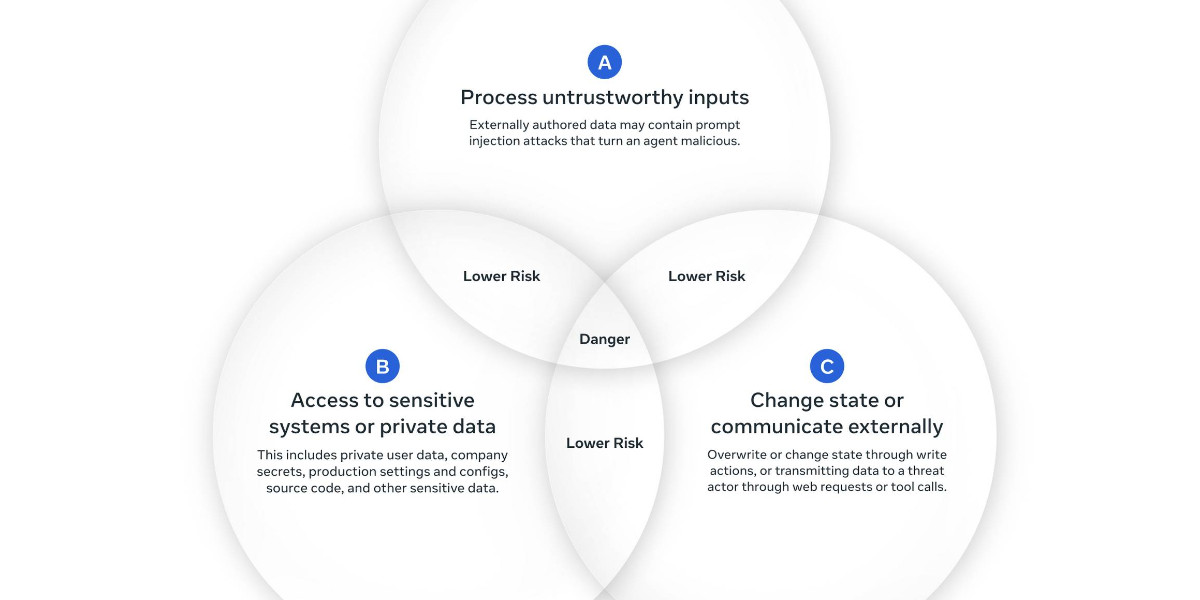
- > [A] An agent can process untrustworthy inputs
> [B] An agent can have access to sensitive systems or private data
> [C] An agent can change state or communicate externally
Somewhat reminds me of the CAP theorem, where you can pick two of three, but one is effectively required for something useful. It seems more like the choice is really between "untrustworthy inputs" and "sensitive systems", which makes sense.
by gs17 - From a practical point of view, what are people thinking about what is considered trustworthy input? Is the data in your CRM trusted?
Keeping the orchestration (and state changes) outside of the LLM is where my thinking is at until I can figure out the answer to that question (among others).
by wj - I actually want prompt injection to remain possible. So many lazy academic paper reviewers nowadays delegate the review process to AI. It'd be cool if we could inject prompts in the paper that would stop the AI from aiding in such situations. In my experience, prompt injection techniques work for non-reasoning models but gpt-5-high easily ignores them...by behnamoh
- I am confused this article does not talk about taint tracking. If state was mutated by an agent with untrustworthy input the taint would transfer to the state, making it untrustworthy input too, so the reasoning of the original trifecta with taint tracking is more general and practical. I am also also investigating the direction of tracking taints as scores rather than binary as most use cases would otherwise be impossible to do at all autonomous. Eg. with sensitivity scores to data, trust scores to inputs (that can be improved by eg. human review). One important limit that needs way more research is how to transfer the minimal needed information from a tainted context into an untainted fresh context without transferring all the taints. The only solution i currently have is by compaction and human review, if possible aided with schema enforcement and optimised UI for the use case. This unfortunately cannot solve encoded information that humans cannot see, but it seems that issue will never be solvable outside alignment research.
PS: An example how scores are helpful: Using browser tab titles in the context would by definition have the worst trust score possible. But truncating titles to only the user-visible parts could lower this to acceptable for autonomous execution if the data was just mildly sensitive.
- I don’t know if it’s just me but doesn’t a huge value of LLMs for the general population necessitate all 3 of the circles?
Having just 2 circles requires a person in the loop, and that person will still need knowledge and experience and a low enough throughput to meaningfully action the workload otherwise they would just rubber stamp everything (which is essentially the 3rd circle with extra steps)
by ares623 - I added this section to my post just now: https://simonwillison.net/2025/Nov/2/new-prompt-injection-pa...
> On thinking about this further there’s one aspect of the Rule of Two model that doesn’t work for me: the Venn diagram above marks the combination of untrustworthy inputs and the ability to change state as “safe”, but that’s not right. Even without access to private systems or sensitive data that pairing can still produce harmful results. Unfortunately adding an exception for that pair undermines the simplicity of the “Rule of Two” framing!
by simonw - Hey folks, one of the authors of the original post here.
First, I want to thank simonw for coming up with the lethal trifecta (our direct inspiration for this work) as well as all of the great feedback we’ve received from Simon and others! Our goal with publishing this framework was to inspire precisely these types of discussions so our industry can move our understanding of these risks forward.
Regarding the concerns over the venn diagram labeling certain intersections sections as “safe”, this is 100% valid and we’ve updated it to be more clear. The goal of the Rule of Two is not to describe a sufficient level of security for agents, but rather a minimum bar that’s needed to deterministically prevent the highest security impacts of prompt injection. The earlier framing of “safe” did not make this clear.
Beyond prompt injection there are other risks that have to be considered, which we briefly describe in the Limitations section of the post. That said, we do see value in having the Rule of Two to frame some of the discussions around what unambiguous constraints exist today because of the unsolved risk of prompt injection.
Looking forward to further discussion!
by mickayz