
Join the discussion
Write your take first — we'll ask for email only when you're ready to publish.
- Hacker News
- EV motors are not that heavy. Ok it is 1/4 of a tesla motor but would that make much of a difference compared to the rest of the car since the weight of an EV motor is in single % of the entire weight.
Sounds like it could be more important for drones?
by rapsey - Drone motors are aircooled though, so I think you actually want the radial configuration.
- Saving up even few % of weight while not compromising on comfort/safety is a holy grail for any decent car manufacturer.
Not sure why the negatives in this thread (maybe too many folks hold TSLA stock?), this is properly awesome (r)evolution.
by kakacik - It is important if you want to put the motor in the wheelhub. Too much unsprung mass kills vehicle dynamics.by KeplerBoy
- Outperformance metric is basically power density. The model described is some 13 kg and delivers 750 kW peak, 350+ kW sustained.
(That's 28 pounds, 1000 hp peak, 470+ hp sustained.)
The 40% improvement is actually 36% and is versus the previous model of the same company.
by FabHK - Thanks. Do you also happen to know the power density of the motors in the average EV car? Because the article uses "nr of Tesla Model 3" as a unit, which is meaningless without further details about it power density.by vanderZwan
- > That's 28 pounds
or about the same as a small dog
by egorfine - I sort of wonder how well these things can be scaled down.
Wheel hub motors are obviously bad, for harshness reasons, but if you could have a motor like this weighing 1-2 kg, and put one on each wheel, that'd be okay.
Power-wise this would be okay if things are linear. 26 kW per wheel sustained power output is more than enough for a light car. The question is what torque a scaled-down machine can be expected to have.
- Peak power is a number that can be manipulated. You just dump short circuit current into a winding. Even if that peak lasts for 1 microsecond, you can "claim" eye-watering horsepower numbers.
I wonder if we defined peak as sustained peak over 100 milliseconds, or some more meaningful number, what that would do to the claims. You aren't really generating meaningful torque over 1 microsecond.
by superxpro12 - It's easy to forget that most of the weight in an electric car is the battery. It's ICE cars where a lot of the weight is in the motor.
That being said, could this be adapted so that a 2.8lb motor produces 100 hp? That would allow putting a small motor in each wheel, thus completely eliminating axels, driveshafts, and allow recapturing the space they used to occupy. It also wouldn't significantly impact unsprung weight.
by gwbas1c - So, this could be better in hybrid cars?by pfdietz
- Is it really easy to forget?
- First, no, it won't scale like that.
Second, don't forget that you're trading one complexity for another. Eliminate a drive shaft and you still have to get power to the wheel somehow, which means now you're running high power electrical cable in a very dynamic environment with exposure to the elements. On top of that, you need to cool the electric motor, so you're probably running some kind of fluid out to it. Not that it isn't a solvable problem, but it probably doesn't reduce the weight much, if at all, when the system is all added up. You'll find that while you eliminate an axle, you still need to mechanically connect the two wheels together (look at the rear subframe on an FWD car) for strength, which also reduces the weight loss. Then the steering on the front... etc.
Until a more significant change than this motor (where maybe a 2.8lb motor could produce 100hp without needing active cooling), we're better off with "inboard" motors still.
- It's cool, but I think deploying motors without rare earth materials will be more impactful. The Nissan Ariya was ill-fated for other reasons, but it had a EESM motor that is easier to cool, more efficient at speed, and cheaper. That's where motor tech is headed. Power density just isn't terribly important in current applications, at least not past current sota.by idiotsecant
- I'm curious as to the efficiency of the motor (basically, how much of the input electric power is converted to motive power).
If it isn't very good, then it might be excellent for drag races, but maybe not so many others.
Also, any power that doesn't turn into torque, is likely to be expressed as heat.
- Exactly my thought as well. You can have all the horsepower you want but if it doesn't convert the electricity efficiently, it's not going to be useful for normal consumer cars.by nabakin
- It would almost have to be very efficient -- they're saying it can do something like 500HP continuous, and it doesn't have enormous fins all over it for cooling.by gcanyon
- There was a video on this motor recently: https://www.youtube.com/watch?v=r4OdH0ibOBk made by a phd in the fieldby alex_duf
- That’s an excellent video!by tverbeure
- Ok so whats the catch with the technology? Its more powerful, smaller, all readily available materials. Some kind of strange shape, longevity challenge? Difficult to make so costs are tough to bring down?
Just noticed that they are owned by mercedes benz- they will kill it accidentally. Corporate wont be able to roll it out. They will try and capture all the value and kill its potential
by boringg - Axial flux motors are difficult and expensive to make.
Motors need to be made of laminated steel sheets to reduce parasitic eddy currents. The laminations need to be thin in the direction of the direction of the flux. For radial flux motors you just punch out a shape and stack a bunch of sheets up. For axial flux you have to wind a strip: https://15658757.s21i.faiusr.com/2/ABUIABACGAAgmviFqAYozvPw-...
Each layer of that strip has a different cut in it, so its much more complicated to make. The shape and manufacturing method typically impacts efficiency; YASA avoids that by spending more money. Efficiency is an unavoidable requirement of high power density- heat is the limiting factor, and going from 98% to 96% efficient means double the heat.
The mechanical demands on the motor are also much higher- radial flux is balanced since the magnetic force pulls the rotor from opposite sides. Axial flux motors are usually one-sided, so the magnets are trying to pull the rotor and stator together with incredible force. That also makes vibrations worse. Extremely strong, expensive bearings are required to handle it. With permanent magnet rotors you need a jig to lower the rotor into place; they can't be assembled by hand. That also makes maintenance more difficult and expensive.
by hwillis - The questions I have mostly centre around how much precision of power delivery it has - it is an all or nothing proposition, can it deliver 0.1% smoothly for real world use, and what is the MTBF / duty cycle / failure mode? I would imagine the last thing anyone would want is a locked wheel, or only one wheel delivering that much power. I know this is unlikely, but as someone with a 22-year-old ICE vehicle I do tend to take the long view on these things and want to know how they will fail as much as how they work. Same applies to the Tesla motors - is there much information on failure modes publicly available?by antonyh
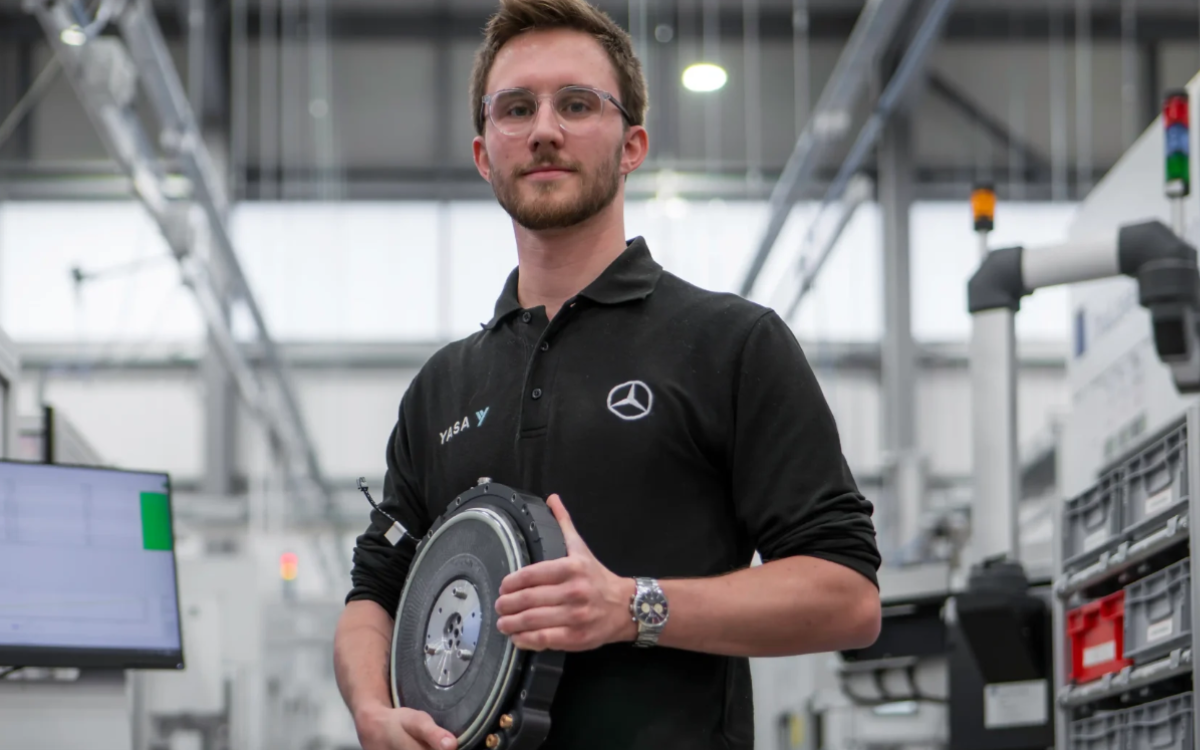
- The new YASA axial flux motor weighs just 28 pounds, or about the same as a small dog.
But how many footballs a small dog weighs?
by varjag - A small dog e.g. toy poodle is about 7-9lb anyway.by hshdhdhehd
- 123.5 cubic centi-litresby jonplackett
- American football or international futbol? If American, it's twelfteen furlongs.by KingMob
- Lol. I was confused by it also. I have no idea how much is 28 pounds, and I could imagine how a small dog can be anything from 1 kg to 10 kg. It happens that the motor weight is ~13kg, but I'm still not sure that 13kg dog counts as "small".by ordu
- Not sure about footballs but 28 pounds is about the weight of a child, a bag of rice, or a dumbbell. Hope that helps!by IshKebab
- > But how many footballs a small dog weighs?
Which kind of football: the British or the US-American one? :-)
- New performance ratio: horsepower:dogweight.by neilv