Join the discussion

Write your take first — we'll ask for email only when you're ready to publish.

  • Hacker News
  • I wonder what the numbers look like if you compare pre-pandemic to now. To me it feels like during the pandemic companies found out they can fire a lot of people without a lot of backlash as long as they have a weak excuse. I feel like AI taking over jobs is such an excuse, especially considering creative jobs and the layers that are supposedly being replaced by AI in the article they call it "Creative roles that “execute” ".
  • Would be cool to see cybersecurity covered here as well. I find it interesting how the machine learning engineer is exploding, but every engineer I talk to about it suggests these positions are mostly doing non-productive "bullshit" work and not really contributing much (arguably this applies to many tech jobs). Obviously that's anecdotal and probably not the real story, but it does seem like "machine learning engineer" is a broad term and probably doesn't tell the full story in itself.
  • I perform a different analysis, focused more on the type of blue collar jobs that most people believe are the prime candidates for AI/robotic job replacement:

    https://emusings.substack.com/p/is-automation-going-to-eat-y...

  • You switch from global automation to US car manufacturing in the first paragraph without a even a line break, basically equating them.

    The first graph you show is missing the corresponding table from the source which shows the exact opposite of what you have stated: the workforce had been steadily increasing until ~2019 and is in decline since then. Not massively but still it contradicts what you stated. Next you switch to Korea and the wage increase without aligning a corresponding price increase or adjust for inflation. Then you switch to the history on the industrial revolution. At that point I gave up because I know the point you are trying to make and I can see, you adjusted your samples to match that point.

  • > While I acknowledge not all job postings result in a hire, and some are ‘ghost jobs’, since I was comparing the relative growth in job titles, this didn’t seem like a big issue to me.

    Uhhh... That's a very big issue. In addition, there is also a glaringly obvious analysis error here related to layoffs/attrition.

    No offence but is this analysis vibe analyzed or something?

    All this is actually measuring is how the number of job listings in a specific industry have changed globally. That's not the same thing as "what jobs AI is replacing" at all!

    Like nurses decreasing 11%. There is 0% chance that AI is disrupting nurses. If anything, nursing is probably in more demand due to continual aging. It might just be that fewer people are quitting because of covid being over. The total number of nurses might be going up still!

    Are we just upvoting anything with AI in the title now? HN used to be pretty respectful of scientific methods. The methodology section here just reads like personal resume filler for showing that you can use AI. I mean I get it and I admire the hustle, but the quality here is pretty lacking overall. https://bloomberry.com/blog/i-analyzed-180m-jobs-to-see-what...

  • The decline in frontend engineering jobs matches my personal impression from the past year. Smaller companies can do a lot with vibe coding alone, while larger companies can multiply their FE team productivity without making any new hires.

    Frontend code can be very repetitive / labour intensive, I bet that has made this more attainable than for other layers in the stack. Most mistakes in UI code are also easily corrected and have a very tiny impact radius.

  • Yeah, I've found LLMs to be pretty decent at frontend stuff.

    I got a new job recently and my main task has been overhauling a Claude generated app into something functional. The backend is an unsalvageable disaster, but the frontend is actually pretty good. Which is great for me because I suck at UIs.

    I think if you have a solid backend already in place, an LLM can produce a pretty functional frontend with far less effort to fix up.

  • Such an interesting thing! I wonder why mobile engineer is down 5%. Maybe companies are moving to React Native / Flutter / Tauri / Electron ?

    Maybe Apps are less of a priority now?

    I'm not familiar in this industry so someone help me out here

  • It depends on a lot of things, a lot of mobile development has shifted overseas, and this report only focuses on US jobs. I can't tell if this is from domestic AI, or outsourcing that uses AI.
  • My experience using Claude code is that it's excellent at React/React Native and because apps are mostly a View layer the consequences of bad "vibes" are less far reaching.
  • There is no causality analysis here, and really no justification for why AI is the reason for these job losses. An alternative explanation is the tariffs.
  • Same is true for sustainability related jobs. Given the backlash first from Texas, Florida, and other red states and now from the Trump administration, it is not at all surprising that these jobs are in decline. AI has nothing to do with it.
  • > First, let’s establish our benchmark: job postings dropped 8% in 2025 compared to the same period in 2024. Indeed reported a 7.3% year-over-year decline for US jobs recently, so this was a good sanity check, and told me that my data most likely was comprehensive.

    Doesn't this also suggest that the job market is in such an unusual state, that any further analysis makes little or no sense?

  • Why would that be?
    by B56b
  • Yeah, I was wondering something similar, especially because there was a huge surge in tech job hiring during the pandemic, and part of the story from 2020-2025 is the industry regressing back to the trendline before then. Some people say the rise of ChatGPT (in what, 2023?) is part of that but I'm not convinced.
  • I've been getting lots of value out of AI coding tools; especially in the last few months. My assessment is that this will lead to more work to do, not less. It's not a zero sum game. More of what I do is baby sitting AIs. But together we do more than me with my team before. It will reflect in my hiring decisions as well. I want people that can do this responsibly (are able to tell good from bad code, are able to think for themselves, are able to get stuff done).

    My observation so far is that micromanaging AIs still sucks

  • to play devils advocate when a company is faced with increasing pnl ( reducing headcount) or trying new ideas why won't they take the former since it is guaranteed
  • Yes, my observation so far is that management is less judicious with what projects we take on, not that we can get by with fewer people.
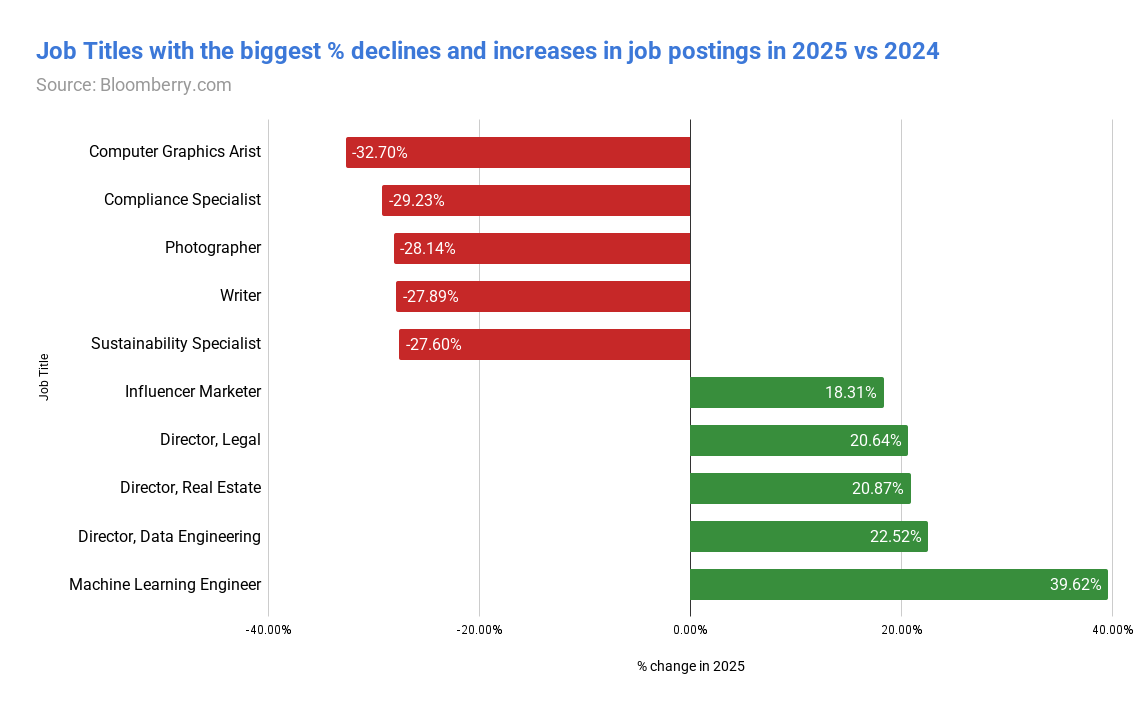
  • I found this interesting: "Still, despite all the hype about how AI coding tools will replace software engineers, software engineering is still one of the most secure jobs you can have today, relative to most other white-collar jobs."
  • At the end of the day, "AI" is just another programming language, albeit one that is much more accessible to the layman. When using AI, you become a software engineer. So it stands to reason that software engineering jobs are strong.

    But what about pay? Elevator operator jobs have never been more prevalent, but increased accessibility to the layman pushed the price to zero.

    by 9rx
  • what about amount of churn in software engineering?
  • Did the invention of compilers eliminate the need for programmers or make them more productive and valuable? LLM coding is really not in the most abstract sense any different from compiling a higher level language to a lower level language.
  • This makes sense to me.

    Until Software Engineers have automated away all the other jobs with AI & software they'll be safe. That's going to take a long time.

    Replacing software engineers with AI only affects the bottom line of software companies. Companies are usually fine with increasing the bottom line if they can exponentially increase the top line. I think software engineers will provide that capability for at least the next 10-15 years.

  • It's funny, almost every conversation I have about the fact that I work as a software engineer with new people I meet nowadays seems to include them asking if I'm worried about AI stealing my job. Maybe it's something that people ask everyone nowadays regardless of what industry they work in, but at least as far as I can tell, the type of work I do doesn't seem in any apparent danger of being replaced by AI any time soon.
  • There is a lot of induced demand in software engineering. We are still in the realm where cheaper software means that people want more and more complex software. And that demand increase is more than enough to offset any efficiency increases

    Meanwhile the amount of accounting that has to be done is pretty inelastic. Whenever accounting gets more efficient you just reduce the number of accountants instead of doing more accounting

    Creative is somewhere in between. Not completely static demand, but not extremely elastic either. The healthy rise in postings for creative directors indicates that the cost reduction has lead to more art being done, but the increase in demand isn't big enough to offset the job losses in the rank and file positions

  • Comparing US job openings from 2024 to 2025 seems to be selective. Is the job in sudden decline? Or a reset to a norm? Or is the decline something that has been happening over even a longer timeframe?

    Taking two years and drawing conclusions from those two years seems to miss larger pictures - especially when the mess of Covid and the pandemic years and that job market is mixed in with this. Yea, that's half a decade back but companies are still trying to figure out how much staff they need where.

    Photography? Yes, that's likely been impacted. Compare https://web.archive.org/web/20230124085038/https://www.bls.g... and https://www.bls.gov/ooh/media-and-communication/photographer... and the rate of growth has changed. However I'll also draw attention to the estimates that there's only a few thousand open positions with that classification each year. This includes self employed stock photographers and artists - corporate photographers have been a hard thing to get for a much longer timeframe (I looked into it a little bit back in '09). Additionally, artistic photography is impacted by the amount of money that regular people are willing to spend at art festivals and the like - that's gone down irrespective of AI.

  • I agree with this. I'm a product designer, and apparently there's "only" been a decrease in job postings of 2.6%. That doesn't seem bad, however in late 2022 through all of 2023 people were getting canned left and right and the market was incredibly tough. Can't really have big decreases when you're near the bottom of the hole.
  • A few more steps (<< post-covid << covid << zero interest-rate << ...) to understand that there is no reliable baseline for this use case.

    This subset is not perfect, but good enough.

  • Completely absent is quantity of jobs. If e.g. ml engineer job postings go +40% from 200 to 280 and writer job postings go -50% (over two years) from 20000 to 10000, then we have a better idea of the impact.

    Without those data this report isn’t really quantifying impact on “180M jobs.”

    by svnt
  • Also absent is any data in SDRs, Sales Account Executives and Sales Managers (all the Revenue vertical.