
Join the discussion
Write your take first — we'll ask for email only when you're ready to publish.
- Hacker News
- How do you extinguish an oil-well fire? Enter the "Big Wind" with two jet engines on a tank chassis. "The water is moving at a maximum rate of 220 gallons of water a second," https://www.caranddriver.com/features/a15138374/stilling-the...by mtmail
- You could also nuke it; https://en.wikipedia.org/wiki/Urtabulak_gas_fieldby hakoda
- Tangentially related and recommended. Werner Herzog's film that also features longer sections on the fire fighting efforts on the oil fields.by dewey
- There was a fire station we used to walk past when my little boy was about 2 years old. Often the fire trucks were out the front being cleaned. The fire fighters always let him sit in the cabin. Heaven for 2 year olds obsessed with trucks.by andrewstuart
- For the curious: most locomotive desiel engine designs have marine origins. That's because ships transitioned to desiel power (from steam) before trains did. At least in the UK. The general design constraints are similar and so when folks began looking into making diesel locomotives they generally selected existing marine designs and adapted them. Often de-rating the maximum power to improve reliability.
When the UK converted from steam to diesel it was easier to switch the locomotives while leaving the coach stock as-is. Modern trains aren't like this: they're "multiple units" with more than one drive car. Anyway, a steam engine can generate much more power than a 1950s diesel engine can, particularly factoring in the UK loading gauge which restricts engine height. So in order to make a diesel locomotive capable of taking over from A4 Pacific steam engines on the east coast main line, it was necessary to design a locomotive that had two desiel engines, with a high power to weight ratio. Hence the class 55 cited in the article. The deltic engines were very complex and costly to maintain but solved a problem arising from the transition away from steam. In the 1970s they were in turn replaced by trains with a DMU configuration (HST), featuring a permanently coupled power/van car at each end, removing the need for a single very high power locomotive.
by dboreham - That https://en.wikipedia.org/wiki/Napier_Deltic is pretty interesting.
You would initially think that the ignition events would be evenly spaced, but that's not the case. For every delta triplet, the ignitions come rapidly one after another, close together in the cycle.
In that second animation on the page, showing the firing order among 6 delta piston assemblies, if you keep your eyes fixated on any of the six columns, you can see the three firing events. Always C, B, A order.
by kazinator - Something the article doesn’t mention is why this was phased out. Was it replaced with something similar?by citizenkeen
- Better building fire suppression systems. Not to mention improvements to flame retardant materials.
- Some interesting history here: https://www.firerescue1.com/firefighting-history/articles/th...by dublinben
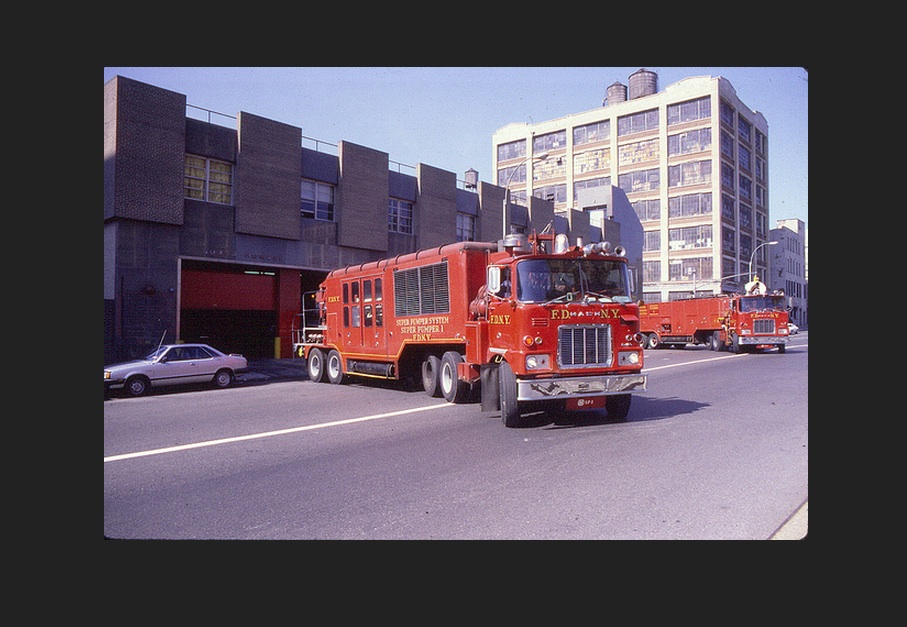
- The article says the "super pumper" could supply 8,800 gallons per minute, and it came with three "satellite trucks [...] not burdened with a pump of their own"
Your basic modern fire pump unit can pump 2,200 gallons per minute (if you can find a water source that'll give you that much) and it'd typically have a crew of 4-5 firefighters on board.
So you'd probably replace it with 4 regular fire trucks? Then you've got just as much pump capacity, plus you've got the flexibility to send the trucks to different places.
by michaelt - FDNY reintroduced the "Super Pumper" concept in a somewhat different form a few years ago.
See:
https://www.firefighternation.com/lifestyle/new-fdny-super-p...
by mindcrime - Ah, the Mack Super pumper. Shame Mack started to struggle in the 60s until the 80s and got out of the fire truck business. They had some very interesting designs in terms of cab design and components. I always loved the F model cab-over which were produced until the early 80s which is what the CF fire truck was built on.by MisterTea
- Anyone else struck by this bit?
Mack was awarded the contract to build the truck in 1964 and by the end of the year, the unit was nearly ready to hit the streets of NYC.
Seems amazingly fast by current standards. Those were the days!
by 7402 - Think about all the processes they just didn't have to do back then.
- This thing feels like a mortal danger to the (up to 8x!) iron pipes / hydrants it's pulling from, that it'd want to just chew up the very pipes themselves! Or to the building it's hurling 37 tons of water a minute at! I don't understand how a connector hose wouldn't collapse, how it maintains any cross-section rather than being sucked into collapse.
Also wondering: what replaced this!
(Ed: great reply from Mindcrime. Also, the new Ferrara Super Pumper shows a very impressive ribbed(?) 8-inch "hard suction" hose! There's a whole wikipedia section for these drafting/vacuum hoses: https://en.wikipedia.org/wiki/Suction_hose)
- I imagine the hydrants were operated at positive pressure. Water mains are generally somewhere between 40 and maybe 120 psi gauge. You don’t gain a whole lot by sucking on them - at most you get to -14 psi, and you do not want to boil the water (aka cause cavitation) in your pump.by amluto
- You don't bust this out until the building is already at risk anyway, so the amount of water is considered "the better option".
(Which is why almost ANY fire is a total structure loss unless you can contain it nearly instantly, because the water used to fight it destroys nearly everything. Only if the building is large, concrete, or the damage limited is it worth repairing; most fire-damaged houses get pulled down as it's cheaper overall.)
by bombcar - This thing feels like a mortal danger to the (up to 8x!) iron pipes / hydrants it's pulling from,
When pumping a fire engine supplied by a hydrant (or any other pressurized source, as opposed to drafting from a static water source like a pond or lake) there's an idea of "residual pressure" which is monitored by a gauge on the pump panel. The engineer is responsible for making sure the residual pressure doesn't drop below the level where damage would occur to the water system, supply hose, or the pump itself. It's been a few years, but I think most departments spec somewhere around 20psi as the minimum residual pressure they allow.
Also wondering: what replaced this!
The Super Pumper[1], of course! :-)
The new one isn't quite as extreme, not tractor drawn and no separate engine. This is more of a traditional fire engine style platform, but the specs are still pretty impressive.
[1]: https://www.firefighternation.com/lifestyle/new-fdny-super-p...
by mindcrime - > Also wondering: what replaced this!
A collection of smaller pumps and monitors, which is likely a better scheme, in terms of flexibility and fault tolerance. While a remarkable design, the single pump with long hoses to multiple hydrants, then radiating to multiple monitors, is a system that takes great coordination and precious time to deploy and rework in action.
The Napier Deltic engine is the party piece in all this. It is an ambitious and yet successful design, intended to push the limit of power-to-weight in a diesel engine. I investigated the state of current diesel locomotive engines in comparison to the Deltic and it remains, to this day, the highest power-to-weight diesel engine in use for locomotives. (There are half a dozen still running in the UK today in limited service.) I've personally visited the Bay City museum to see this engine.
These engines require forced induction; they cannot run naturally aspirated. In its various naval, rail and other applications there were many different induction designs applied to the Deltic: turbos, superchargers and combinations of both. Today, we have electric forced induction, enabled by the high performance electric motors that have emerged elsewhere in transport applications. One thinks of what diesel wonders might be created by combining the Deltic design with electric forced induction.
by topspin - That "deltic" engine just for the water pumping is incredible, I'd never seen that cylinder layout before.by giobox
- It amazes me what we manage to figure out on the mechanical side of things. Just look at motorcycle engines. Screaming along at upwards of 20k RPM and just taking it in stride and moving people down the road at what might as well be supersonic speed.
- Two of the three crankshafts rotate in the same direction, whereas the third one moves the other way around!by enopod_
- > The Napier Deltic engine is a British opposed-piston valveless, supercharged uniflow scavenged, two-stroke diesel engine
Any tech that includes the word “scavenged” must be cool and efficient
by whycome - There are numerous "atypical" piston engine layouts, though I cannot recall precisely where I'd seen a reference, probably on YouTube ~10 years ago.
The basics are a single piston, dual (often opposed at an angle or flat-head design as on older BMW motorcycles), in-line (usually 4-cylinder), or V (as in V-6, V-8, V-12, etc.)
Then there are radial engines used in piston-driven aircraft. These virtually always have an odd cylinder count, to prevent locking (there's always an unbalanced force in the direction of intended rotation, or so one hopes).
<https://en.wikipedia.org/wiki/Radial_engine>
There are various rotary engines, with the Wankel design best known. Very high power-to-weight ratios as a result of having three combustion chambers per rotor, but a relative short lifecycle due to wear, and some compromises in efficiency. "Flying car" company Moller International, out of Davis, CA (and apparently inactive since 2015) had at its core a Wankel-based powerplant, with four pairs of counter-rotating engines powering four ducted fans. It sounds like all the angry hornets in operation.
<https://en.wikipedia.org/wiki/Moller_M400_Skycar>
Wikipedia lists some other unusual designs as well: <https://en.wikipedia.org/wiki/Reciprocating_engine#Miscellan...>.
I believe that the axial engine may have been featured in that video mentioned in 'graph 1:
by dredmorbius - They're unique. Originally designed to power fast torpedo boats during WW2, three of these powerful and compact engines would churn out plenty of power for the boat up to 50 kt.by mrlonglong
- Piston engines got pretty wild before turbines eventually took over the world. The most efficient ones were more efficient than today's turbines in terms of BSFC[0]. One of the most interesting to me was the Napier Nomad[1], which used turbo- and super-charging. However, the turbo had secondary fuel injection and effectively ran as a turbine to drive the compressor.
[0]https://en.wikipedia.org/wiki/Brake-specific_fuel_consumptio... [1]https://en.wikipedia.org/wiki/Napier_Nomad
by hydrogen7800 - The type 55 "deltic" locomotives, named after army regiments used to do the east coast Edinburgh-London train run, there were 22 of them in service and one in the science museum London. They had the first 100mph rating for diesel passenger service.
The engine had a unique characteristic whine or whistle. As an avid train spotter at Waverley station in edinburgh I loved hearing it, saw every one and was in the cab of two thanks to long suffering kind engine drivers.
There was a mini deltic too. I'm not sure it went beyond a testbed loco.
by ggm - Napier was on the cutting edge of certain kinds of IC engines for a long time.
https://en.wikipedia.org/wiki/Napier_Sabre (1938).
Powered the absolute monster that was the Tempest (up to the Mk 2 - they did have reliability issues they never quite solved but 3000+HP out of an engine that weighs barely more than a tonne dry will do that)
https://en.wikipedia.org/wiki/Hawker_Tempest
Was happy to see the name re-used for our upcoming fighter.
We also called the Eurofighter the Typhoon and the (WW2) Typhoon (also a Sabre engine) was the predecessor of the Tempest - it started as a re-wing of the Typhoon but enough changes where made to give it a new name.
Just a devastating superprop in its day.
by noir_lord - My dad worked on the Space Shuttle main engine program in the 80s. One of the things they built was the turbopump [0], which generated 23,000HP (and could drain your average home swimming pool in one minute).
Seeing the test firings of the pump was pretty amazing, draining one "swimming pool" and filling another in a minute.
by jedberg - That's always blown my mind about rocket engines. If the FUEL PUMP has that much power, the overall machine energy flow must be insane. Especially in such a small package.by HPsquared