Join the discussion

Write your take first — we'll ask for email only when you're ready to publish.

  • Hacker News
  • Man, I wish that the modern internet -- and great stuff like this -- had been around when I took GR way back when. My math chops were never good enough to /really/ get it and there were so many concepts (like this one) that were just symbols to me.
  • Its unfortunately all too common for Physics/Math to be taught in that way (extremely technical, memorizing or knowing equations and derivations). The best teachers would always give a ton of context as to why and how these came about.
    by pm90
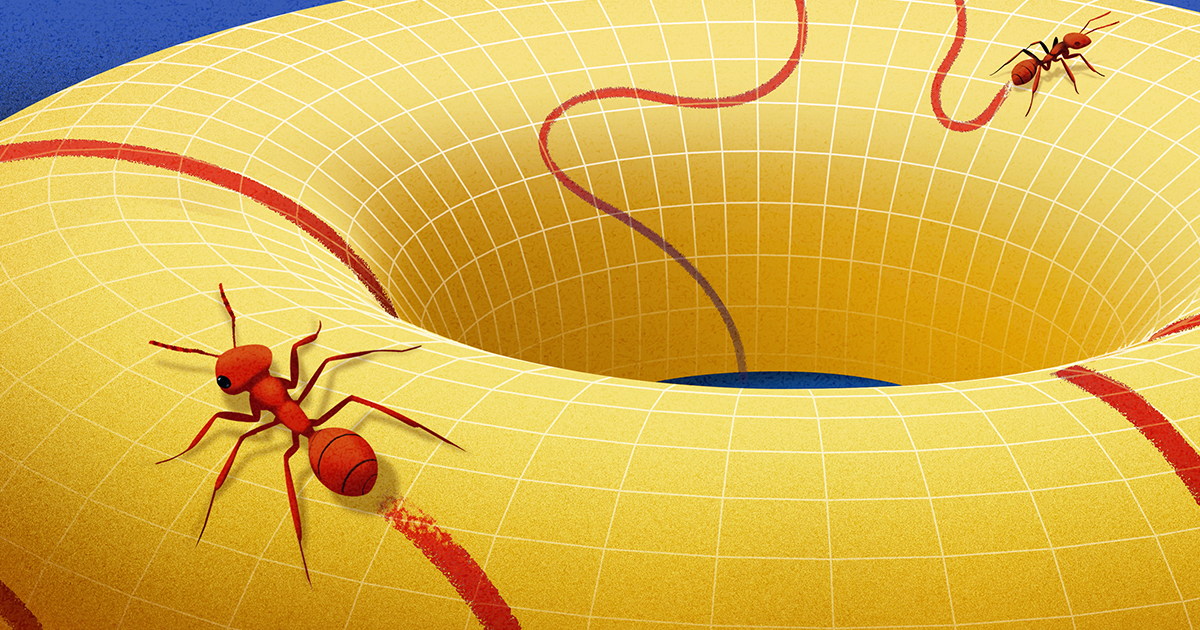
  • Every time I try to get some handle on the essence of this topic I fail. No different here. In the second paragraph it defines manifolds as "... shapes that look flat to an ant living on them, even though they might have a more complicated global structure"

    So manifolds are complicated shapes that are at large enough a scale that an ant (which species?) will think they're flat....ok

  • I rarely see manifolds applied directly to cartographic map projections, which I've read about a bit, though the latter seem like just one instance of the former. Does anyone know why cartographers don't use manifolds, or mathematicians don't apply them to cartography? (Have I just overlooked it?)
  • One reason is that it would be like hanging a picture using a sledgehammer. If you're just studying various ways of unwrapping a sphere, the (very deep) theory of manifolds is not necessary. I'm not a cartographer but I would assume they care mostly about how space is distorted in the projection, and have developed appropriate ways of dealing with that already.

    Another is that when working with manifolds, you usually don't get a set of global coordinates. Manifolds are defined by various local coordinate charts. A smooth manifold just means that you can change coordinates in a smooth (differentiable) way, but that doesn't mean two people on opposite sides of the manifold will agree on their coordinate system. On a sphere or circle, you can get an "almost global" coordinate system by removing the line or point where the coordinates would be ambiguous.

    I'm not very well versed in the history, but the study of cartography certainly predates the modern idea of an abstract manifold. In fact, the modern view was born in an effort to unify a lot of classical ideas from the study of calculus on spheres etc.

  • Manifold: Any m dimensional hyperplane embedded in an n dimensional Euclidean space, where m is less than or equal to n. More simply put, a manifold is any set that can be continuously parameterized, with the number of parameters being the dimension of the manifold.

    A continuous manifold will have a line element that allows you to compute distances between its points using its parameters. The simplest line element was first written down by Pythagorus I think, it allows you to compute the distance between two points in a flat manifold. In physics we do away with gravitational forces by realizing that masses move along geodesics (shortest paths) of a manifold, hence the saying,"matter tells spacetime how to curve and spacetime tells matter how to move". We stich together large curvy manifolds like a patch quilt from the locally Euclidean tangent spaces that we erect at any point.

  • I always found interesting that the English mathematical terminology has two different names for "stuff that locally looks like R^n" (manifold) and "stuff that is the zero locus of a polynomial" (variety). Other languages use the same word for both, adding maybe an adjective to specify which one is meant if not clear from the context. In Italian for example they're both "varietà"
  • This is not really something limited to mathematics.
  • FTA

    > The term “manifold” comes from Riemann’s Mannigfaltigkeit, which is German for “variety” or “multiplicity.”

  • In English, not all varieties are manifolds, see forex https://math.stackexchange.com/a/9017/120475
  • Lobachevsky... "the analytic and algebraic topology of locally Euclidean metrizations of infinitely differentiable Riemannian manifolds"
  • боже мой.
  • Plagiarize!
  • There's antimony, arsenic, aluminum, selenium…
  • Does the way "manifold" is used when describing subsets of the representational space of neural networks (e.g. "data lies on a low-dimensional manifold within the high-dimensional representation space") actually correspond to this formal definition, or is it just co-opting the name to mean something simpler (just an embedded sub-space)?

    If it is the formal definition being used, then why? Do people actually reason about data manifolds using "atlases" and "charts" of locally euclidean parts of the manifold?

  • The closest thing that you may get is a manifold + noise. Maybe some people thing about it in that way. Think for example of the graph of y=sin(x)+noise, you can say that this is a 1 dimensional data manifold. And you can say that locally a data manifold is something that looks like a graph or embedding (with more dimensions) plus noise.

    But i am skeptical whether this definition can be useful in the real world of algorithms. For example you can define things like topological data analysis, but the applications are limited, mainly due to the curse of dimensionality.

  • There's a field known as information geometry. I don't know much about it myself as I'm more into physics, but here's a recent example of applying geometrical analysis to neural networks. Looks interesting as they find a phenomenon analogous to phase transitions during training

    Information Geometry of Evolution of Neural Network Parameters While Training

    https://arxiv.org/abs/2406.05295

  • It's hard to prove rigorously which is why people usually refer to it as the "manifold hypothesis." But it is reasonable to suppose that (most) data does live on a manifold in the strict sense of the term. If you imagine the pixels associated with a handwritten "6", you can smoothly deform the 6 into a variety of appearances where all the intermediate stages are recognizable as a 6.

    However the embedding space of a typical neural network that is representing the data is not a manifold. If you use ReLU activations the kinks that the ReLU function creates break the smoothness. (Though if you exclusively used a smooth activation function like the swish function you could maintain a manifold structure.)

  • I was reading a book on string theory and I remember the Calabi–Yau manifold

    https://en.wikipedia.org/wiki/Calabi%E2%80%93Yau_manifold

    I'm not going to pretend to understand it all but they do make pretty pictures!

    https://www.google.com/search?q=calabi+yau+manifold+images

  • I learned about Calabi Yau manifolds a long time ago and have forgotten most of the details, but I still remember how hard the topic felt. A Calabi Yau manifold is a special kind of geometric space that is smooth curved and very symmetrical. You can think of it as a shape that looks flat when you zoom in close but can twist and fold in complex ways when you look at the whole thing.

    What makes Calabi Yau manifolds special is that their curvature balances out perfectly so the space does not stretch or shrink overall.

    In physics especially in string theory Calabi Yau manifolds are used to describe extra hidden dimensions of the universe beyond the three we can see. The shape of a Calabi Yau manifold affects how particles and forces behave which is why both mathematicians and physicists study them.

  • A manifold is a surface that you can put a cd shaped object on in any place on the surface, you can change the radius of the cd but it has to have some radius above 0.
  • > you can put a cd shaped object on

    You're thinking of open sets.

  • Including the hole at the center of the CD?
  • Nicely done!

    Initially I recoiled at the thought of the stiffness of the CD, but of course your absolutely right, at least for 2d manifolds.

  • This reminds me of how physicists will define a tensor. So a second rank tensor is the object that transforms according as second rank tensor when the basis (or coordinates) changes. You might find it circular reasoning but it is not, This transformation property is what distinguishes tensors (of any rank) from mere arrays of numbers.

    Looking at things from abstract view does allow us not to worry about how we visualize the geometry which is actually hard and sometimes counter intuitive.

  • > You might find it circular reasoning but it is not

    Um, yes it is. "A foo is an object that transforms as a foo" is a circular definition because it refers to the thing being defined in the definition. That is what "circular definition" means.

  • I don't get why people act like this definition is so circular. If you were to explain in detail what "transforms as a second rank tensor" means then it wouldn't be circular anymore. This just isn't the full definition.
  • I found the physicist definition of a tensor is actually more confusing, because you are faced with these definitions how to transform these objects, but you never are really explained where does it all come from. While the mathematical definition through differential forms, co-vectors, while being longer actually explains these objects better.
  • This is a tendency among physicists that I find a bit painful when reading their explanations: focusing on how things transform between coordinate systems rather than on the coordinate-independent things that are described by those coordinates. I get that these transformation properties are important for doing actual calculations, but I think they tend to obfuscate explanations.

    In special relativity, for example, a huge amount of attention is typically given to the Lorenz transformations required when coordinates change. However, the (Minkowski) space that is the setting for special relativity is well defined without reference to any particular coordinate system, as an affine space with a particular (pseudo-)metric. It's not conceptually very complicated, and I never properly understood special relativity until I saw it explained in those terms in the amazing book Special Relativity in General Frames by Eric Gourgoulhon.

    For tensors, the basis-independent notion is a multilinear map from a selection of vectors in a vector space and forms (covectors) in its dual space to a real number. The transformation properties drop out of that, and I find it much more comfortable mentally to have that basis-independent idea there, rather than just coordinate representations and transformations between them.

  • This is a very informative article about the history of manifolds and their significance. Don’t let the title fool you into this being just a definition.

    It’s actually much more well written than the majority or articles we usually come across.