
Join the discussion
Write your take first — we'll ask for email only when you're ready to publish.
- Hacker News
- Oh god, I miss the information density of old articles. Especially contrasting with these kinds of pieces. Today, this one would be at least 5 times as long without a good reason. This was a breeze to read.by ruszki
- Indeed!by downbad_
- by downbad_
- I am always confused when BigTechCos buy SmallCos and then unceremoniously kill them off fairly shortly after. I guess it's basically to cannibalize the source code?by tombert
- The want the: developers, IP, customers, to kill some competition, or some combination.by esseph
- It's how The System kills something it wants dead without triggering Streisand Effect and creating a huge backlash. It punishes with success.by Lammy
- It could just be a failed acquisition but an variant sometimes happens. OpenAI bought Statsig and then sold the Statsig brand and customer base to Amplitude.by arjie
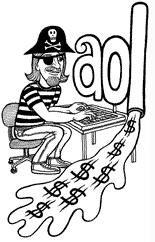
- This was during the dotcom bubble and AOL/Time Warner need to optically look like they were doing something relevant with the internet to justify their valuation. It was pure messaging, with a bit of killing a threat on the side.by lorecore
- > when BigTechCos buy SmallCos and then unceremoniously kill them off fairly shortly after
There's many reasons, but in general incompetence, malice and small crumbs problem.
I've done my small share of M&A DD work as an engineer, which was a lot of fun, but the results on my sanity and my outlook was bad.
On one hand, you get to go talk to a core founder of a company and they're entirely open to you picking their brain on "Why this" / "Did it pay off?" on pure eV math they did in their heads.
On the other, you see what happens after your recommendation and it is not within your control to change any of it.
Incompetence is generally "Please rewrite this software by our practices" devops hell or "Let's look for better customers for this product, ignore the old ones" in the ICP land. Google and dodgeball comes to mind.
Malice is more clear cut, where "Let's buy it and shut it down, so that we don't have a threat to our business" - I'm eagerly waiting to see what happens with Groq and Nvidia for example. AWS buying Groq would've been massively different. Classic case in point is Apple buying Fingerworks & shutting it down, but launching the iPhone.
Lastly, there's the small crumbs problem (or as it has been famously said "Do not anthropomorphize the lawn mower").
A company can get bought and the product doesn't really add great value to the buyer, beyond getting a few people who really know the space. The small number of people them gets redistributed into a neat set of existing reqs where they just accelerate the existing company's products based on that knowledge or in general fail to surface back to make a significant ripple in the future.
For example, I am wondering what will happen to Promptfoo after OpenAI.
by gopalv - Source code is only useful when you want the actual product, which is the rare case. Most of the time they want the patents, naming rights or just customers.by okanat
- It's because BigCo's tend toward decisions with dumb outcomes, while SmallCo's still benefit from the strategic direction of their founders. Although not a hard and fast rule, if you take a good look at where innovation occurs you'll often find the most successful products of big tech companies (after the initial one that made them big in the first place) came from acquisitions. Just look at Google's case: Android, YouTube, Maps, etc.
Sometimes the aquisition doesn't pan out as planned, or they were just after the talent or to snuff out a potential competitor / snag its customers (like Postini), or it was a dumb move in the first place and the numbers finally bore that out. BigCo's don't usually have the same determined, long-term dedication to their acquisitions as the people who the founded them, so you also see premature shedding of ventures that could have a ton of potential over time.
by rkagerer - The usual play is to acquire the customers and brand, with the team as a bonus.
Except for rare unique products, the source code might not matter at all. They're after the business, brand, and customers.
Having been in acquired SmallCos a couple times: There are always plans and justifications involving the products being acquired, but most don't survive impact with the acquiring company. People in a BigCo have their little fiefdoms established and everyone resists the sudden appearance of new developers and new code that weren't under their control. To be fair it goes both ways and the SmallCo developers who were previously in charge of everything don't like giving up control of parts of the system to the established teams and procedures in the BigCo.
by Aurornis - That year range definitely surprised me. In my generation I suspect many of us think of winamp as being just sort of always there, but of course it wasn't. When you add it up, it really only existed for <25% of the history of the web (taking 1996 -> 2026 as the time range, I think 1996 is defensible start for when the web becaome accessible to some portion of people in the first world). Hell, I probably have coworkers who were born after the dissolution of nullsoft (interns anyway).by Octoth0rpe
- I won’t nitpick too hard because the percentage doesn’t move much, but Netscape went public in ‘95 so it’s got to be before that. The minimum would be ‘91 (first website) but that’s too early. Super geeky but I will peg it at April 1 1995, which was the first release of Apache HTTP.by sulam
- Ah memory lane. I created the "speaker head" characters and lead the redesign of the WinAmp web site back in 2004. Good times. Through Odopod in San Franciscoby jweir
- As a teenager I spent a ton of time on this website, specifically the skins directoryby foco_tubi
- For anyone who was also curious what Justin Frankel got up to after the speculation at the end of the article, he founded Cockos Software and is the lead developer on the excellent REAPER DAW.by Fwirt
- Easily one of the best values in commercial software if you have a need for what it does. I think I paid something ~$70 a couple of years ago. While there's a limitation on the number of updates you get based on release version, I'm still getting updates under the license a couple years on. All that and you get a genuinely professional level tool for much less than what similar software from competitors offer.
I couldn't more highly recommend it.
by sbuttgereit - Oh, I had no idea. It's been a few years since I used it in anger but it was a very pleasant package to use, with an extremely friendly licensing scheme (purchasing a permanent license for <current.X> got you all releases up until version <current+1.max>)by misnome
- This Frankel guy apparently had a hand in a lot of the tech that surrounded my youth. [0]
Looking back and looking forward I understand why software developers became these larger-than-life-or-at-least-an-incrementally-past-the-norm personalities in the late 20th/early 21st century. And I understand why people (particularly in the software development industry) feel so deeply about how technology influenced/s their lives.
The Information Age gave us direct involvement in the flow of information and the tide of culture. So many people...many of them barely adults, became involved in the social construction of the world around them. This probably isn't mind-blowing to most of you...but this is me coming to terms with this all in real time, right here, after silently writing a lot of users here as dorks detached from reality. I get it now. I'm surely simplifying some things too.
Anyway.
It's interesting how the level of agency and involvement that technology afforded society in the past has been straitened to accommodate corporations instead of to spite them.
[0]: Note to self—Nullsoft is not the company who made Tony Hawk Pro Skater.
by tolerance - To this day Justin maintains https://www.askjf.com/ if you ever want to ask him something :)by corford
- Publishing Gnutella while being acquired by a greedy media company was such a baller move.by lorecore
- The network still lives, even today. This is so underrated.by rickcarlino
- My favorite Nullsoft software that came out the end of this era was WASTE [1].
Peer-to-peer (back when P2P was all the rage), encrypted, decentralized private networks.
Group of friends and I used it post-college as a way to share files and chat, and was much better than AIM or other instant messaging at the time.
by ecliptik - WASTE introduced me to Thomas Pynchon. Thank you Justin!by BLKNSLVR
- WASTE became popular in our area just as LANning was ending its heyday. Even now I think the whole course of technology could have been altered if WASTE was utilised in a "corporate VPN" fashion, instead of the rise of Juniper routers and Sharepoint spaces, we could have had much simpler secure work-collaboration protocols.by samplatt
- I always thought WASTE was so cool, but my family was pretty late get off of dialup to be able to actually use it. Sounds like it's still around in some form, do people actually use it nowadays?by gh02t
- Went down the Frenkel (Nullsoft founder) rabbit hole. Check out his forum where they've recently discussed AI bots scraping his forum [0]. Or his question submission page; he hasn't "left a reasonable question unanswered since 2009" [1]
> nothing specific against cloudflare, but the point of the internet is that it's decentralized and I'd hate to contribute against that (though we already do somewhat, hosting on aws etc). anyway our homegrown solution is working nicely these days! for now - Justin January 2026
- Additionally to Winamp, I guess what I will always remember Nullsoft with is also "NSIS - Nullsoft Scriptable Install System" [0]. In a previous job I sat down, read the docs and wrote a Windows-Installer for our product using this thing, since management didn't want to pay for InstallShield.
What made quite an impression on me back then was the fact that the scripting language somewhat resembles assembly. [1] Also, NSIS had/has a tool called "NSIS Dialog Designer" which I used to design the Installer forms.
It was quite the fun experience and I'm pleasantly surprised that NSIS is supported to this day [2].
0 - https://nsis.sourceforge.io/Main_Page
1 - https://nsis.sourceforge.io/Check_whether_your_application_i...
by p2detar - back in the days when i was doing windows desktop apps, this was the way. installshield was such a piece of hot enterprise garbage that felt like it was designed by management consultants. overengineered, way too complicated, way too many steps to do the simplest of things. it was literally a case study in how not to do software.by a-dub