Join the discussion

Write your take first — we'll ask for email only when you're ready to publish.

  • Hacker News
  • I read once that they wanted Autobahn to be longer but sadly the limitations of the LP was 23 minutes. If only they had access to the CD! What could have been.

    Still as it was it must have been a tremendous shock to the hippies of the era. It was the sound of the future.

  • Honest question, why a shock to the hippies? In 69 less than a decade before there was Woodstock and the music, while not futuristic, was very progressive and innovative. All in all I think these folks might have had more to do with the hippies than anyone else at the time, specially in a time right after the world war, with the extreme anti-fascist sentiment in the country.
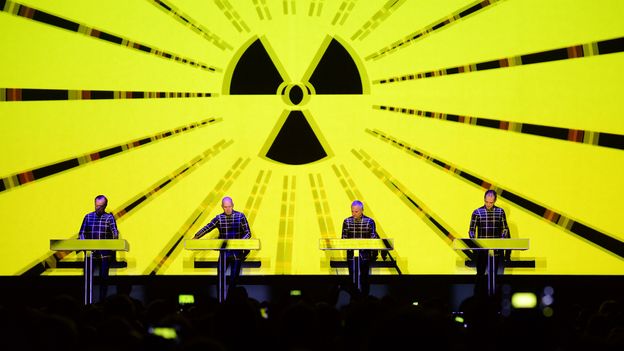
  • I remember thouroghly disliking The Mix (1991). The changed new versions of the old songs were all worse, not better, and especially egregious was the change of Radio-Activity from an etherial hymn about radio communication, to an overtly political activism song about nuclear power.
  • If you're into "kraut rock" see how many references you find name-checked in The Doleful Lions tribute song (The Sound of Cologne): https://youtu.be/LmXjs7O5kUQ?si=fWAM0dqWQsmtyx8d

    And stumbled upon a documentary (in German) on Conny Plank: https://youtu.be/YD29GzjiSvw

  • This seems like a good post to mention my old friend Laszlo Baksay.

    He was part of the original krautrock scene, being a member of the band Dom (see https://dom1972.bandcamp.com/album/edge-of-time , scroll down to the notes at the bottom). If I recall correctly, he went to school with some of the members of Kraftwerk.

    Later, he because a particle physicist at CERN. When I was in grad school he was my thesis advisor, while I was doing a project on the measurement of... radioactivity.

  • Fun fact, these "radicals" were behind one of the longest running copyright lawsuits in European history, one that started in 1997 and ended this year https://ra.co/news/85004
  • Saw them last year in Seattle. One of those bands I never thought I'd get the chance to see (I'm 54), but thanks to them they are still touring and making great music.

    It was an amazing show, and incredible night.

  • Only related in awesomeness but whenever I see VLC’s icon I think of Kraftwerk.

    Kraftwerk sounds novel even today, I can’t imagine how it must have sounded 50 years ago.

  • Ruckzuck is way more interesting and ahead of its time (1970).

    https://youtu.be/yUFc5QoMG1E

    P.S

    Also check out Ashra - Deep Distance (1976).

    https://youtu.be/BJZ9PVvu9OA

  • If the suggested political impact of this music is to be believed, the music might be one of the biggest environmental disasters of all time.

    Germany has been pretty widely criticized for decommissioning it's nuclear power program, only to replace it with Russian oil.

  • Lots of brown coal, which famously emits more radioactivity than any nuclear power plant ever did. The anti nuclear movement is a fucking joke, and the people I know personally here in Germany who oppose(d) nuclear still think the danger is an atomic bomb level explosion, or generational crippling mutations, or losing their house.
  • >> only to replace it with Russian oil

    with Russian gas.

  • that would be an odd criticism because we never generated any meaningful amount of electricity from oil (and started importing Russian fossil resources 30 years before we turned nuclear power plants off). The chief source for energy in Germany was coal. Gas is primarily an industry and heating input rather than a source of power generation, gas plants have only become more popular in recent years.

    What replaced all other fossil fuel sources are renewables, which at 50% are now by far the single largest source of energy.

  • The original version is quite different from the version performed today. The original lyrics refer to the pun of "radioactivity" versus "radio activity", meaning, activity on the radio.

    The new live version refers almost exclusively to the former meaning, and adds "stop" to turn it into a protest song.

    I've seen Kraftwerk live twice, at London's Albert Hall and Berkeley's Greek Theater, both times absolutely amazing. Highly recommended.

    I've often thought they would be the ideal band to perform inside the "Sphere" in Las Vegas.

  • Just saw Kraftwerk live exactly a week ago, 2026-05-06, in Hong Kong on their Asia tour. They played Radioactivität, among their other hits. Recommended indeed. There might not be another tour, Ralf Hütter is 79!

    Over the next month, they will play in Ireland and UK, then Eastern Europe. https://kraftwerk.com/concerts/index-concerts.html

  • both times absolutely amazing. Highly recommended.

    Saw them last year in Brussels. And while I agree with this and would go again and would recommend it to others, the side note for me is: I've listened to a lot of electronic music old and new and for my personal taste almost everything Kraftwerk makes is on the mediocre side. I'd never play it at home to listen to. But to see them in concert with pretty nice visuals and at the same time realizing they basically pioneered all of this 50 years ago does remain sort of mindblowing.

  • I love Kraftwerk, but contributing to anti-nuclear sentiment in Germany hasn't been a major success. If only more European countries had followed the French example and developed substantial nuclear fleets.
  • What do you mean by "nuclear fleets"??
  • I, for one, am glad we don‘t have yet another 2600 square kilometers exclusion zone in densely populated Germany, like the one around Chernobyl.
  • Being against nuclear only kept the world on coal longer.
    by msla
  • coal kills more people, this is a fact. so with blocking nuclear lead to coal, so they indirectly supportered killing thousands, incredible stats really. who said art can't be bad for the public?
  • nuclear is only cheap, if taxpayers pay for it, if all costs would be considered, nuclear is not cheap
  • Like most backward looking judgements these days, such things require understanding the culture and zeitgeist of the mid 70s.

    I'm pro-nuclear as well, but understand that for many decades the "smart" thing to do was to oppose it. I wouldn't expect a musical artist to have a more nuanced opinion than most of their contemporaries.

  • Nuclear power has been killed off by economic forces; there’s no turning back. Solar and wind power generate cheap electricity in abundance, and midday electricity prices in Europe regularly dip into negative territory (as low as minus €500 (sic!) on May 1!).

    Modern grids do not require high-risk investments in ultra-inert baseload power that ultimately fails to find a market; instead, they require low-risk investments in highly flexible power sources, such as batteries or pumped-storage facilities and transmission upgrades, that can capture surplus electricity at low cost (sometimes negativ) and sell it hours later at favorable prices.

    The 2036 electricity futures price for Germany is €70/MWh. The break-even point for France’s EDF for old nuclear power plants that had long since been written off financially was at roughly the same level in 2020. Due to rising labor costs, their break-even point is now significantly higher. There were solid economic reasons why EDF was recently nationalized 100%. New nuclear power plant construction in France is a foreseeable economic disaster. Private investors would have fled long ago.

  • If you like Kraftwerk and you're not aware of this book, I recommend it:

    "Kraftwerk: Future Music from Germany", by Uwe Schütte. It's packed with details of albums, songs, tours, equipment, and people.

    The anti-nuclear message in "Radio-Activity" certainly came later and was repeatedly updated, right into the Fukushima era [2011], but this was not the original sentiment [1976]. From the book:

    "At the time, Billboard magazine featured the most-played singles by the large network of radio stations under the heading 'Radio Action'. The band seemed to have misread or misremembered this as 'Radio-Activity'. 'Suddenly,' remembers Wolfgang Flür, 'there was a theme in the air, the activity of radio stations, and the title of 'Radioactivity is in the Air for You and Me' was born. All we needed was the music to go with it. ... The ambiguity of the theme didn't come until later.' Radio-Activity was intended to celebrate radio broadcasting as a convenient, easy and democratic means to listen to music and news."

  • Currently reading it and I’d agree!
  • Great story. Had no idea. Still love the name Uwe. One of those German names that doesn’t have an English equivalent unlike, say, Pieter.