Join the discussion

Write your take first — we'll ask for email only when you're ready to publish.

  • Hacker News
  • I don't know, man, that bottom left image sure doesn't look like a bald eagle.
  • it's a juvenile, which has a brown head!
  • Would be great for modern humans as plenty of calories available for an inefficient but better vision eye.
  • Soo evolution doesn't always optimize for biochemical efficiency in isolation. Sometimes it optimizes the whole system, and "wasteful" metabolism can be the right answer if it removes a bigger constraint.
  • > always

    Ever

    > sometimes

    Always

  • > Soo evolution doesn't always optimize for biochemical efficiency in isolation.

    How could it?

    Evolution "optimizes" (as far as local hill climbing can go) fitness, which is the ability to produce viable offspring. Genes get mutated and then combined (in sexual species) and passed to offspring via reproduction ... that's the process that results in biological evolution, which is the change over time of the presence of alleles in a population. That's it -- there's no secret "evolution" sauce or engine. The optimization for fitness occurs through the environment affecting the relative survivability of traits--traits that increase survivability become more common in the population--this part is tautological.

  • Natural selection can only work at the granularity of whole organisms, since they're the things that compete and reproduce. There is no finer pressure on specific concepts like efficiency, except that they may help the organism survive - but whatever solution works for the whole organism, works.
  • Birds have all sorts of optimizations that improve efficiency, some of which make them very different from mammals. Their lungs are different from ours in two respects. Firstly, they are relatively rigid and the pumping is done primarily by separate air sacs. Secondly, they have an outlet pipe so can take in new air while also expelling the old. The result is continuous oxygen exchange rather than a breathing-in/breathing-out cycle like mammals.

    You can see the effect in how prey is eaten after a hunt. A mammalian sprint-predator like a cheetah has to catch its breath before eating what it has just caught. Its avian equivalent, like a Peregrine falcon, can immediately start eating.

  • interesting article, but now I'm left wondering how the glucose gets to the retina. Why is this easier than supplying oxygen?
  • Who said anything about being easier? This way of providing energy evolved because of evolutionary pressure to see better.
  • My understanding is that glucose diffuses from the pecten oculi into the vitreous humor (it's the jelly-like thing that makes up most of the eyeball) and from there glucose diffuses into the inner retina.

    I'm not sure why this is easier, but I'm guessing it has to do with how much oxygen you need for aerobic glycolysis. In blood, glucose just exists in the plasma by itself, oxygen has to be carried by red blood cells. Without blood vessels it's probably difficult to get enough oxygen through diffusion into the inner retina.

    Fun fact: the human cornea also doesn't have blood vessels. Instead oxygen diffuses from the atmosphere into it and from the aqueous humor - a fluid? behind the cornea. The aqueous humor is also where the cornea (and the lens) get nutrients from.

    Yep, your cornea basically breathes!

  • The paper on which the article is based:

    https://www.nature.com/articles/s41586-025-09978-w

    Damsgaard, C., Skøtt, M.V., Williams, C.J.A. et al. Oxygen-free metabolism in the bird inner retina supported by the pecten. Nature 650, 657–663 (2026).

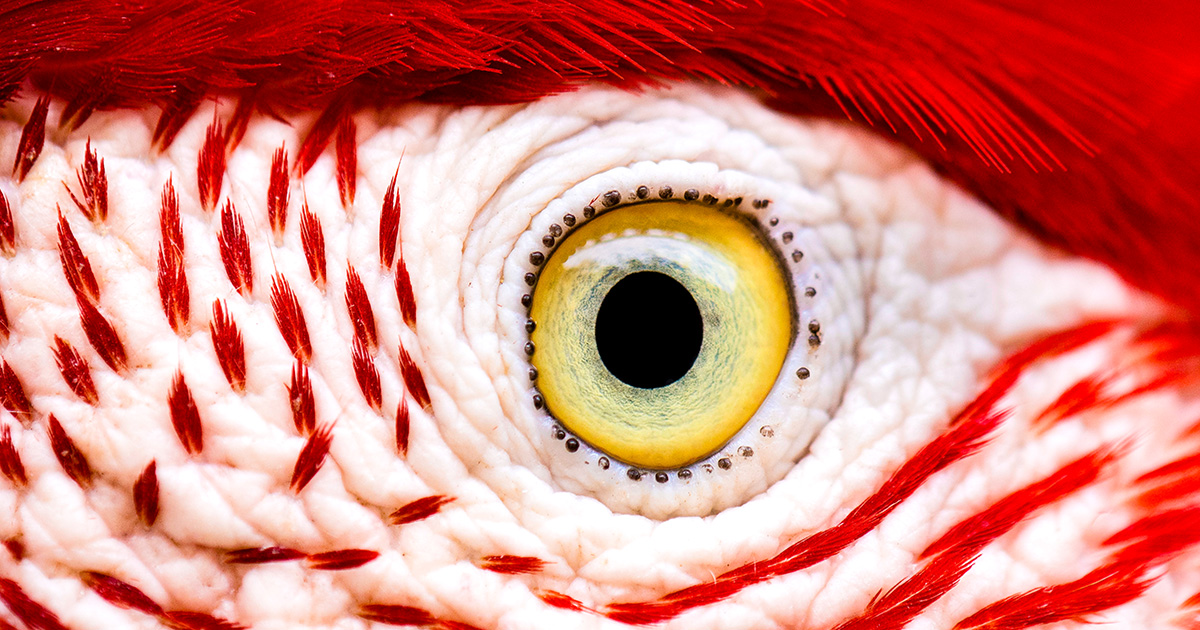
  • The photography of the bird eyes in the article is stunning especially the 3x3 grid.
  • Those bottom-row pictures were kind of freaky.
  • And the photography almost steals the show
  • Yeah, they help remind me that eyes are strange biological sensors rather than the cartoonish familiar things I see daily. Kind of like when you take acid and realize how weird you look. Or your cat’s basically a mouth with legs.
  • It is plausible that the original non-avian theropod dinosaurs which gave rise to avian theropod dinosaurs like modern birds were more vision-oriented predators than mammalian predators.

    That would have favored eyes built for sharper vision at the expense of higher metabolic demands.

    The different evolutionary track may come from the fact that theropods stood upright on two legs, so they could scan farther across the landscape. Also, they were active during the day. Early mammals, by contrast, were mostly nocturnal, so hearing and smell mattered more than sharp vision.

    Interestingly, humans have some of the best vision in the animal kingdom and humans are both upright standing and diurnal, i.e. active in the daytime.

  • It really hit me moving to Australia, most of the mammals are nocturnal (Kangaroos were the ones that caught me most by surprise) - most (if not all) of the reptiles are diurnal - got to have that sweet sweet sun to warm the blood.
  • Which means the Jurassic Park tyrannosaur that could only see things that moved was probably seriously inaccurate (also in reality it probably had feathers).¹

    1. While checking Wikipedia to confirm my belief about feathers, I found that the consensus among paleontologists was that tyrannosaurs had superb vision, better than humans, in fact.

  • > Could this be an adaptation, or is it a coincidence of evolutionary history?

    Ha! It’s the same thing.

  • Either way, the bird ends up with the same strange bargain: unobstructed vision paid for by an inefficient metabolic workaround
  • Technically, every adaptation is evolutionary history, but not every evolutionary historical pattern is an adaptation.

    The distinction is very sharp and clear: adaptation is not a mere property discovered in the organism, but an exciting post-hoc human classification of evolutionary history. It's powered by the grand human psyche doing what it does best: projecting competitive, status-oriented social psychology onto non-human biological processes.

    If you ever wondered "how dare biology fail to conform to a clear narrative easily processed by the human mind?", adaptation fixes exactly that.

  • Evolutionary biologists disagree. Adaptations are the result of numerous evolutionary coincidences, but not all evolutionary coincidences are adaptive. Not only are most survivable mutations neutral, but there are traits that are truly "coincidental" in that they come along for the ride, like the color of our blood being red being due to chemistry, not adaptation. (Our visual system that treats red as an alarm, OTOH, is adaptive.)

    See also https://en.wikipedia.org/wiki/Genetic_drift

  • > The retina is one of the body’s most energetically expensive tissues.

    I never knew, but it explains why when you close to fainting you lose your vision. Or when you are working at high heart rate close to your maximum. It works as a kind of a warning sign, than you are probably shouldn't try it that hard.

    > The lack of blood vessels could also offer birds the advantage of better vision.

    Now they are ready to reintroduce blood vessels back, but this time behind the retina.

    by ordu
  • How does it explain either of those things?
  • > Or when you are working at high heart rate close to your maximum.

    When I was in college, running on the track, I decided to see how fast I could run by ignoring the stress and pain. My vision began rolling and surging in a weird way impossible to describe. I stopped and laid down on the ground, unable to do anything but pant.

    I realized that what I had done was extremely stupid and never did it again.

  • Yet birds eyes still have nerves on top of light sensitive cells, obstructing the light. Birds also have a blind spot on each eye where nerves need to pierce the retina to go to brain.

    Contrast with squid eyes, that have nerves underneath the light sensitive cells. No blind spots, better light sensitivity.

  • Squid are really stupid. What if blind spots make you smarter?
  • I've only discovered Quanta this year but it's quickly become my favourite publication. The focus on quality articles across science, and especially pure maths, feels very unique. I don't know whether it's profitable or reliant on the Simons Foundation funding - but hopefully it's a sustainable business model that will stick around.
  • It's a non profit publication according to their about page, but my understanding is that the Simons foundation has deep pockets.