Join the discussion

Write your take first — we'll ask for email only when you're ready to publish.

  • Hacker News
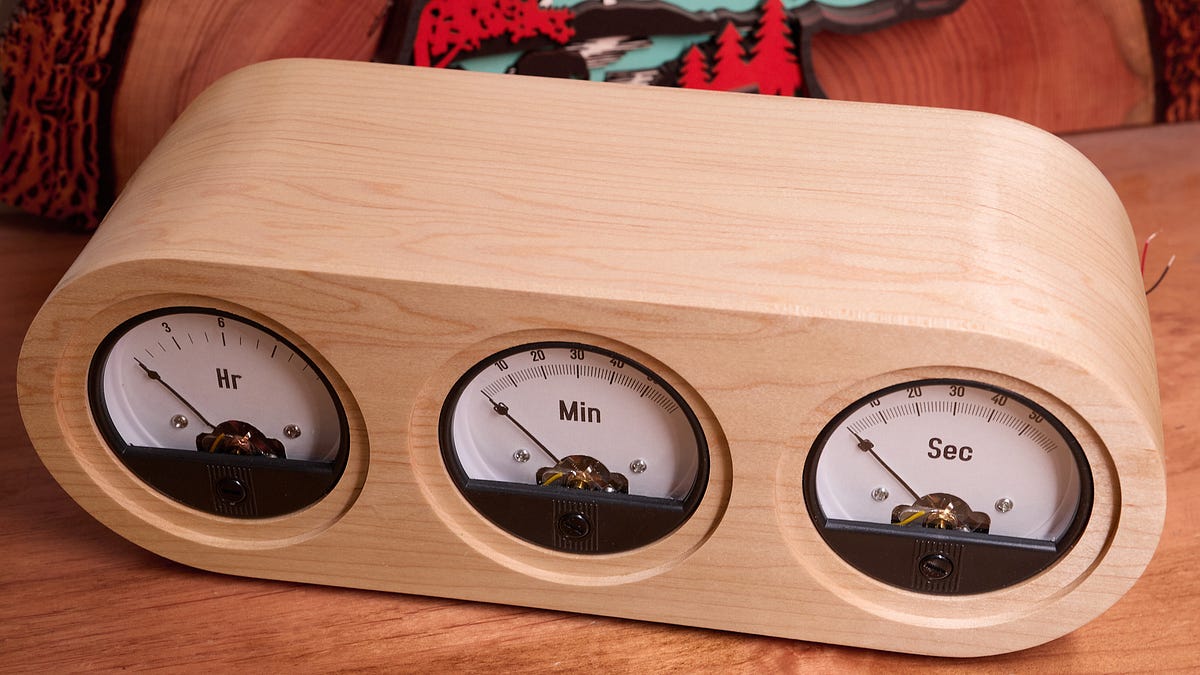
  • Very nice!

    I skimmed TFA, came back here to ask for the obligatory 11:59:59 rollover, but then went back and found it.

  • This is gorgeous. I really need to hunker down and learn 3d modeling. It unlocks so many options from cnc to 3d printing.
    by tra3
  • tinkercad
  • I've had a lot of fun with onshape, it's free for public projects
  • In my experience, having a project/goal will make it do-able for you. You have both the motivation and an target (dare I say, North Star?) in sight.
  • The build itself is absolutely wonderful! This part is totally my hangup, but a second hand that has to reset bugs me to no end. :/
  • Random idea:

    volts as Hours amps as Minutes

    Resulting wattage drives an iridescent bulb

  • I suspect you meant "incandescent".

    Iridescence essentially would mean it has a groovy, far-out metallic layer making rainbows on the surface. Not bad, but irrelevant.

    PS: Neither of those would really communicate the needed information, except as an extreme (11:59 pm would look just like 10:27 pm, but very different from 12:01 am).

  • I think I don't completely understand your idea. The current flowing through the amperemeter¹ depends on the voltage and the resistance of the incandescent(?) lamp. To vary current by the minute, you would need a digital resistor or potentiometer, I guess. Is that your suggestion?

    ¹) I just found out that it is more commonly called 'ammeter' in English - which is so unintuitive that I prefere 'amperemeter'.

  • Cool! I was at least hoping for an op amp or two for the circuit however ;)
  • Nice! Needs just a tweak to prevent the overshoot and bounce when going from high to low.
  • making it worse with more code is not trend one should follow
  • For that, you just need to not make the transition from 100% duty cycle to 0% duty cycle instantaneous, but to ramp down linearly the duty cycle over a large fraction of a second or even an entire second.

    As another poster said, the overshoot may look cool, but I would be worried that a cheap panel voltmeter would not survive a very large number of such shocks.

  • Wut? We add extra lines of code just to get that in digital?

    ;-)

  • Nah the bounce is gorgeous
  • I love using analog meters in digital projects. Here's a few different places I've used them.

    Minecraft Server Meter:

    https://imgur.com/a/minecraft-server-meter-QHpVbY1

    Mini Model of a Minicomputer:

    https://imgur.com/a/mini-model-of-minicomputer-UTaqI0i

    https://imgur.com/a/erniac-u9YVa7K

  • I built one of these recent after Princess Auto had an amazing deal on surplus meters like these. They were under just over 1$ each and I bought a lot of them.

    The one I built isn't as nice, but it's a really nice way to display the time and people are mildly fascinated by it when they see it.

  • So sexy! I could probably build the electronics easily enough, but such projects need workworking tools I just don't have room for in my tiny flat.

    (nor would the missus be pleased for me to buy them - but that's another matter)

  • You should check your local libraries too. Some have all kinds of crazy tools you can borrow or use on-site.
  • If there's a makerspace or hackerspace near you, they might have a CNC router. Apart from (I believe) the front panel being a two-sided job, this is pretty straightforward and could be done entirely on a Shopbot or equivalent. Worst case you might need to learn FreeCAD and buy some collets ($10-$50) and bits (~$50-$75 if you're getting two). Best case, they have software and tooling you can use.

    Source: am a furniture maker professionally. Have worked out of a makerspace, and have done equivalently complex projects on their Shopbot.

    Edited to add: if you skip the rabbets around the gauges on the front panel, you can make that a single-sided CNC job, which makes it much easier. With some care, you could do those with a handheld router and a rabbetting bit.

  • I saw somebody's arduino based voltmeter clock way back around 2014, I think here: https://maniacallabs.com/2014/07/08/meter-clock-pt1/

    I thought it was pretty cool, but a bit expensive for what it was.

    So I made my own with a PIC chip: https://www.n1kdo.com/meter-clock/index.html

    Mine is more of a novelty than a accurate clock. It is a interesting desktop geegaw to invite discussion.

    by loph
  • > https://www.n1kdo.com/meter-clock/index.html

    Can't access it. Connection attempts time out.

  • I always enjoy projects like this. Both because the are artistically neat and because the give me all sorts of ideas.
  • It's certainly nice to see the nice woodworking in combination with a simple elegant design.

    Ways to keep more than one brain center active!

  • Funny, I've been playing with panel-meters as well…

    I have an analog computer I'm finishing up. I have ADC's to convert the analog to digital to display the values on an LCD (with an ESP32 dev board—it was more flexible than panel meters, cheaper than an oscilloscope).

    But because looking at "simulated" panel-meters seemed to kind of undercut the point of the analog computer, I went ahead and created a small PCB to go from my analog computer to a panel meter like the one in the clock.

    Running a "Spring + Mass" simulation on the analog computer and seeing both the LCD/ESP32 representation of a panel meter and an actual panel meter move in sync brought it all home.