Join the discussion

Write your take first — we'll ask for email only when you're ready to publish.

  • Hacker News
  • Anyone with a gaming rig and an interest in scale of a galaxy should check out elite dangerous.
  • Space engine too
    by ge96
  • This is pretty cool. Has anyone ever seen a diy star projector for the home? Most of these toy star projectors like the Sega Homestar require placing the projector at the center of the room to point up. At the same time most of the small active projectors (like for movies) require a screen for the image to be better seen (they aren’t very bright). Ideally I would like something that could autocorrect the dimensions of things on the surface, so it would project distorted in a way that it would visually look non-distorted and also I would be looking for the cheapest projector that still manage a good bright for stars during the night, without requiring to put a screen on the home ceiling.

    I’ve seen proper star projectors from Zeiss but my ceiling is not a dome - plus expensive and requires infinite amounts of power..

    by a1o
  • Very cool. On Voyager 2 we placed a map on the side of the probe that places the position of our sun based on an array of Pulsar stars (the map was designed by Carl Sagan). I noted in the PHM movie Rocky and Dr Grace made similar 3D maps (I think they were pulsars(?)). I guess pulsars form natural beacons that can be detected at large distances.
  • Pulsars also have a rotational period that provides a reference point for interpreting arithmetic notation.
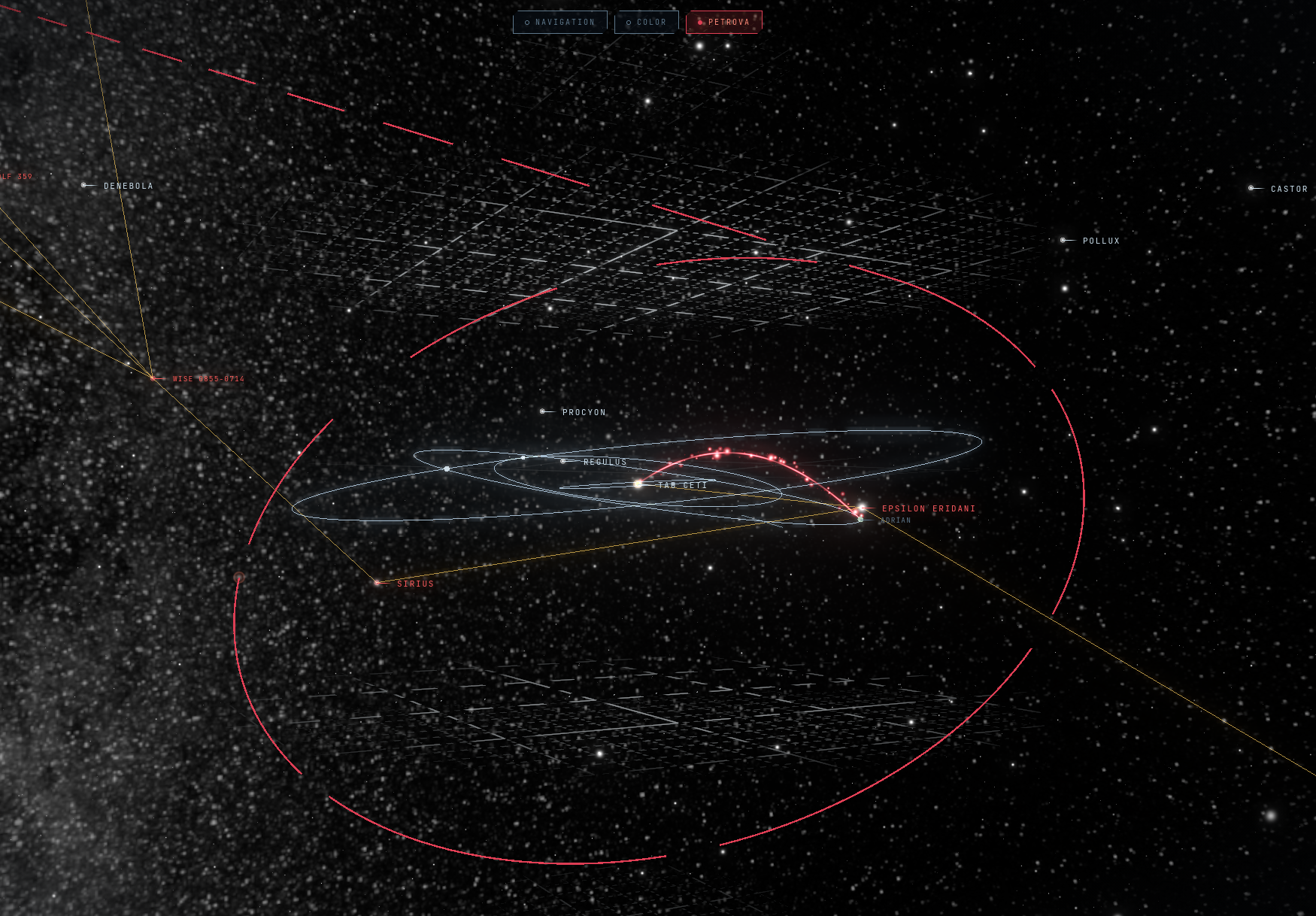
  • I thought the maps they made were of the neighborhood of stars around Tau Ceti, marking their respective home stars with the petrova line.
  • Cosmos : The Shores of the Cosmic Ocean - https://youtu.be/x-bJLG9_sUg?si=1K96fMX2T9iXu0zA&t=783

    For the "how far?" https://www.aanda.org/articles/aa/full_html/2011/04/aa16141-...

    We can get timing (rather than imaging) parallax...

    > We find that with the first method a parallax with an accuracy of 20% or less can be measured up to a maximum distance of 13 kpc, which would include 9000 pulsars. By timing pulsars with the most stable arrival times for the radio emission, parallaxes can be measured for about 3600 ms pulsars up to a distance of 9 kpc with an accuracy of 20%.

    (one kpc is 3261 light years)

    Not only can they be detected at large distances, but measurements of how far can be done at greater distances than can be done with imaging ( https://www.youtube.com/watch?v=hFMaT9oRbs4&t=608s ).

  • Thank you for making this whoever you are. There is a wonderful video at https://www.youtube.com/watch?v=8FT-oz9aZU4 that visualizes space travel and time dilation in Hail Mary. What I wished I had immediately after watching it was an interactive stellar chart.
  • You're welcome! I love that channel so much. Their videos and the blog post I link in the about section/citations on the starmap were inspirations for making this.
  • Those interested in this might also like my "Project Hail Mary Stellar Map" at:

    https://dwheeler.com/essays/project-hail-mary-map.html

    My page shows a stellar map (from the viewpoint of Polaris) and a sky chart showing the key stars from Earth's viewpoint.

    Source code (MIT license for my stuff) is at: https://github.com/david-a-wheeler/plot-stars

  • Thank you so much for the blog post! I credited you in the about page, I used your charts as reference for the Astrophage infection graph view with the Petrova mode. I shared your blog with my friends, it was a great read.
  • I had sudden memories of playing Frontier: Elite 2.

    I wanted to go to Sol, buy luxury goods...and take them to Barnards Star

  • I have memories of using a hex editor to edit the save file to get enough money to buy a docking computer because even as a kid my technical abilities were much better than my hand eye coordination.
  • I have a dim memory that one of my A-Level physics teachers (David Massey) was credited as a consultant on the Newtonian physics in F:E2.

    The game came out at the start of my upper-sixth year so it often came up during his classes.

  • Yep, quick trip in your panther clipper to ross 154, park up and buy everything on the planet.
  • For anyone who enjoys this, exploration in "Elite: Dangerous" (for which you need to be neither elite nor dangerous, exploration is peaceful) might be enjoyable for you as well.

    From the wiki: Elite Dangerous has a 1:1 scale simulation of the Milky Way galaxy based on real-life scientific principles, scientific data and theories. It includes around 400 billion star systems, modeled on actual galactic charts. Planets and moons rotate and orbit with 1:1 scale in real-time, thus constantly changing a system's environment

    https://elite-dangerous.fandom.com/wiki/Galaxy

  • It's been a long time since I played, but I don't recall the motion of the planets mattering much. Supercruise lets you move fast enough that planets and moons that move enough to be noticeable are very easy to get to regardless.
  • Elite would be a great game if it wasn't for the frustrating and terrible game design.
  • For other software engineers thinking of following in Andy Weir's footsteps and writing a novel, I put together my guide to self-publishing using software tools and techniques here: https://frequal.com/forwriters/
  • Didn’t know he was a programmer!
  • I can also recommend https://www.youtube.com/watch?v=8FT-oz9aZU4 Time Dilation Visualized (by The Overview Effekt).

    It talks about the distances and times involved and how time compression and astrophage infection rates work out. As a fan of the book and the movie it was nice to see the actual 3D star chart of everything. (warning: there may be spoilers there)

  • The time dilation aspect of it is cool, but doesn’t discuss how far we are from a propulsion system that could credibly pull this off. Even if we solved fusion it wouldn’t get us remotely close. Maybe if you could somehow produce 50 tonnes of antimatter you could do it. But we have no idea how to produce antimatter efficiently or at scale, and even if we could do it with 100% efficiency, it would take many years of humanity’s current energy budget just to make the antimatter fuel for a single manned trip.

    To me it seems like we’d need new physics (not just new technology) to have any chance of pulling this stuff off.

    The book dodges these inconvenient numbers with a bit of a deus ex machina plot device that I won’t spoil here :)

  • I am so happy this movie did great, the book was great

    Similar to me books: Bobiverse, Long Way To A Small Angry Planet

    I'm not a heavy reader

    This site is cool, I want to get to know stellar navigation stuff for astrophotography watching a video like this where they pull up star charts to point the telescope at it pretty cool https://www.youtube.com/live/TexqPMQMyZg?si=oEnvrxW21-D0VXGV...

    Tangent I'll throw in here, I never get the fabric folding gravity well diagrams as it seems to have a "down" direction, I guess it looks like it's down since it's a slice but the effect is an inward sphere?

    by ge96
  • I doubt my opinion will be well-received by all, but I hope that creators like the author of the Bobiverse will be able to, affordably and within their own capabilities, create new forms of content, such as AI-generated long-form content, like entire TV seasons, as the technology matures. That series is fantastic.
  • it's like an inverse gas bubble underwater, or a liquid blob in gas in microgravity, but without phase border.

    see, it's not that easy to explain or visualise.

  • In the vein of popcorn scifi, expeditionary force books are fun.
  • Just a question - why do you classify Long Way with PHM - because there are aliens working with humans? I don’t see any other similarities. The technology IIRC (haven’t read in years) in the Becky Chambers book is closer to Star Trek than reality, and there’s not that much of an overarching plot - which is not to say a book cannot be good without one but it’s a big difference.
  • > I guess it looks like it's down since it's a slice but the effect is an inward sphere?

    Yes, gravity is a vector field: every point in space near a heavy body has a vector pointed at the center of the body with a magnitude of the field strength. https://en.wikipedia.org/wiki/Gravitational_field

    Whenever someone uses fabric sheet analogy, they need to shout that the X-Y of the sheet is a 2 dimensional analog of X-Y-Z space, and the Z direction of the sheet is the field magnitude, with the slope indicating direction.

    All models are wrong, but some are useful (for understanding).

  • Just FYI the sizes of the planets, stars, and their orbits are not to scale at all. To get an idea of how empty space is, there are 63,360 inches in a mile, and 63,239 astronomical units in a light-year. So if you scaled everything down such that Earth was 1 inch from the Sun, Neptune would be 30 inches away and Alpha Centauri would be 4 miles away.

    If you were using a 4k display and had the Sun and Alpha Centauri visible at opposite sides of the display, the orbit of Neptune would be in the same pixel as the Sun.

  • Even sci-fi writers that try to get this right have a hard time wrapping their heads around it.

    "It's called space for a reason."

    When I saw the series adaptation of The Expanse, it was really obvious they played a lot of artistic license to make it exciting. A real space battle would be dots firing invisible dots at each other. "Close quarter battle" would be within something like 2000 kilometers, maybe more. That is close.

    by api