Join the discussion
Write your take first — we'll ask for email only when you're ready to publish.
- Hacker News
- > Differential privacy makes this trade-off explicit, and thus impossible to ignore. Maybe banning it is a way of pretending that the problem doesn't exist, in the hope that it will go away?
Or it's saying that one of these conflicting goals is more valuable than the other, and so shouldn't be sacrificed for it.
by tbrownaw - The replies here arguing we should publish it all are wild in the worst kind of first-order thinking way.
It’s a census: it just asks questions.
If you start publishing and weaponizing the data against people with various attributes, they’ll just lie or not answer. And then you are left with worse than nothing: bad data people try to act on.
by asolove - Ban it from the dataset, add it to the analysis. You can choose your own flavor of noise.
I don't know what the political undertones are here, but at some level you need to have actual ground truth, including "this person/household declined".
Publishing raw data though? That seems like shooting yourself in the foot from a national security perspective, not to mention all the other reasons not to do it.
by jmole - i have such a hard time reconciling stuff like this:
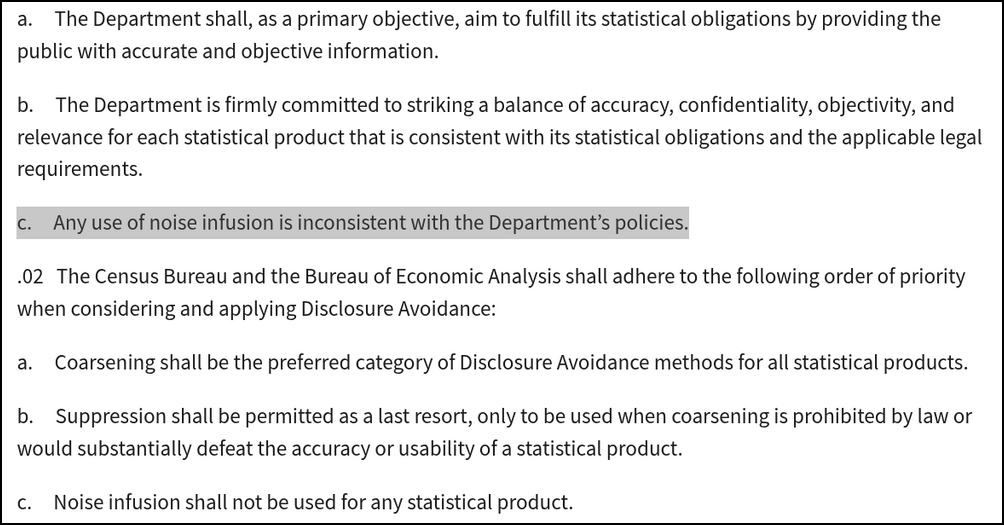
> The census bureau decided to adopt differential privacy for the 2020 Census
and:
> The consequences will be dire for utility or for privacy, and possibly both. It's hard to understate this point: future statistical releases will either be useless compared to past ones, or they will be incredibly unsafe
so we took the census for centuries before this point, and it was “ok.” and for the last census only we added some privacy items. but if we remove just one of those filters, we are in “dire” circumstances? but there were no privacy features before. so we’re actually still much better off than we were for hundreds of years before this.
this makes it feel like an emotional overblown problem
by foolfoolz - An earlier article on the same blog had some very useful information on how easily the aggregated census data from 2010 (before differential privacy) could be used to reconstruct real data for individuals: https://desfontain.es/blog/us-census-reconstruction-attack.h...
I am personally convinced that the reason noise infusion was banned was because powerful people were already reconstructing individual data from census for the purpose of gerrymandering, and they wanted to continue gerrymandering.
by kccqzy - Whatever you do, there is a level of trust that is assumed when census takes place. The trust that this data is then not identified in a way that could be targeted for scams, frauds, and other such evils. But in NY, house sale records are made public but much to the detriment, many mortgage companies fake a bill for payment.
Differential privacy is absolutely necessary, and the social scientists being unable to reconstruct the data at an individual level is intended. A macroscopic description is rather enough for most purposes, and anything more is asking for a surveillance state.
- Pretty sad, in my opinion. In my ideal the state should have visibility into the shape of the people present so that we can make good decisions about our combined organization. I think we’re making a mistake we will come to regret by intentionally damaging our data collection infrastructure.
I think a large amount of the US’s success is the result of good institutions handling granular data. Policies can be adjusted to match outcomes more rapidly than otherwise.
I understand why people decide to diminish all state capacity - they feel that governments are populated by their opponents who will use state capacity against them. But as our relative strength wanes, our ability to overcome these forces of inertia does as well. And then our governments become less capable and eventually life starts getting worse.
We don’t need house-level data immediately (except perhaps in order to place census blocks within their appropriate congressional district etc). But there are aggregation units above which we should be using as good information as we possibly could be.
by arjie - I "enumerated" for the last census. Trust in my community was already not high* and I had lots of interesting encounters. I really believed the rather invasive data I was collecting with a friendly face would be used and handled responsibly. I feel for the poor souls that'll sign up to go door to door for 2030 now that the firewalls against weaponizing and monetizing all of our sensitive government data has been torn down, and even more for those that will volunteer information that can hurt them.
The comments that this rather expensive endeavour should just be about getting a head count are also amusing to me. The data collected was such an important baseline of common understanding, and this will not be a good thing for its future quality. I've grown very jaded now seeing all the things taken for granted in this country and lost or degraded recently with a whimper.
*: To be fair, they sent me specifically to places that didn't respond, so I was naturally led to believe that everyone in my region hated the government, ignored bizzarrely threatening fliers, or had recently moved and had no knowledge of the inhabitants (if any) during the census period.
by kajman