Join the discussion

Write your take first — we'll ask for email only when you're ready to publish.

  • Hacker News
  • > store №20

    > MEAT. FISH.

    That's some Edward Bernays-level trickery right there. /s

  • Reminds me of the old Soviet joke of somebody going to the butcher and asking if they have fish. The butcher responds we only have no meat here, you need to go to the fish shop if you want no fish.
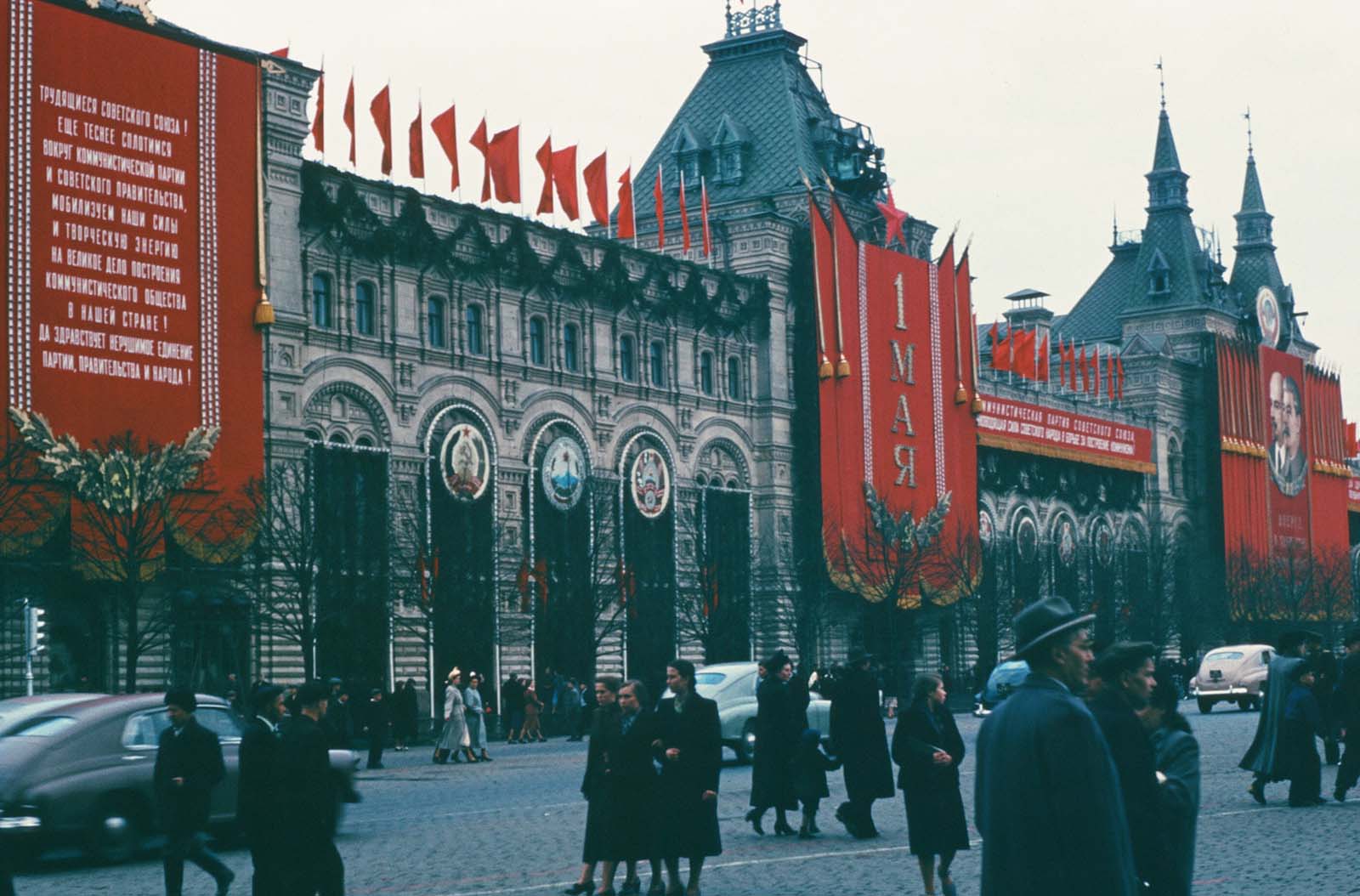
  • "It becomes evident that the parade was a carefully choreographed spectacle, designed to showcase the Soviet Union’s ideology and power to the world."

    Ah yes, everyone known that in a TRUE democracy parades are spontaneously occurring events, self organizing to show the country's weaknesses and the population's biases.

    Seriously tho, what does this mean, has anyone ever been to a parade and concluded it was neither coreographed, planned, or meant give a positive image ?

    How do you determine people's enthusiasm is planned and orchestrated by looking at them ?

    Are all parades proof the country is actually the torture Truman show or just the countries you're being payed to spy on ?

  • Just visit any (sparse) Dutch events, like King’s day, you’ll see what it means when people self-organize.
  • Every seen a pride parade?

    I'm not sure what kind of special torture you'd employ to make people display that kind of enthusiasm :)

  • Ugh, how I hate this sort of relativization coming from people who never experienced an actual authoritarian system.

    By the age of 6, I was required to carry a standard paper lantern on the November 7th celebration of the Great October* Socialist Revolution, with my parents fully aware that presence and absence lists were maintained by the teachers, who would forward them to the school cadre bureaucrats keeping dossiers on the kids, who could alert the secret police to take a closer look at the repeat offenders, and who would definitely play a big role in allowing you later to enter high school or not.

    My grandpa was subject to hearings and threats because his son (my uncle) had bad marks in the compulsory Russian language lessons and the spooks were convinced that he was bad at it on purpose, by being secretly taught animosity against the Soviet Union at home.

    I wonder if you ever experienced this sort of paranoia and coercion from your government. In the Czechoslovak Socialist Republic, this was the norm even during the late 1980s.

    * Yeah, the October/November mismatch fits, because in 1917, then-Russia was following the Julian calendar and only later switched to Gregorian. Hence the difference of 18 days which was reflected in the timing of that parade.

  • In my experience as an American, most of the parades I'm personally familiar with are organized by local groups rather than the government. Maybe you can read some ideology into the American Legion marching with flags, but it's more an exercise in giving the local high school band a chance to march, the Shriners an excuse to break out their clown cars, and maybe the whole thing is an advertisement for the 4H or FFA fair. That's not to say that the US doesn't have parades in the genre the article talks about—the Army 250th Anniversary Parade probably counts. But not every parade is a propaganda exercise.
    by wl
  • Interesting and sad to see the ratio of women to men doing hard manual work in these photos, even road repairs are done by women. It's mind boggling how devastating the war was for the country.
  • The war, and also Stalin.
  • You can get more labor out of people if you assume children take 0 time and cost $0.
  • Ah, is that why... I noticed this too but assumed it was due to some communist ideal of gender equality leading to more women tradespeople, wishful thinking I guess
  • It wasn't just hard manual work. IIRC, for decades the majority of doctors were women.
  • There is exactly one photo with three women pouring something onto small holes? Only other work shown has women going to clear/sweep and cleaning is traditionally female work.
  • That's a funny take these days, that women are too dainty to do "men's work". Should they be kept barefoot in the kitchen? Or just allowed in women's jobs?
  • The Soviets were one of the few countries where Women were employed on the front lines during the war. They were tank drivers, anti aircraft gunners, pilots, snipers.

    A famous unit of all women pilots known as the 'Night Witches' made a name for themselves during the war https://en.wikipedia.org/wiki/Night_Witches

  • More information about the origins of the collection and the photographer (a U.S. Army officer, assistant military attaché): https://manhoffarchive.org/narratives/intro
  • As someone who grew up in the Soviet Union (during a later period), I found it really interesting to look at this photographs.

    One thing worth pointing out: Moscow was very different from the rest of the country. It had better housing and infrastructure, the shops were stocked far better than elsewhere in the country, it had more grandiose architecture and richer cultural life and so on.

    In many is ways it was the country's showcase city.

    by aix1
  • I read or was told that 60% of the Russian economy flows through Moscow in one way or another.
  • So a Potemkin capital, as it were?
  • So, the same as any big urban center anywhere has better infrastructure and cultural life compared to villages and rural areas? Or was it particularly pronounced in the USSR?
  • Moscow plus Leningrad plus Vladivostok. The rest fought for the crumbs.
  • Nothing has changed in that regard. Moscow still receives much more monetary attention than any other city in Russia.
  • Lots of contention here around the narrative. The original link should be removed and replaced with the original source that has what’s seems to be accurate and different narratives for the pictures. The linked site seems to simply steal what is a pretty nice coverage of the archive.

    https://www.rferl.org/a/the-manhoff-archive/28359558.html

  • Please email the mods! They can change the link :)
  • And the ads on the link posted to HN - very inappropriate subjects and pop up video ads. Grrr
  • Thanks - we've switched the top link to that from https://rarehistoricalphotos.com/stalin-era-soviet-union-pic....

    Submitters: "Please submit the original source. If a post reports on something found on another site, submit the latter." - https://news.ycombinator.com/newsguidelines.html

    by dang
  • The most striking thing about it, is that no matter how sorry do most of those people look, a good half of them represent Soviet 1% ers. And virtually all of them, top 20%. Vast majority of population wore homemade clothes, lived in villages with no documents (literally having no right to have an ID issued, which was necessary for all things except working in their kolkhos they were attached to), and could be jailed simply for leaving their village without a written order, at will.
  • "According to Smith, after Manhoff’s wife died he was asked to check the home of a former official for valuable memorabilia."

    I wonder how much valuable memorabilia is just getting thrown away because no one thought to check for it.

    Here's your nudge to ask your older relatives about their memorabilia, and record conversations with them while they are still alive.

    If you want to put the info online somewhere to increase the chance that it's useful to someone someday, you could try a free genealogy website like familysearch.org or wikitree.com

  • To be fair, most people aren't a diplomat to Russia. So it's good to check but maybe this was a much more advanced case.
  •   It unveils the stark contrast between the carefully constructed façade 
      presented by the Soviet authorities and the harsh realities experienced by 
      ordinary citizens.
      
    I guess without examples of the "carefully constructed façade" its difficult to understand if there is a contrast. To me, the photos just look like ordinary 1950s street scenes. Waiting at Walgreens the other day I spent the time examining the store's decorative antique photos; aside from differences in culture and subject area, so many details of vehicles, building construction, clothing styles are remarkably similar.