Join the discussion
Write your take first — we'll ask for email only when you're ready to publish.
- Hacker News
- It's important to factor in just how many US adults are basically illiterate nowadays.
As of 2023, 27% of American working-age adults were at a PIAAC Literacy Level of 1 or below, out of a total of 5 levels. This has gotten drastically worse in the past 10 years as, in 2013, Level 1 and below was only 17%.
Full scores for 2023 are: % Level 1 or below: 27% Level 2: 29% Level 3: 31% Level 4/5: 13%
For reference, Level 1 means someone can't really handle a full page of text, and can sort of handle simple 1-page web pages. Level 2 is the point where someone can start to handle a few pages of straightforward text, but still nothing particularly complicated.
(Both of those descriptions undersell just how bad it really is, but I'll leave it at that, for the sake of brevity.)
People that aren't using AI at all often aren't using it because they effectively can't. On a fundamental level.
Source: https://nces.ed.gov/surveys/piaac/2023/national_results.asp
- I fear AI is going to be used for everything not because it's the best solution, but because people are inherently lazy and just want to get their thing done, and they don't care so much about the quality.
"low effort and convenient" seems to consistently win over "best quality" and this is going to be a downgrade in everything, for everyone
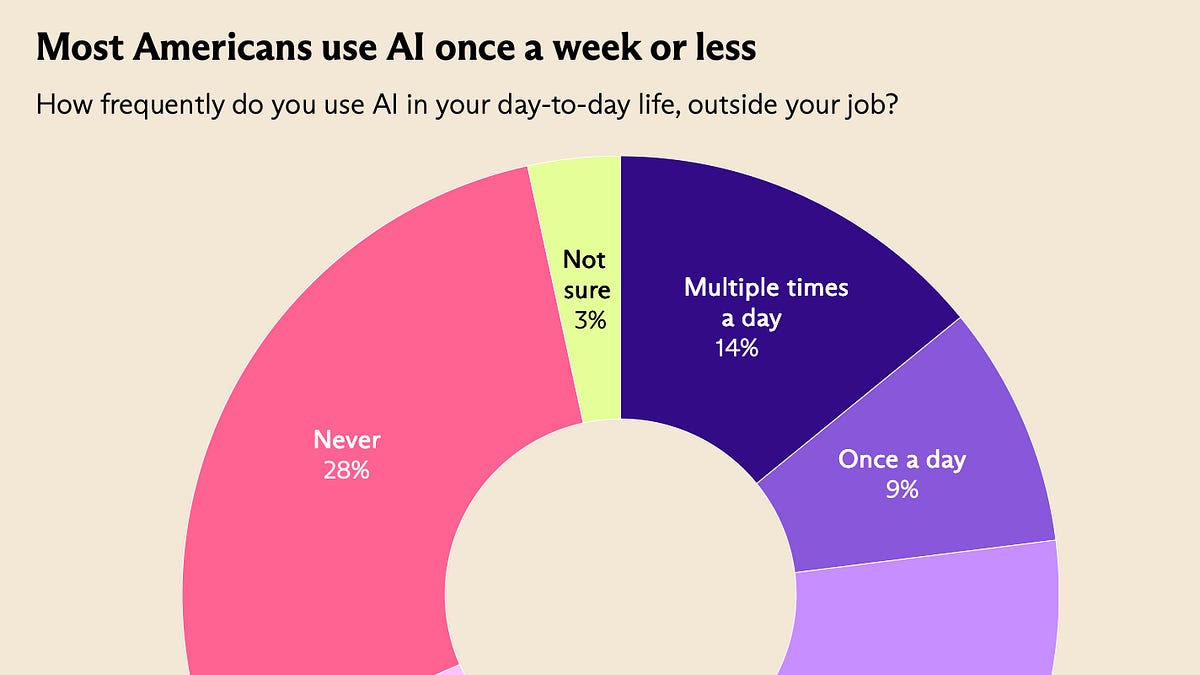
by tripleee - Good piece, but I think there's a missing angle to it. He cites a study showing how often people say they "use AI", and a little over 50% use it less than once per week.
If we're just talking about AI chat interfaces, sure. But I think the way that AI usage is going to grow isn't mostly by getting more chat engagement. It's about baking AI features into software that people already use.
For example, suppose you asked the same people "How often do you search on Google?" I am willing to bet the numbers go up a lot. And all of those people are "using AI" in a very real sense, they just don't think about it when it's baked in.
by bjt - I think the gap is because 1. For coding, Claude is amazing - mainly because of its curated skills and because massive amounts of working code has already been carefully labeled over the last decade or so via GitHub. And because with any Turing complete language, there is only so much one can do.
But 2. For most other things, LLMs are fairly underwhelming. Research is usually mediocre. Try being rigorous and repeat your research prompt many times - then make a confusion matrix to tally up how many false positives and false negatives occur. And for the rest, be honest and ask yourself if the LLM is doing much more than a basic search engine query or trip to Wikipedia would have told you. For “normie” use cases, it’s handy-ish but far from revolutionary
by AvAn12 - I've noticed several companies replacing deterministic systems in their support flows with a LLM version that is slower and worse. Many interfaces simply aren't better with AI addedby variety8675
- One thing I'd personally like to see a little more discussion of (at least within my social circles) is.. what exactly does "using AI" mean?
How does this connect to everyone's high level ideas/thoughts about "tech", "AI" and "morals and feels" etc. These lines can start to seem a little blurry, at least for me.
For example, would we say my partner is "using AI" (for all intents and purposes), if she's frequently using Google.com throughout the day, and then ends up picking and believing the AI generated answer overview at the top of the SERPs almost every time?
Or do we feel "uses AI", is more along the lines of the vampire kids running 1000 sub-agents on a mattress floor in SF?
I kind of find the whole spectrum really interesting because even basic phone use is now stuffed with AI, whether we choose to label it or not.
by wamatt - > AI has gotten so good that despite any misgivings, “everyone is using A.I.”
In my experience, it's a mixed bag. I wrote this comment[0], yesterday. It reflects my current work, and how I am integrating an LLM.
I have used it for two parts of my project:
1) The backend (PHP), and
2) The frontend (Swift)
It has been a huge help, in both, but #2 is a cautionary tale. It really needs adult supervision, in developing native UIKit Swift apps. I'm realizing how truly bad the code it wrote was. I mean, terrible.
That's jarring, because it did a great job with #1. It made sound, reasonable design decisions, and provided code that is better than what I would write.
With #2, it behaved exactly like an inexperienced engineer, panicking, when confronted with real-world problems. My rewrite is going to feature a much simpler, sound approach.
All that said, it has been a net positive, and has increased my productivity by a large margin.
I guess the lesson I needed to get from this, is that it is good at helping me to find problems, but maybe not so good at fixing them.
- On the post-grad job hunt right now - I note that most employers will ask in a technical interview or whiteboard interview "how are you using LLMs?"
It's tough to answer because you want to hedge for both an AI enthused employer and an AI hesitant employer with limited information about who they are and how they personally use these products. I've been responding with a sort of long winded answer about how 'there is clearly a learning curve for how this technology fits into any process and how I always always always double double double check yadayadayada'
I'm probably using the chat/ask functionality on a daily basis for quick debugging / new technology learning questions but I have yet to really use the fully agent or computer-use products because I've had more bad results than good the few times I've tried them (re-factoring a big repo of decades old fortran+C code for modern compiler/OS some things started to work but ultimately I abandoned that effort).
by acc_297