
Join the discussion
Write your take first — we'll ask for email only when you're ready to publish.
- Hacker News
- Very cool, we're doing similar except we let agents open PRs as well + we track release metadata and agentic sessions via our ReARM system + we've recently launched an option for agents to track helm-based deployments via ReARM - https://docs.rearmhq.com/workflows/devops.htmlby taleodor
- I didn't mention this part, but while writing this I realized I could easily add a skill to hit the Forgejo PR API. There's no forgejo CLI like there is with GitHub sadly.by rsgm
- Two main reasons I don't have this setup already is - the resource you need to give the VM running opencode to build your projects - Faster testing
I run pi coding agent right on my mac and I run our entire software suite - example: redis, postgres, kratos, .. etc. With coding agent running on my main development device, I can build faster (assuming opencode VM is a on a low specd machine) as well as test it faster. Example: I can just rebuild the backend and restart it and test it on the UI client with the new changes.
by orangeisthe - I've got a gitea instance and a systemd timer polling for issues assigned to my bot. The systemd timer clones the repo etc and spawns the agent in a restricted environment where it has a private localhost (enforced by systemd), and then I set HTTP_PROXY to an inner proxy that connects to an outer proxy over a unix socket. The outer proxy enforces an allowlist and injects credentials. The agent doesn't have access to any credentials inside its sandbox.
For the agent I was using `claude -p` with a pro subscription, but they've been treating their paying subscribers like they're on a free trial (they're subsidizing it so heavily it might as well be). So now I'm using an ollama pro subscription and a homebuilt agent with a bash tool and a str_replace tool. It gets on just fine with only those two
by atn34 - This is great. Homelab AI feels like it's going to fun as heck. I currently have Claude maintain my homelab across all devices; it made homelab setup and maintenance go from "This is a trap that will fascinate you for years but never fully work right and waste time that would have better been spent elsewhere" to "This is actually a great idea and really extends my capabilities."by templar_snow
- I’ve found, even using the latest models, there are some time saving nuggets but mostly subtle config difficulties that just cause an enormous amount of debugging and a net negative on balance, unless you’re just asking for super targeted tasks like “set up a docker compose file” or “give me an NSD config.” But with both of those you need to already know you need the underlying tech and what to ask.by ohyoutravel
- Im doing something very similar. Running my OpenCode on a proxmox lxc. I have an additional layer of Kimaki, which gives you Discord integration (hate it or love it). Chatting with your codebase (voice messages, too, if that’s your jam), is very very cool.by dlxfoo
- That's very cool. Thanks, I'll have to check that out.by rsgm
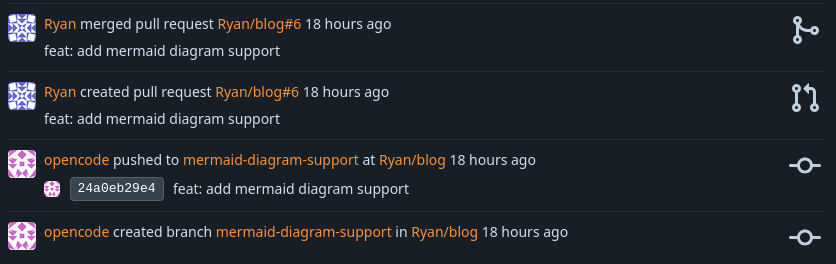
- > I set up OpenCode Web UI with Git access to make my homelab easier to manage. OpenCode pushes to Git, I approve the PRs, GitOps deploys the changes. Best of all, OpenCode runs as a server with persistent coding sessions synced across devices.
> I’ll share my homelab setup soon. There are about a dozen docker compose stacks for the services that I manage.
That is probably neat, but before I read, how many thousands of dollars would I need to spend to acquire the RAM and GPUs needed to do something similar?
by palmotea - 0? OpenCode is just a harness, it can connect to any model hosted online.
- I’ve been building something similar for quite a while, with a stronger focus on minimizing dependencies on external services: https://github.com/kvladsrc/gym/tree/main/production
I find it convenient to interact with frontier LLMs through a Kanban board powered by Kanboard. For example, the LLM creates backlog tasks based on alerts from the cluster. I manually move selected tasks from the backlog to Ready, the model picks them up, works on them, and submits a patch for review in the comments. From there, the usual pipeline takes over: CI, LGTM, merge, and CD.
Another surprisingly useful part is desktop configuration management, covering everything from the compositor and system tray to text editor configuration with the same pipeline. For once, I genuinely enjoy using Linux on the desktop.
by zjgkknk - Any idea as of why this domain is blocked by quad9 resolvers? I am unable to open the website because Quad9 filters the domain:
dig @9.9.9.9 rsgm.dev NS
;; OPT PSEUDOSECTION: ; EDNS: version: 0, flags:; udp: 1232 ; EDE: 17 (Filtered)by schanz - It's on a malware list: https://quad9.net/result/?url=rsgm.dev#domain-tester
- If I had to guess, it's because the registration is brand new (about 8 hours old), created at 2026-06-15 14:01:25 UTC.by abtinf
- I've added a few more bells and whistles to my agentic rube goldberg, but the gist is forgejo tag listeners triggering argo workflows to orchestrate
1. issue tag
2. write pr
3. testing
4. review+revise loop
5. merge mutex to ensure you don't get a merge storm
6. rebase and merge
I've been trying really hard to have it properly implement agentic identity where the pod gets a spiffe-attested token and then trades that for access to the vault secret for a project-scoped forgejo service account. I wish forgejo could configure a trusted external jwt signing authority so I could skip vault and the accounts.
Here's the inspiration for the auth model I've been trying to implement: https://datatracker.ietf.org/doc/draft-klrc-aiagent-auth/
The last piece has been using gvisor + kubernetes agent sandboxes. My fable adventure last week was having it debug the process of attesting and distributing workload identities for agents running in gvisor, as it creates a layer of indirection that confuses spire to the point it won't issue an ID.
by constGard - I've been trying to find the motivation to do a write up on my AI lab, and this is just what I needed. Thanks for sharing. My setup is a similar idea, just with n8n/git/argo/k3s. It's mainly for automated workflows that Qwen or Gemma4 can handle.by doctorspazz
- Some times I feel like a lot of people in tech independently go through the same things right around the same time with few people writing/sharing about it.
I am also creating this and enjoyed the post and comments all going through the same thing :)
by MisterPea - I have created this in 3 different ways, also with e2b.dev (great service). And yeah, that is my problem - I spend 99% of time hacking cool stuff, 1% yapping about it. Should do more yapping.by iagooar
- Not only in tech. This is a common phenomenon. We're not that original.by plmpsu
- I've been doing something pretty similar, except instead of having a persistent opencode server, I've been using this workflow that runs opencode inside of the Forgejo action runners:
https://codeberg.org/dragonfyre13/forgejo-opencode
Still tinkering with it, but the gist is that I can invoke Opencode with /oc inside of an Forgejo issue, then it will come back with a PR for me to review.
- Nice! I've done that with Claude Code + Forgejo but as a small separate app to run Claude in Docker: https://github.com/smithy-ai/smithy-aiby t0mas88
- I did this with github actions + opencode. It has mainly two components called daydream and nightwatch. Daydream runs on a daily schedule looking at the VISION.MD file in the project and also look at the project and suggest new ideas, security , maintenance tasks (you can set a ratio of maintenance vs new ideas) and create a new issue. Then nightwatch runs daily at night and picks up oldest issue and suggest a PR. I'm in total control of merging, can ask for changes which agent again will execute immediately.
This has been helpful to revive few old projects and keep momentum on active projects. I've been closing more PRs than merging but I think that's fine. I quickly ran out of free github action hours so I had to self host actions. However basic self-host actions setup may not be secure enough because VM is not destroyed after each action like github own action jobs environment.
Anybody can try it out actions from https://github.com/chamoda/agent-foundry, minimal setup don't need any API keys, works with mimo 2.5 free model by default.
by chamoda