Join the discussion

Write your take first — we'll ask for email only when you're ready to publish.

  • Hacker News
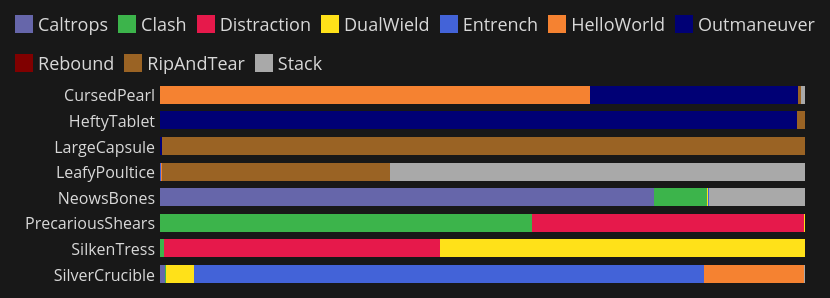
  • Random thing I ran into while trying to seed search for a challenge run, but since the seed is passed through a 32-bit hash function it means there's effectively only 4 billion seeds (as opposed to the first game, which had 64 bit seeds). This is great if you wanna do something like prove/disprove whether there are unwinnable seeds since its trivial to brute force all of them, but it does mean the potential for fun "high roll" seeded runs is much lower, which is a shame since the new game has so much more variance than the original.

    This was the challenge run I ended up with (Ascension 10 win without taking any cards) https://youtu.be/PbP284CZrZ4?is=iL1E7gIzj_kgx0MS

  • > the game used several distinct pseudorandom number generators, to prevent e.g. randomness within a combat from influencing future card rewards.

    Why is this important? Feels like fixing what seems to be a non-issue lead to a bunch of real issues.

    With a good RNG it should not be possible to predict future numbers based on past numbers so players cannot manipulate card rewards in their favour based on combat actions, right?

  • You could observe future random numbers by taking combat actions, and then reset to the start of the fight and play a line which consumes fewer random numbers in order to manipulate your card rewards. Maybe you could generate the card reward at the start of the fight, but what if they play a card which impacts the card reward, e.g. by creating an extra card reward.
    by bzax
  • You're confusing RNG manipulation (really clearly bad, basically cheating by removing the randomness from the game) from RNG prediction (less bad but still unfun, being able to predict future random states).

    You can be safe from RNG manipulation while still suffering from RNG prediction. Players can't modify the events that are going to happen, but if they can predict them, it's still a problem.

    The situation is like there's a bug in the blackjack table where, instead of shuffling the whole shoe together, each deck in it was shuffled on its own in the same way and then the identical decks are stacked together. Once you've seen 52 cards, you know the repeating pattern and can play with perfect or near-perfect knowledge of what's about to be dealt.

  • Because they appear to have a curious way of doing their saves. From the article:

    >The way Slay the Spire allows you to save and resume runs is by storing the total number of times each RNG has been called, and then calling each RNG that many times (throwing away the result) whenever a save file is loaded.

    Depending on what the game is like (I know nothing about it), that could make sense, even if it is inelegant.

  • > With a good RNG it should not be possible to predict future numbers based on past numbers so players cannot manipulate card rewards in their favour based on combat actions, right?

    I think you're overlooking the distinction between seeded and unseeded runs. An unseeded run is a run in which the player enters the game not knowing what the seed of the RNG is and not being able to pick it (this is the default mode). A seeded run is where the player provides the RNG seed. Generally, things like unlocks and steam achievements can only be earned on unseeded runs, but players want to be able to play seeded runs anyway. Of course all runs have an RNG seed: an unseeded run is when the seed is itself chosen at random, a seeded run is when the player specifies the seed.

    Imagine a game with a standard deck of cards played over several rounds, where your opponent performs actions in response to your actions. The deck of cards is shuffled pseudo-randomly between every round. Every time you make a move, your opponent has N valid moves, and picks between them pseudo-randomly.

    Players play a seeded run because they want to retry the same set of challenges, because they are asking themselves "if I had done this, would I have won" or "if I had done this, what would have happened".

    So in this example, given a known seed: in round 1, my cards are shuffled this way, and in round 2, my cards a shuffled this other way, regardless of which moves I make in round 1.

    If the opponent picks its response using the same RNG that shuffles the deck, the players actions in round 1 would change the shuffling of the deck in round 2. This would change the design parameters of what a seeded run means: it's no longer giving the guarantee "the deck is shuffled in the same way in round 2 regardless of what you do in round 1", which is the experience the designer wants to create and what the players want to play. Players might, e.g., say "who can get the highest score on this seed", they might search for the easiest or most difficult seeds, or they might search for seeds where particularly unlikely sequences of events are guaranteed to occur, because perhaps this sequence of events is so unlikely that a human would have to play a hundred million games to witness that sequence organically, and people want to see that sequence of events because it's interesting in some way. It's designed this way so that if you play the same seed, certain random events play out the same way, i.e., non-randomly.

    by zemo
  • Some degree of stability in seeds is desirable, partly because of the compatitive elements (multiple players playing the same seed should have roughly the same game), but also when updating the game is means that if they tweak one area the rest of the seed will stay roughly the same. (Maybe less important for games with short runs compared to sandbox games like Minecraft where the world might be generated by very different versions if the game and you don't want blatent seams when it happens)
  • The game stores and allows you to see the RNG seed that controls the run's events and layout. The developers want players to be able to share seeds that produce interesting runs.

    That requirement is what made this problem difficult for the devs to solve.

    by eig
  • For a singular seed, they wanted the resulting run to be stable in the sense that small deviations in decision making does not result in a vastly different result (as far as random events are concerned)

    Imagine the game of two players having the same state X. While combat, one player would trigger a random action, the other doesn't. After the combat, both should still get the same randomized reward options. This wouldn't work with just a singular RNG.

  • I don't think it's deliberate RNG manipulation they worry about. It's a single player (or coop) game after all.

    However, one of their design goals is that people playing on the same seed should have roughly the same game, it should feel "fair". Some things you probably want to be fairly random, for instance your card choices can depend on what cards you chose before. But it's also important that people choosing the exact same cards (and taking the same path, maybe?) should be offered the same options.

    In STS1, the order of relics was fixed from the start as I recall. So if you skipped a shop, you'd get exactly the same relics in the next shop as you would have in the one you skipped. Good for seed fairness, but a little odd.

  • > The phenomenon of "correlated RNG" (or "CRNG")

    This is a pretty funny abbreviation since CRNG is sometimes "cryptographic random number generator", which would not be susceptible to this correlation. Albeit I think CSRNG is more common.

  • The criteria for calling a RNG "cryptographically secure" are incompatible with the game design goals here.

    The game needs a RNG that's stable when seeded, for reproducible runs. I look for the same kind of qualities when doing generative art.

    In comparison, a CSPRNG should be safe from oracle attacks, which is essentially the opposite goal.

  • I don't understand the motivation for using multiple RNGs in the first place. If the game had one global, seed-able source of randomness, would this problem just disappear?
  • Think of chaos theory, or at least the pop-science version of it. You brush aside a butterfly today, and the fated hurricane doesn't happen next week.

    However if insect-wingbeats and weather-systems used two independent PRNGs, you could safely walk in the garden without changing the meteorological future.

  • They want two players with the same seed to have a similar gameplay experience in terms of challenges encountered.

    For this reason they want to isolate the RNG that procedurally generates maps, card rewards, shop contents, from other RNG streams such as the RNG used by random enemy attacks in battles, random event outcomes, etc.

    One example of the wonky things that are possible when there is a single RNG stream is speedrunners manipulate the RNG state. For example, in Super Mario 64 they can jump in place to produce dust clouds that advance the RNG state until it is in a favorable position.

    https://www.youtube.com/watch?v=MiuLeTE2MeQ&t=476

    by ufo
  • The main reason to allow users to set seeds manually is to allow players to share seeds among themselves. And the reason that players want to share seeds is because players will find exceptionally rare seeds that other players might want to try out. This sort of exceptional rarity might take the form "the first shop in act 1 sells a relic that gives you 2 potion slots, then the act 2 ancient offers a relic that gives you 4 potion slots, then the act 3 ancient offers a relic that fills all your potions slots at the start of every combat". However, when players share seeds, they aren't sharing the exact series of inputs they performed in that game. This means that the relics that have been "randomly" offered like the ones above need to be offered on the same seed regardless of any prior player decision. And player decisions can generally cause the RNG to advance an arbitrary number of times. So this means that you want to have entirely separate RNGs for every thing that the player has any power to influence, because this makes the randomness of a single seed more usefully reproducible in practice.
  • The motivation boils down to trying to make runs with the same starting seed feel "similar" in meaningful ways. It's "better" in a vibes way if both you and I were offered the same card choices in runs with the same seed, even if we took different amounts of turns on the first battle.
  • The post suggests replacing the linear congruential generator (LCG) with a permuted congruential generator (PCG). The latter has more random-looking output.

    Another solution is to switch to a cryptographic hash function. For example, using sha256(seed || event type || counter) only requires storing seeds and counters in the save game.

    This has several benefits:

      - You can find efficient implementations on all platforms without having to roll your own.
      - Gives the same output on all platforms by design.
      - Output is practically indistinguishable from randomness by design.
    
    The main downside is that sha256 is significantly slower than any non-cryptographic PRNG, but considering how few random numbers you need during a typical game, this doesn't really matter.
  • Sincerely blows my mind to see someone recommend cryptography to generate pseudorandom numbers. It speaks volumes of how fast computers are now, and how used we are to waste that power.

    Slay the Spyre is a rogue deck builder, the PRNG of Windows Freecell (3.11) would be good enough for it.

    Edit: From https://github.com/joshuamkite/freecell

    > Microsoft FreeCell RNG Algorithm: Uses seeded random number generator (seed = (seed * 214013 + 2531011) & 0x7FFFFFFF) for reproducible deals (games numbered 1-1,000,000)

  • Well the .NET random is bad.

    It seems really the problem is twofold: the reference is from 1992 and cites a 1981 publication's reference to an unpublished 1958 generator. Not to say that being old makes the algorithm bad, but it's a bad implementation of an algorithm that already is questionable given more recent research.

    I'll go section by section: > //Apparently the range [1..55] is special (Knuth) and so we're wasting the 0'th position.

    This is a silly comment. Knuth explicitly states that "24 and 55 in this definition were not chosen at random; they are special values that happen to define a sequence whose least significant bits, {Xn mod 2), will have a period of length 2^55 - 1. Therefore the sequence (Xn) must have a period at least this long."

    Then you have the initial seeding of the LCG with with a = 21 and m = 55, which is interesting. Numerical Recipes uses those values, but Knuth whom they got the algorithm from does not suggest them. The closest Knuth suggests is 24 and 55. This suggestion is from 1981, so the viability is questionable (and Knuth clearly states that this is an unpublished algorithm from 1958 - Numerical Recipes itself questions the quality).

    Then they use 21 for inextp - this is wrong. Numerical Recipes uses 31, and that is significant per the period length quote above. The use of 21 should measurable lower the period.

    Instead if it were a simple LCG using values found in L'Ecuyer's 1999 publication on the topic (https://www.ams.org/journals/mcom/1999-68-225/S0025-5718-99-...) I assume it would have a better distribution.

    So the implementation is a questionable algorithm from 1958, and it's done incorrectly. Numerical Recipes opens the chapter on randomness almost immediately with: "Now our first ... lesson in this chapter is: be very, very suspicious of a system-supplied rand()," and then the authors of the .NET random package show exactly why that is.

    by j_w
  • > (By the way, floor 2 Corpse Slugs will both be attacking on turn 1 less than 3% of the time. How nice of them!)

    I assumed that was just deterministic. Didn't realize the game permitted such a challenge on floor 2 :(

  • This is such a great article- I’ve had so many runs where it’s felt like “why am I always getting this random card?” And now I’ll know! Thank you!
  • This is also the cause of the thing in Minecraft where you find surface clay, move X blocks over, and dig straight down into diamonds.
  • Interestingly, StS2 got this problem because it was using C# System.Random in Godot, while the RNG class in GDScript (Godot Engine's own scripting language) is using PCG32 which should be free of this particular problem.
  • I haven't had time to read the whole article, but I really appreciate the cross section of the world that reads HackerNews and plays STS2. STS1 and STS2 are my favorite games and to see this pop up here brought a big smile on my face. Thanks for sharing.
  • You may like a game my younger brother developed. Same genre as slay the spire.

    He and one other guy coded this together for a few years. Really good reviews on Steam.

    https://store.steampowered.com/app/3057670/Pluto/

  • Another cross-section is space enthusiasts. I really have to rewire my brain every time someone says sts-n and doesn't mean a mission number of https://en.wikipedia.org/wiki/Space_Transportation_System
  • Combining this article and discovery of an unwinnable seed in the original Slay the Spire [0] — I've always pondered the existence of some kind of "RNG hell", where a game uses the time as its random seed and, due to some quirk of the hashing function and the game mechanics, the game is rendered completely unwinnable for (say) four days straight. (Sometimes it feels like I'm in it!)

    [0] https://oohbleh.github.io/losing-seed/

  • Putting this into my rotation of excuses. "It wasn't my fault! They were hacking, also my fingers were slippery and the deterministic behavior of psuedorandom number generators guaranteed we would lose anyway."
  • > Implementing a PRNG within the codebase instead of calling the C# standard library has an additional advantage: seeds are guaranteed to be the same on all platforms. In Spire 1, seeds on the desktop version of the game were different from seeds on the mobile version of the game, because the standard library implementation of PRNG differed between platforms. It is also worth mentioning that the standard library implementation might change over time, which would break all past seeds.

    This is the correct conclusion - game developers should consider gameplay-relevant random generators part of their gameplay code rather than platform code.