Join the discussion
Write your take first — we'll ask for email only when you're ready to publish.
- Hacker News
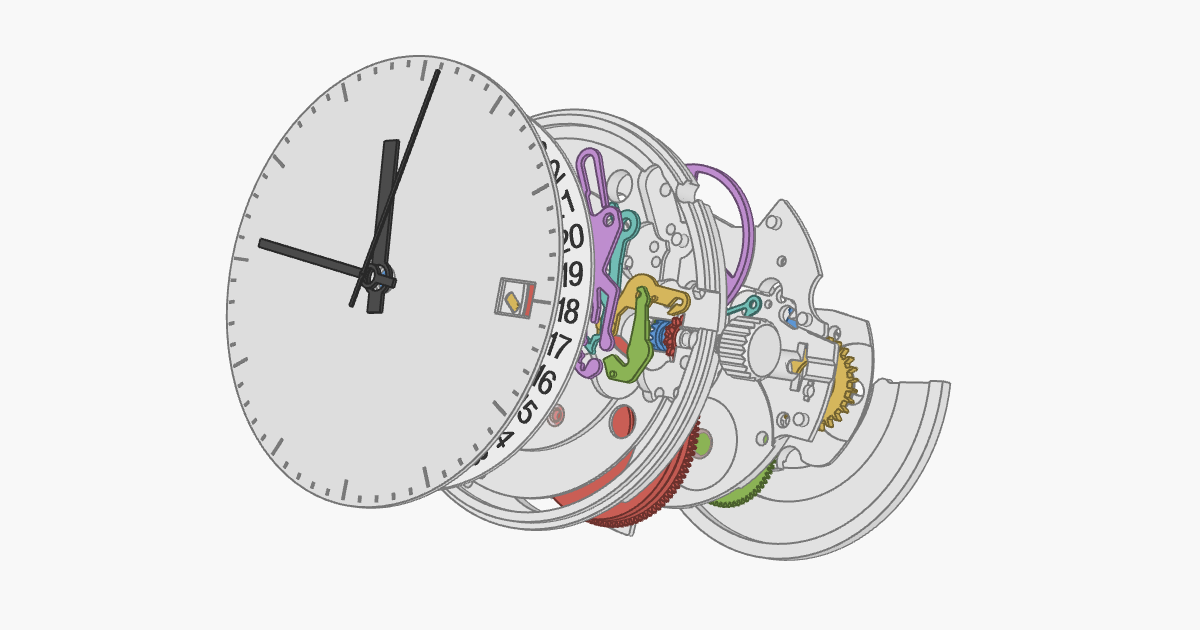
- I love that there's not only the internals of a standard three-hand, but the automatic mechanism as well. If you're going pure mechanical, an automatic is the best way. As long as you actually move during the day the watch generally stays wound up (though a twist when you put it on is a good measure). There's a ton of great watches out there powered only by walking around, and it's fascinating to look at what they can do with that.
The mechanics of a six-hand are similar, using the mechanism that is described here for the date indicator.
Another fun device, though more from an EE POV, are the solar+radio/GPS versions of the same. Automatics can hold power for a few days and need walking around to wind. Solar needs light (any light, though sunlight is always best) and hold power for over a month. Many higher-end models can self-set over radio time or GPS signals as well.
When the world goes tits-up someday, both classes of watches will suddenly become essential, and are already essential for people who spend a good amount of time "unreachable" for work or pleasure.
by ahknight - I think one of my favourite things about an automatic is that its design calls for it to be worn and not collected. If you collect them, then you'd either be wnding or shaking them when you actually want to wear them, so they aren't automatic. It forces you to wear, and therefore own, just the one, which is how it should be. I have a seiko 5 which i always wear except in the shower.by haritha-j
- I recently bought the book 'Watch Repair for Beginners' for reference (a project I slightly unwisely agreed to do).
It has some great diagrams, but obviously nothing on these interactive animations (er, naturally, since it is a book).
However the author (Harold C. Kelley) has descriptions for the diagrams similar to a maths proof - like "Warning lever W is raised in position to engage the pin P ... The unlocking lever U lifts the drop lever D ..." - not easy to follow, but maybe if you have the mechanism in front of you!
by gilleain - I find there is something indescribably fascinating with mechanical timepieces. I'm more of a clock guy than a watch guy, though I've had plenty of watches apart, and the two disciplines merge in many places. I've learned so many new mechanical skills in my now six year journey to be able to repair these things, and to learn to repair them is to learn to make them, as you need to know how to fabricate every single piece in order to be able to repair any movement, thus why clock and watch repairers are called clockmakers and watchmakers.
- Probably my favorite thing about the author's posts is that it's all handwritten, vanilla code - as far as I can tell. It seems like all the HTML, CSS, and JS are just plain, standard, universal code. It's one of the few "advanced" sites that just works on an old iPhone 7, for example. So many modern sites that use modern frameworks just don't work anymore.
Also just a huge fan of using the existing infrastructure of browsers - even older ones - in effective ways. Browsers have been quite capable for awhile now.
by harrisi - As a teacher I understand how difficult it is to explain complex topics in a simple step by step way.
The site has some really impressive technical aspects, but the educational angle is the most rare and special! The simplicity of the language and explanations disguise how difficult this is to do.
This is the original use of the internet- giving away free knowledge to people, perfectly suited for the medium of a website.
by awongh - The author seems too humble to put a giant Patreon link in a popup (it's at the very bottom), but in case anyone wants to know how to support: https://www.patreon.com/ciechanowski/membership?vanity=ciech...by turzmo
- This article inspired me to build an exploded view of a mechanical watch movement in real-life (2025): https://fellerts.no/projects/epoch.htmlby fellerts