Join the discussion

Write your take first — we'll ask for email only when you're ready to publish.

  • Hacker News
  • Okay, question because someone here might know. I have a faint recollection of reading a few years ago that prior to the current train automation system in Japan, they used to have to keep a staff of graduate students or other temp workers on standby to handle the busy periods. Am I hallucinating this fact? Does anyone know? I've tried to find the article where I read it to no avail.
  • Western trademark law really isn't compatible with the Japanese culture of noren-wake. The Japanese solution seems more beautiful and cooperative, while the western style seems intent on conflict and formenting division. Something like Tokyo Fugetsudo and Kobe Fugetsudo, where the new branch operates with the master's blessings, recipes, supply routes, teachings simply cannot exist under western rules. You must defend your trademark or lose it after all. What is sad is the Japanese are starting to adopt the western way instead of the other way around. You can look at JR and see ONE system where people work together in harmony. Even though it's really a half dozen different companies working to do their best job together. The American way would be to fight amongst each other until the greediest least moral company has defeated the others and become a monopoly to everyone's detriment.
  • It's always frustrating to read anything by most foreigners about Japanese trains.

    There are around 100 train companies in Japan. JR is 7 of those 100. The other 93 are NOT JR. Drawing any conclusions about Japanese trains from inspecting 7% of them is just wrong.

    The title, "How Japan's railways stayed one" is just false. They were never one, they are still not one.

    Take Tokyo, off the top of my head there is Toei, Tobu, Odakyu, Keio, Seibu, Tokyu, Keikyu, Tokyo Metro, ... and JR

    If you're in Shibuya. You can take JR (4 lines: Yamanote, Saikyo, Shinjuku-Shonan, N-EX), Keio (1 line: Inokashira), Eiden (3 lines: Ginza, Hanzomon, Fukutoshin), Toyku (2 lines: Den-en-toshi, Toyoko)

    Or Osaka, there's Hanshin, Hankyu, Kentetsu, Nankai, ... and JR

    Those others, except maybe 1, are all private, and have always bene private. Even JR's 7 are now private and they were originally private, there was a middle period where the government took them over. It was the period where they nearly went bankrupt, had extremely bad performance.

  • Tech industry needlessly idolizes the country, so you're unfortunately bound to read this slop until the heat death of the universe.
  • Why are you frustrated when you didn’t even read the article?
  • > "Hanshin, Hankyu, Kentetsu, Nankai"

    Also Keihan. And most, if not all, of these companies have huge land and real estate development projects generating non-rail income all up and down their lines.

  • Yeah, it's always obvious when this kind of thing is written by someone who has only ever been to Japan as a tourist, if they have at all.

    Just a deep fundamental misunderstanding of how things work.

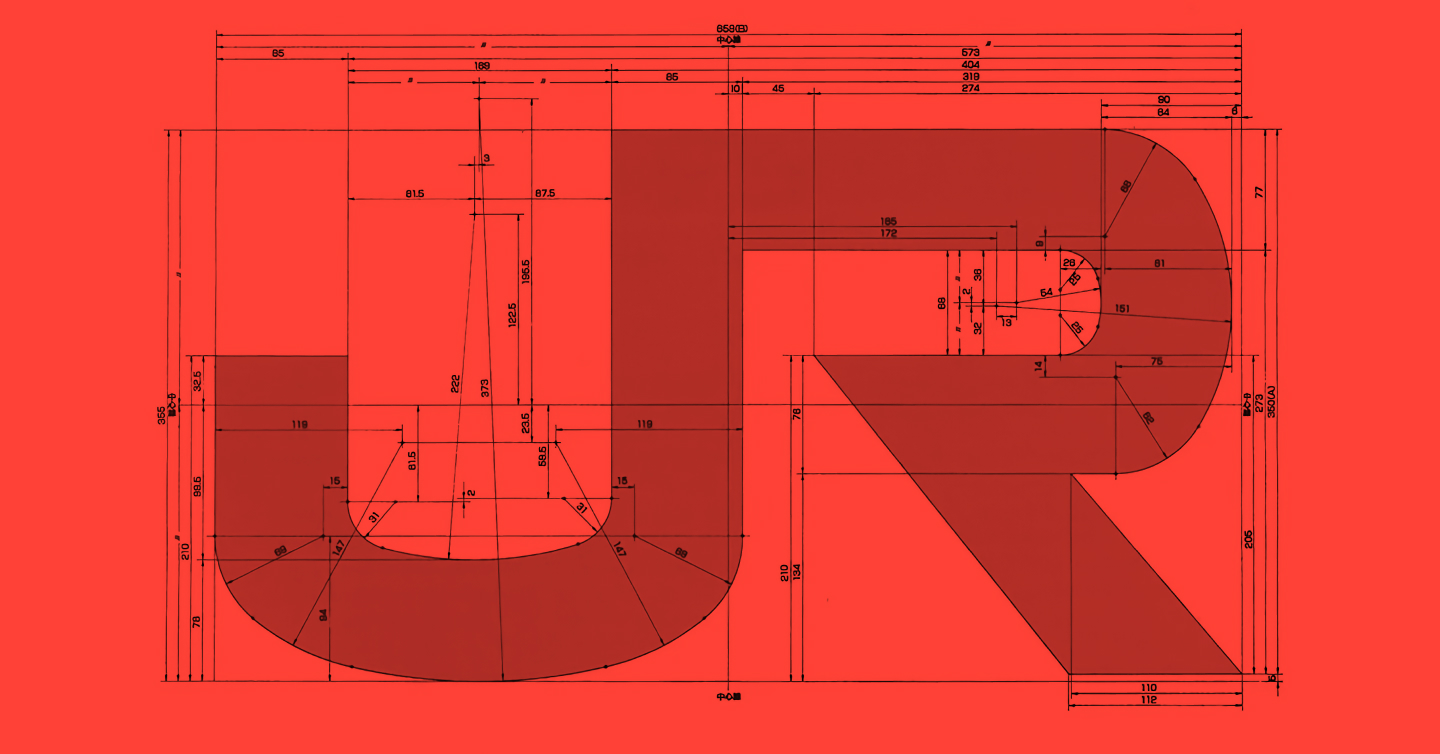
  • What does any of that have to do with the article, which is about the branding and logo of JR?
  • This article is about the JR branding and design, not train operations. The title may be overstating the case, but the content is definitely not drawing over generalized conclusions about railroads in Japan.

    Not to mention the idea that JR is only 7% of Japanese railroad makes little sense in real life. JR carries a majority of rail passengers in Japan. The long tail of non JR railroad companies in Japan are small, regional operators owning maybe one or two lines with infrequent services. Many of them are also private only in the sense that they are incorporated in the same way as private companies. But if you dig a little around you will find out they are actually owned by local governments.

    https://en.wikipedia.org/wiki/Third-sector_railway

  • > There are around 100 train companies in Japan. JR is 7 of those 100. The other 93 are NOT JR. Drawing any conclusions about Japanese trains from inspecting 7% of them is just wrong.

    JR is a whole lot more than 7% of trains (downthread you claim 38% of passengers, but even that understates things; over 60% of passenger-km are with JR).

    > Eiden

    Not what it's called lol.

    > Those others, except maybe 1, are all private, and have always bene private.

    Yes and no. Other operators are structured as private companies but often have significant public ownership, and even those that are notionally 100% privately owned often have strong ties with the political system via the keiretsu system, and always collaborate very closely with local and national governments in practice. E.g. fares are regulated, not simply set at "what the market will bear" levels; conversely the government provides a lot of legal support and subsidy for building new lines.

    by lmm
  • The U.S had the greatest rail network and then we built the Interstate Highway system and abandoned rail.

    Truth is that nobody funds multiple competing transportation network. Japan chose rail, we chose highways.

  • japan is a small island the US is one of the most extensive and biggest distance from population centers country on earth

    I tihnk that helps explain the feasiability of train on each country more than inherent choices

  • This decision makes a lot of sense from a strategic point of view, right?

    Road is much more difficult to destroy than rail

    If you had to choose one or the other, especially in a time of war/aggression, road seems to be the clear choice

  • Rail companies were rather abusive - because they could get away with it. Also, shipping freight was much more profitable/easier/simpler than shipping people. When the interstate system was being built, folks would much rather drive than ride a train (or bus for that matter).
  • The US did not abandon rail, it just used it for freight

    Europe shifts people by train, not freight.

    The US/Canada/Mexico is about 10% more than the EU, but it shifts 7 times as much freight by rail.

  • Germany has both the Autobahn and rail.
  • Rail is great when you have a lot of people or things moving on the same path.

    Highways are great when everyone has a different path.

    Japan has most (but not all) of its large destinations on the pacific coast, which works great for rail.

    I'm sure passenger rail networks used to have more routing options than amtrak does now, but it's hard to get between a lot of places by rail without going through Chicago. In the western US, you can go north/south in the pacific states or near the missisipi. Sure mountains are hard to cross, but there's no north/south in the plains either... Or Atlanta to Florida, etc.

  • Rail is hardly abandoned in the US, the US has a top tier _freight_ rail network. It's just passenger rail that sucks big balls in the US.
  • Although Japan also has extensive highways, and they're privatized in a similar way to JR (NEXCO East, West, Central) and are nearly all tolled - if you're driving alone, it's often the same price in tolls alone as a ticket on the Shinkansen (but the equation quickly flips when you more people in the car)
  • Nakanishi was opposed to treating corporate identity as just a logo and a logotype; instead, he created a framework splitting it into three layers. MI, or Mind Identity, is the philosophy, values, and vision behind a company. BI, or Behavior Identity, is how the company and its people act in the world — the kind of service they provide. And VI, or Visual Identity, is the visual expression of how the mind and behavior identities are manifested.

    A nice framework for all types of communications.

  • If you're interested in a deep dive into all this, Substack Bahn has a series on the history of JR:

    https://www.substack-bahn.net/p/aura-of-success-the-first-ye... (and note the links to the earlier pieces at the beginning)

  • Every platform at Shinjuku plays a different song when a train pulls in. There are sixteen platforms. The system started in 1989 with twelve.

    Made something to listen to all the songs - https://sheets.works/data-viz/bells-of-tokyo

  • Eki-melos are the things that I really liked about taking trains in Japan.

    The chirping bird sounds to help blind users find their way to and from the platforms is also a pretty interesting design decision.

  • Something I don't see mentioned in this article is the nation-wide adoption of a universal transit-payment system: IC Card (Suica is only one of several companies, but often used colloquially to mean train card). This makes it so easy to board any bus/ferry/train without worrying about setting up 30 different accounts each with its own card system.

    I've lived in Japan for 4 years now and it was a bit of a culture shock travelling to Germany where I had to have a different pass/app for the various buses and trains. The U.S.'s public transit buildout is slow but happening, and I worry it's falling into the same trap. I'd like to see a federal bill requiring all private/public transit to use the same universal payment scheme accepted in Japan in order to get federal funding for their projects.

  • The IC card system is one of those things people don't appreciate until they travel somewhere without it.

    I remember reading that interoperability between Suica, Pasmo, ICOCA and the others didn't happen overnight. A lot of agreements had to be worked out between companies that were technically competitors.

    It's interesting how much invisible coordination goes into making a system feel simple

  • Been wanting to write about this. The graph of interoperability agreements that makes this possible is crazy.

    My first visit to Japan, there were still places that would only accept a subset of IC cards and not all.

  • Although I'm seeing more and more public transit around the world (including Japan) adopting tap-to-pay so you can use your regular debit/credit cards.
  • I've always thought the JR logo looked like 駅, the kanji for “train station”, and assumed it was deliberate. Perhaps that was a factor in them settling on the JR name?
  • I think that's just coincidental. I've mentioned it to Japanese people before and they can't see the connection at all.
  • Here a link to the best recent HN-featured long-form article on Japan rail network. Probably spent more time with this than any other item posted here in months.

    “Why Japan has such good railways”

    https://news.ycombinator.com/item?id=47815395