Join the discussion
Write your take first — we'll ask for email only when you're ready to publish.
- Hacker News
- They have enough employees to build native apps that run super quick but are still seduced by the web portability argument which, as we all know, is mostly untrue even now and which introduces all kinds of non-deterministic latencies/errors, which cannot all be handled neatly.
To be honest, this is the same in almost all apps that have any more than 10 developers working on them (my estimate!). Death by dependencies and a lack of coherent design.
As someone else said, though, some things like fastmail work OK in the browser so it is possible.
by lbriner - Calculator taking measurable seconds to load was the last straw for me for Windows 10. Exclusively Linux at home for a couple of years now, and there's a relatively steady stream of headlines to remind me of how good a decision it was to switch away.by BLKNSLVR
- Microsoft has always been careless about performance. Two anecdotes:
A friend of mine used to work for Microsoft (long ago). One day I was complaining to him about some package that Microsoft had put out. "It's so slow!" I said. He replied, nonchalantly: "buy Intel stock. People will have to upgrade their PCs!"
Second one is from about 15 years ago. At one of the local meetups, I was chatting with a long-lost friend who worked for Yahoo. He was describing their recently-concluded Search deal with Microsoft, and how it worked in practice. This was an issue he had raised with Microsoft engineers and gotten no traction on their side. (This is all from memory). Basically, he described how a search request from an European user was handled by Yahoo Search. So, say someone goes to "search.yahoo.de" and enters a search term and it triggers a request at some Yahoo server in an EU datacenter. According to the deal, that would be forwarded to a Microsoft server, based in Virginia. Now, since the request was from EU, the Microsoft server would turn around and make a request to a MS server based in EU. Which would then respond with the search results to the MS server in VA. Which would then send the response back to the Yahoo server in EU. So, basically, 4 cross-Atlantic hops for one search request. He claimed latency figures of around 1500ms, when their internal goal was to keep latency below 300ms (after which it becomes noticeable and hurts metrics?). But when he brought up this massive latency spike to his counterparts in MS, they just shrugged it off.
by mlmonkey - Genuinely curious how quality is so poor at MS. Tech debt and deadlines and red tape?
This is the company that invented the term dogfooding and forced everyone to use Exchange until all the bugs were worked out.
I’m building a next gen web mail app at work and there are a ton of UX edge cases but the performance of the core UI is not rocket science.
I’m looking for help play testing to squash bugs, improve the last mile of performance, and to add Outlook support.
The incentive is the mail app is “malleable” so you can craft custom workflows and UI widgets to help you get to inbox zero.
by nzoschke - Started a new job, with Windows 11. notepad.exe now takes 3 to 4 seconds to load on my work system... (even after closing the last tab and reopening the program).
Hah, it even has in-app purchases, for AI writing...
by netsharc - And to think that the "old" Outlook's splash screen is there for a reason: it used to take a while to open before SSDs became commonplace! Windows in general used to be usable on HDDs; SSDs would blow everyone's pants off making everything open instantly. These days we have 20+ Gbps SSDs without the AHCI latency tax and they're no longer enough to open an e-mail.
THAT'S how low the ball has been dropped.
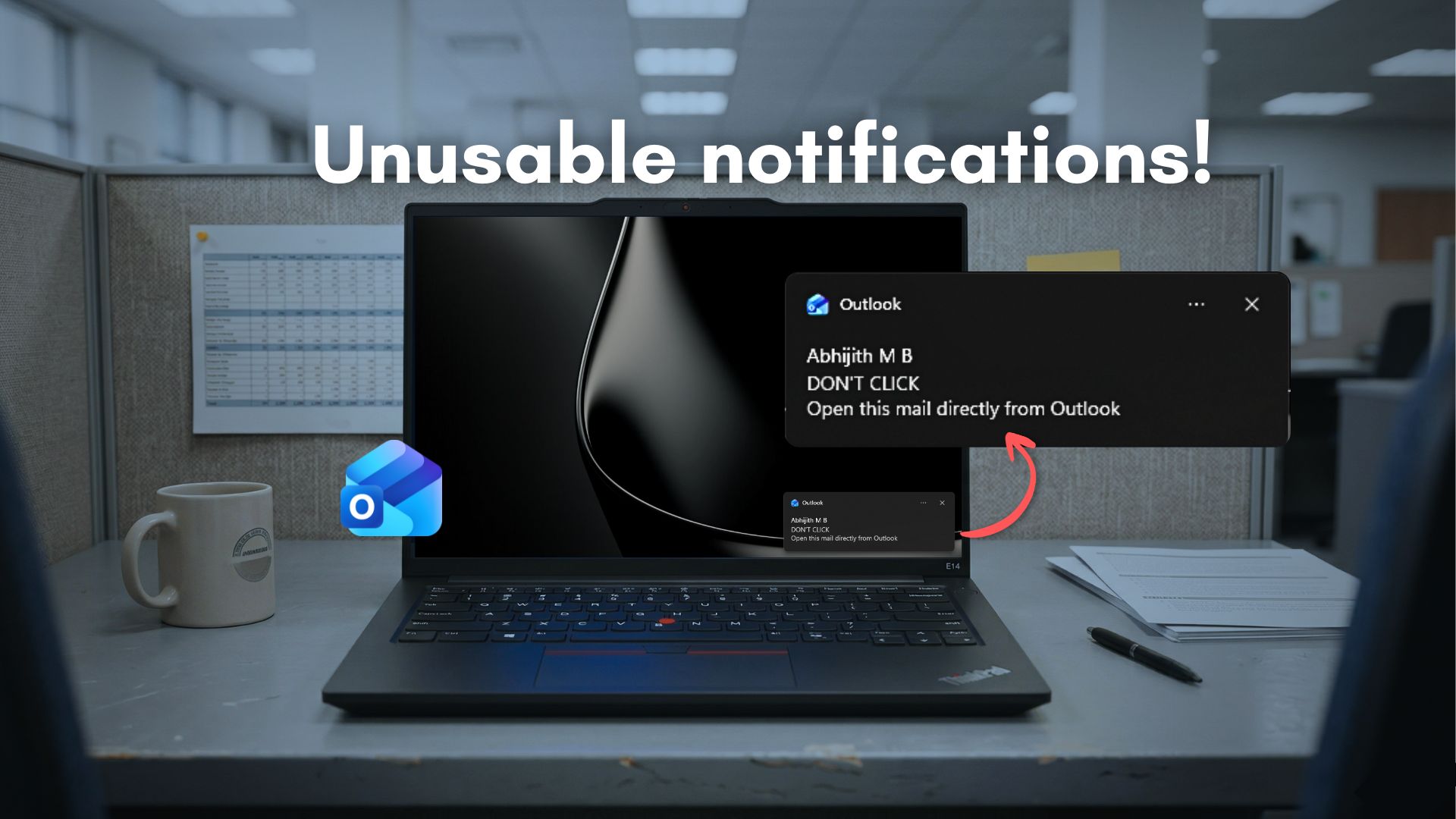
by m132 - > Outlook is based on WebView2, and like all web apps, it’s slow
Fastmail also has a web based email client, which is as fast as (if not faster than) Outlook Classic.
The new Outlook is just bad. Load order is wrong, it renders everything on every window, loads unnecessary data, etc. Plain annoying.
by patates - Up until 2019, Windows was my daily driver and had been for the prior ~20. years. I had been regularly ssh-ing into Linux machines, but it didn't seem like a place I could live. Then, in 2019, I built a PC and, wanting to get more proficient in Linux environments, I made it a dual boot setup with a Ubuntu desktop partition and a Windows partition, expecting I'd inevitably get frustrated on the Linux partition by sidequests debugging driver issues or setting up peripherals, unproductive yak-shaving stuff. I had to google a setting or two over the first couple days, but other than that, everything just worked on the Linux partition. Things opened quickly, things installed easily, and things I was worried about (e.g. nvidia and printer drivers) were either automatic or a one-time step so small I don't remember it. After a couple weeks, I noticed there hadn't been a single moment where I had to switch to the Windows partition, and a month after that I reformatted the Windows partition ssd and added the storage to the Linux partition.
If you have considered switching to Linux and worried that it would be a chore, give it a shot (if you have the freedom to choose). It has been polished and ready since at least 2019. I have to use a Windows machine for work and, like this New Outlook issue shows, MSFT has concluded most users can't or won't leave so there's no margin in improving UX and some margin in doing things that make UX much worse. I don't think I'll elect to have a personal Windows machine ever again in my life.
by modriano