Join the discussion

Write your take first — we'll ask for email only when you're ready to publish.

  • Hacker News
  • I'm reminded of the Sun Fire X4500 "Thumper" for which ZFS was originally developed. 48 SATA drives packed in a slide-out rack: https://www.youtube.com/watch?v=-zQ5RLAyA7w
  • Then-still-independent Sun sold storage appliances, and during their development and debugging it was noticed that vibrations effected performance… by yelling at the drives:

    * https://www.youtube.com/watch?v=tDacjrSCeq4

  • I am highly interested in this, especially if it works well with Time Machine to do backups over the network. I've got a fully 10GbE + WiFi 7 network w/ Ubiquiti gear already, would love to ditch my janky DIY NAS setup for something that is integrated with the rest and could potentially give me a better backup setup for my photography as well as enough storage to act as a media server.
  • Wireless Time Machine backup works until one day, Time Machine decides to shit the bed. Do not trust it. Invest in a different backup solution if your data is at all important to you. Something like Arq or Backblaze or tarsnap.
  • I have a UNAS-Pro, which runs the same Unifi Drive software as this, and it works great for Time Machine backups. Dead simple.

    I also have tons of other Ubiquiti gear, and honestly there's not a ton of synergy between the NAS and everything else. It's a great NAS though. And also, it's only a NAS. It's not an application server like a Synology NAS.

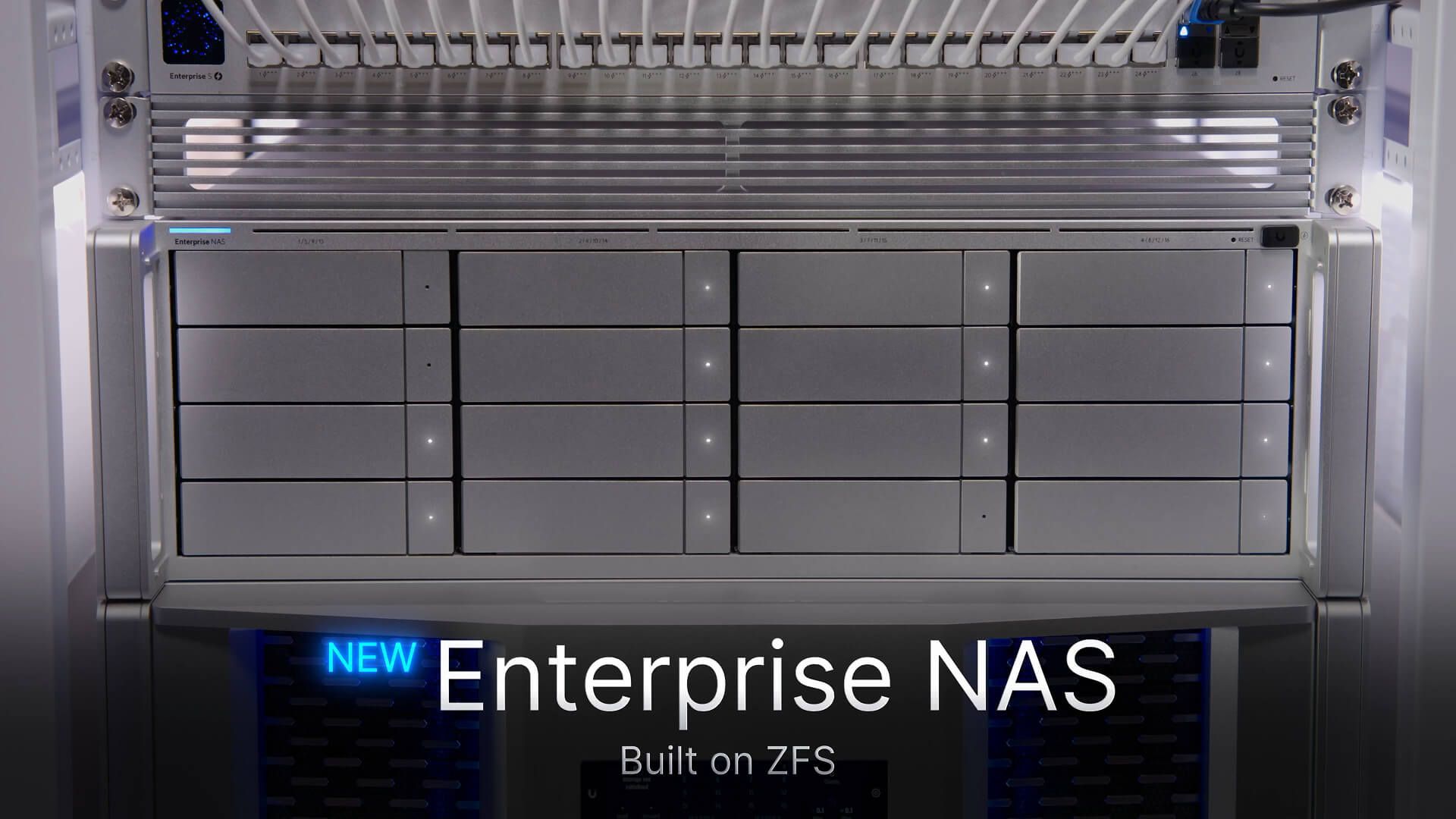
  • Is this some xBSD or UniFi OS (debian) with ZFSoL? Can't tell from what they've written. 8C+64GB: enough for essential block+file service, but not for dedup and other demanding ZFS features. Also, doesn't appear the controller is redundant; just the power supplies. iSCSI is headlined; nice they didn't limit this to file. No mention of object store, or NVMe-oF.

    Seems like a nice, basic, affordable platform for workgroup/SME stuff. Not NetApp/Pure Storage "enterprise" grade though.

  • Their other UNAS devices are based on debian11. I'm curious what the bootdrive on the ENAS runs since ZFS is dkms on debian
    by JP44
  • Could be Linux as well since ZFS on Linux is pretty good now. It would fit in with their other devices which are also Linux based AFAIK.
  • They seem to follow the anti-corruption layer model for most of their offerings, so I would expect they use what ever OS is best supported by the upstream.

    It is a large reason they can mitigate vendor risk IMHO, offering different tiers of switches as an example without being held hostage by on particular switch IC vendor like many brands.

    I do wish someone would take up comstar though, netapp bought and killed several jbod lines etc… to kill it before Oracle bought Sun and also killed it to protect their enterprise storage offerings.

    NVMe-oF may be a possibility because there are FPGA IP vendors but without comstar there are some challenges IMHO.

  • Ubiquiti is an interesting company. It seems to be well-managed

    https://krebsonsecurity.com/2015/08/tech-firm-ubiquiti-suffe...

    https://krebsonsecurity.com/2015/06/crooks-use-hacked-router...

    https://www.bankinfosecurity.com/ubiquiti-insider-hacker-sen...

    https://www.theverge.com/2021/3/31/22360409/ubiquiti-network...

    https://www.bankinfosecurity.com/ubiquiti-insider-hacker-sen...

    https://www.theregister.com/security/2022/03/30/ubiquiti-sue...

    In the case of the fake whistleblower, it sued a journalist for defamation but its counsel could not spell the word "damning"

    Was it meritless. Would it have been dismissed for failure to state a claim

    If yes, this might explain why Ubiquiti agreed to a stipulated dismissal

    https://dn721900.ca.archive.org/0/items/gov.uscourts.vaed.52...

  • 2,-1,2
  • I was literally looking today to see if there was any news on this, because it’s been widely assumed that they’d release it.

    $4000 is… a lot. I can buy a used CSE-846 for about 1/4 of that, an X10–era mobo for a few hundred bucks, and have 1.5x the bays (tbf, also 4U instead of 3U). Managing ZFS is just not that hard; it’s not Ceph. If you want easy mode, throw TrueNAS on it, and you’ll get an awesome UX that abstracts away everything difficult.

    If this were < $3000, I’d probably buy it. I’ve been holding off on replacing my two CSE-826 because I’ve been waiting for this to come out. Disappointing.

  • I recently bought a used Dell R240 and 4x 20TB for less than this. From TechmikeNY if anyone's interested.
  • Think about the competitors - they're aiming at the Synology RackStations and similar, which are $3-5k without drives.

    The segment UI and Synology are in are 10x more than the minisforum, beelink, qnap, cwwk type devices, but still 1/10 of the price of getting started in enterprise gear from HPe, Dell, Pure, etc.

    by 9x39
  • This is not a homelab replacement part. It’s enterprise with all the positive and negatives that come with that phrase. The second you start talking about old X hardware, it’s a different product class.

    For that use case I recommend UNas from ugreen or the minis forum ryzen Ai stuff.

  • “Enterprise”

    First hand experience many times over: there is little more regrettable than placing Ubiquitis latest test-it-in-prod release in to an Enterprise setting.

  • UI is so overrated.
  • I mean it's all prosumer grade stuff. I get hassled at work to sell their network gear over Cisco and Aruba because of the price but it's a flashy and cheap.
  • https://app.opencve.io/cve/?vendor=ubiquiti

    Yeah, that's the kind of people you want to be running your company's storage appliance.

    Tons of those are pretty basic web security stuff. Nearly as bad as TP-Link, a bargain-basement brand.

    Compare and contrast:

    https://app.opencve.io/cve/?vendor=freenas

    https://app.opencve.io/cve/?q=vendor%3Aproxmox

    Proxmox's record in 2025 wasn't particularly great but it's a hell of a lot better than Ubiquiti's. And before someone starts complaining that it's not a fair comparison because Ubiquiti has so many more products: they have a unified OS and management tools. They also have orders of magnitude more revenue and can afford far more in engineering resources.

  • > with ... no firmware restrictions on drive models, organizations can scale capacity without being restricted by proprietary hardware ecosystems.

    This looks like a dig at Synology, who do this.

  • Synology also don't (didn't?) offer a ZFS product, which is why I bought a QNAP. Restriction-free and ZFS storage. Apparently you can also completely replace the OS if you want, although I haven't tried it.
  • They did it for a very short time. The community backlash was so bad that they recanted immediately.

    I'm not at all surprised that Ubiquiti is getting ahead of that and promising it from the start.

  • Pays for itself in ~40 months of not paying $100/month for streaming services.

    Edit: Drives are not included :(

  • That seems reasonable, I don't buy NAS for datacenters (just run a modest 80tb one for my home lab) but equivalent rackmount 16-bay ones from other vendors would be more expensive (maybe $5k-6k?) and with less polish.
    by mpeg
  • > "Dual 25 Gigabit SFP28 ports and redundant power supplies for resilience"

    Can you actually saturate the links with the spinning drives?

    I've had the hardest time making my TrueNAS ZFS server fast when it was filled with HDD spinning disks. I initially also had 12 of them trying to get maximum speed. I have 128GB RAM and a 10G ethernet connection. I tried all types of optimizations like L2ARC via NVMe, etc, and it wasn't very effective and just too much time spent tweaking and testing.

    Instead I just threw up my hands and replaced all the spinning disks with NVMe drives for the data I actually shared (8x 4TB NVMe drives.) And now it very usable and no need for LRArc, etc. Random or streaming access is equally fast.

    Best choice I made. Now I did do this over a year ago so I skipped the NVMe price inflation.

    I still keep 4 spinning disks but it is for archival data that I expect to never access unless something bad happens. It is slow and I use it like a tape drive.

  • With NVMe-oF and RDMA I can saturate a 25G link with spinning disks easiliy with around 16 drives.
  • with the zil/slog on nvme yes -- you would want redundant power, UPS and a raid of nvme drives but with all that in place the data would get securely written to flash media before being flushed to spinning rust.
  • > Can you actually saturate the links with the spinning drives?

    I can mostly saturate my toy 100gbit link with it on read (to memory, since the other side also needs to not be the problem). Just for as long as it's already in the ZFS cache (which can be huge with in the hundreds GB of ram in servers in general). Not in practice since when you hit the disks you take a massive penalty, but then again, it can be done.

  • Made me think of this:

    I got a 10G ethernet network card for my NAS only to realize it has to overlap with my modem's supported bandwidths (IIRC 2.5G, 5G).

    Knowing nothing about the space, I had assumed it would use max(node1, node2), but instead it negotiated a 1G link. So it was faster to use the mobo's built-in 2.5G port.