Join the discussion
Write your take first — we'll ask for email only when you're ready to publish.
- Hacker News
- Permanent and global boycott of Samsung due to them shoving ads into smart refrigerators.
They’ll keep pushing till you push back.
by tim-tday - Good luck with thatby zuzululu
- Just don't buy smart refrigerators. They make other very good products.by UltraSane
- Basically every smart fridge they make has an equivalent (nearly identical) non-smart variant. You don't need a smart fridge, you don't need a screen on a fridge at all.
As an aside, my old Westinghouse fridge shows me ads. The ads arrive in my mailbox and then I put them on the fridge with a magnet. One of the ads on my fridge at the moment is for Dominos.
by King-Aaron - by BiraIgnacio
- Thanks! we'll put that in the toptext too.by dang
- so whats the implication for average joes here ? have no idea what these technical terms mean....by zuzululu
- Computer chips go fasterby edward28
- Making chips smaller is very hard at the nanometer sizes, and it requires the kind of expert equipment made by one single Dutch company (ASML) and expertise only the likes of Taiwan's TSMC have.
Stacking means keeping the same size, but adding more of it so it matches the same compute power as the more advanced smaller chip designs.
China (who is banned from buying from ASML) is currently pursuing stacking as a short to medium term strategy until they can catch up to TSMC.
by khurs - This seems like it could accelerate the transition to sub-1nm nodes (previously projected to mid 2030s), maybe by the end of this decade.by armitron
- Why does it seem like that?by guerrilla
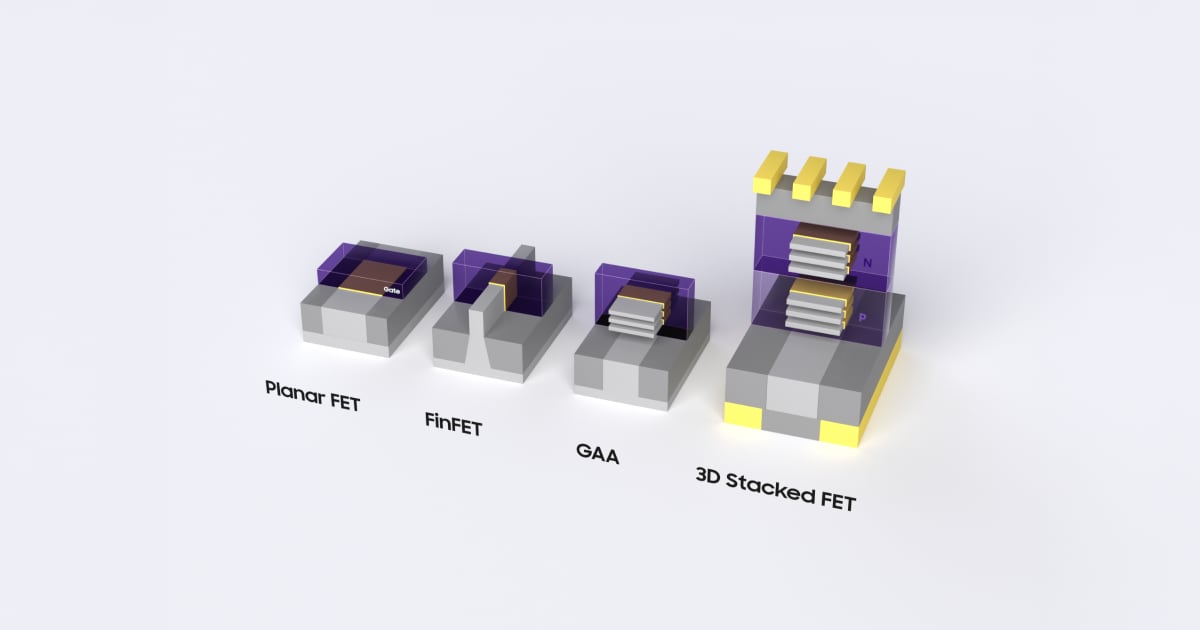
- > A city provides a useful analogy. When available land becomes scarce, urban planners initially reduce the spacing between buildings and use roads and open spaces more efficiently. Eventually, however, further horizontal expansion becomes impractical. At that point, the solution is to build upward. High-rise buildings create more usable space on the same piece of land by utilizing the vertical dimension.
Really? someone tell that to my city
- It only works for cities designed from the ground up for such density, simply because of all the supporting infrastructure that humans need (utilities, roads, public transport, education, entertainment, recreation).
Retrofits are insanely expensive and often fraught with issues.
by mschuster91 - How about heat? Seems these days it's the heat above everything else that's the issue. And more density would only aggravate it.
- I wonder if the proposed CPU/GPU laser cooling technique that was on here a few days ago would penetrate the Si layers?by ortusdux
- If heat is produced by conductors resistance then shorter paths would lead to less heat produced.by deepsun
- What you loose in heat you gain in speed caused by proximity. Perhaps this will allow for lower voltage and thus less heat.by arein3
- That's always an issue, but the industry seems to be moving away from 2D circuits.
Reducing trace length seems to be the way forward for faster/larger circuits. Signal propagation time on-die is becoming an issue.
Things like Huawei's Logic folding, or TSVs, and so on, attack the issue by reducing signal travel time.
This looks like another building block in that direction.
There's also some push at cooling chips from both sides.
by juancn - Heat is mostly driven by leakage current and gate capacitance.
The big issue today is leakage currents. They typical account for around 30%-50% of total chip thermal budget, and they get increasingly difficult to control with smaller devices and lower voltages. They're also get worse with increased temperature(!).
The stacked devices here aren't the worst for leakage currents, but they're not fantastic either. Look at the 2nd graph in section 5: You'll see that the current never drops to zero over the range of gate-source voltages (for V_DS=0.7V). The minimum point is the best-case leakage current, and you can see it's well above zero! (The units on the vertical axis of the graph are unknown btw: The label reads as "current drain-source, arbitrary units")
by mota7 - > By stacking multiple nanosheet channels, the effective channel width can be maintained even within a highly compact footprint.
The fact that this level of precision can be achieved on 300mm wafers over many dozens of separate steps in separate devices is an insane achievement on its own.
by mschuster91 - A much greater achievement than training frontier models, or building any kind of software stack, if you ask me.
Yet everybody seems to think the moat is with the AI companies or nvidia.
by amelius