
Join the discussion
Write your take first — we'll ask for email only when you're ready to publish.
- Hacker News
- To spare the ones that still didn’t lose all their good sense to have to go through the all article. It ends with trying to put Trump in the same bucket as Pol Pot and Sadam Hussein (this is all so tiresome).
So, it seems clear this film does have a side to pick and will be of dubious accuracy.
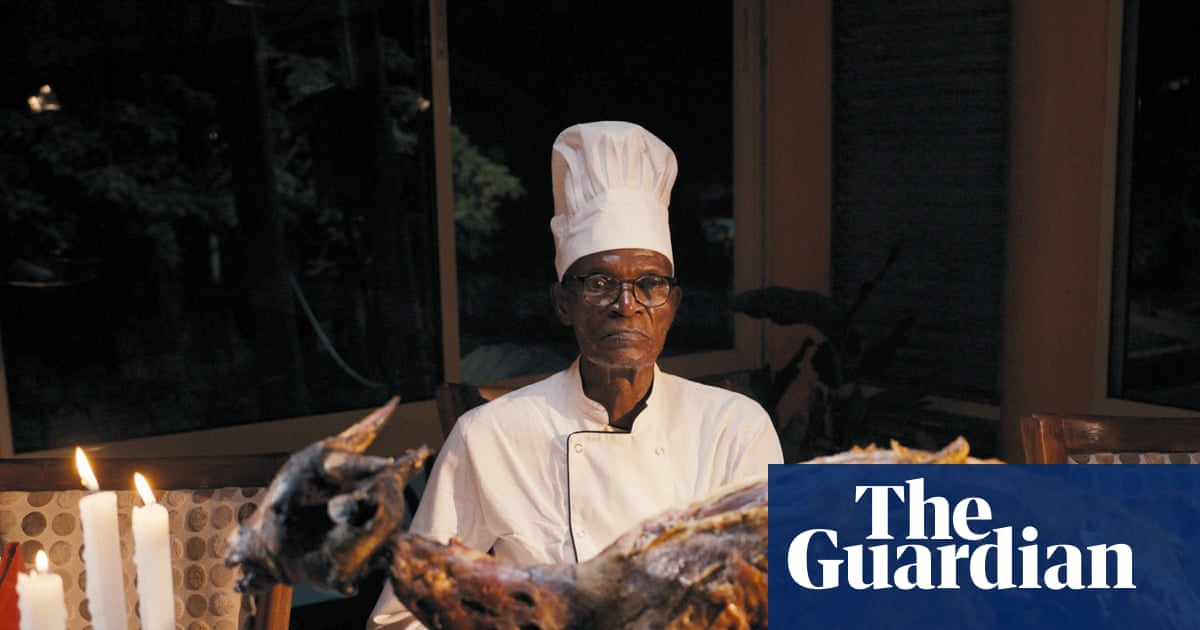
“Neel did give some thought to including Donald Trump in his film – even though, “to be clear, he is not a dictator,” he says. “He wants to be one, but he’s not. I did find a chef who cooked for him before he got elected.”
by mbmbn - But maybe he belongs in this bucket, tiresome or not.by brettermeier
- See also https://en.wikipedia.org/wiki/The_President's_Cake , which is nominally about cooking.by esafak
- Not the original titleby sublinear
- In the case of book reviews (and film reviews, I guess) we often change the title to that of the book/film being reviewed.
We started doing this years ago after realizing that book review titles often do pirouettes on top of the book being reviewed; it's kind of a minor art form (a very minor art form!) but it doesn't serve the reader who just wants to know what-is-this.
I wouldn't call the OP title a pirouette, but the pattern of following HN's original-title rule through an extra hop (from the review to the thing being reviewed) has held up so well that we do it pretty consistently now.
It's amazing how many sub-cases like this there are. Who would have thought that reviews need to be handled differently from non-reviews, but it actually does work better.
by dang - This is one of the most unexpected ecranisations ever. The book is great on its own, but I would never assumed it could become a film. The topic itself is a bit heavy, and I somehow assumed that most of the people pan Szablovski interviewed at one point or another are already dead. This is going to be a fascinating watch.by okaleniuk
- > “It goes back to Hannah Arendt’s banality of evil a bit,” says director Andrew Neel. “These everyday things that are beloved to us, like food, can take on an entirely different dimension within the context of a dictatorship.”
That’s not at all what Arendt was writing about. She was writing about those who do evil things are rarely the “evil” monsters we imagine but rather bureaucrats motivated by things like promotions. Hard to remain motivated to consume an article after reading this in the opening.
by ashalhashim - Also I have to wonder why this made to the front page of a tech forum. One of the things I used to love about HN was that it was free of politics. These days it seems like there's just political propaganda everywhere in the guise of being relevant to tech. Hope HN doesn't become another political echo chamber like Reddit.by neya
- That’s exactly his point about the motivations of the chefs. It’s not identical, but close enough.by dash2
- Why? It seems like you take umbrage with a particular quote, but you understand that the author of the article didn't make this statement, right?by dfxm12
- Tangential point but just to be clear, Ardent's book is a journalistic work not something that is proven or widely accepted. There are many who disagree with this idea that Einchman was just a simple person who took orders since there are several documented events where it's clear that he was a piece of shit nazi and fully embraced the role.
> In Eichmann Before Jerusalem (2014), the German historian Bettina Stangneth reveals another side to him besides the banal, seemingly apolitical man, who was just acting like any other ‘ordinary’ career-oriented bureaucrat. Drawing on audiotapes of interviews with Eichmann by the Nazi journalist William Sassen, Stangneth shows Eichmann as a self-avowed, aggressive Nazi ideologue strongly committed to Nazi beliefs, who showed no remorse or guilt for his role in the Final Solution – a radically evil Third Reich operative living inside the deceptively normal shell of a bland bureaucrat. Far from being ‘thoughtless’, Eichmann had plenty of thoughts – thoughts of genocide, carried out on behalf of his beloved Nazi Party. On the tapes, Eichmann admitted to a sort of Jekyll-and-Hyde dualism:
I, ‘[t]he cautious bureaucrat,’ that was me, yes indeed. But … this cautious bureaucrat was attended by a … a fanatical [Nazi] warrior, fighting for the freedom of my blood, which is my birthright… Arendt completely missed this radically evil side of Eichmann when she wrote 10 years after the trial that there was ‘no sign in him of firm ideological convictions or of specific evil motives’. This only underscores the banality – and falsity – of the banality-of-evil thesis. And though Arendt never said that Eichmann was just an innocent ‘cog’ in the Nazi bureaucracy, nor defended Eichmann as ‘just following orders’ – both common misunderstandings of her findings on Eichmann – her critics, including Wolfe and Lipstadt, remain unsatisfied.
https://aeon.co/ideas/what-did-hannah-arendt-really-mean-by-...
by altmanaltman - I don't see a misrepresentation there - the need to eat and the love of good food is common to most of humanity and points to the fact that even dictators are also just people. Banal humans rather than cartoon villians.
> Hard to remain motivated to consume an article after reading this in the opening.
I think it's unfortunate to be so dismissive of an article over one quote from one person that you disagree with. You can still get something out of the piece if you open your mind a bit.
by danparsonson - Later:
> By most measures, theirs was a great gig – logic that can excuse almost anything. “Saddam’s chef got a car every year,” Neel says. “That phrase, ‘it was a great gig,’ I think, actually runs the world. Like, ‘It was just business.’”
I’d say they understood the meaning.
by namuol - This is an interesting article backed by months of hard work. It offers perspectives we probably won't find anywhere else. The quote is pretty tangential.
I see this over and over again on HN: pick the weakest sentence, attack it, proclaim the article is rubbish, and move on. Why? There are no internet points awarded for maximum drive-by cynicism.
by zerobees - Hannah Arendt's 'banality of evil,' as I understand it, refers to human beings who are incapable of thinking. Within a massively bureaucratized and divided system, the immense guilt of killing someone is broken down into tiny, mundane tasks, like stamping a document. Because the system absorbs all individual moral friction, ordinary people can become cogs in a vast machinery of evil without ever questioning it. (In other words, the individual is not morally evil, but the system is designed to break things down so thoroughly that it renders those parts mindless, and that is the truly frightening part.)
In that sense, I can understand part of what the article is claiming. The phrase 'it was a great gig' seems to be the core of what it was trying to say. The high salary, the Mercedes, the abundant food supplies all point to the fact that the source of that funding came from the dictatorship.
An individual can be moral, but the system numbs them. That is why evil is not interesting; its desires are too simple. Wanting to earn more money, wanting to beat someone else, becoming consumed by such things. But in that regard, good is interesting. Because it means overcoming one's own contradictions, striving for the greater good, or even sacrificing one's life for the sake of everyone.
by jdw64