
Join the discussion
Write your take first — we'll ask for email only when you're ready to publish.
- Hacker News
- Hopefully they can also find a good balance between using cheap parts to actually being safe and comfy. The cheap EVs on the market normally lack in one of these. I have not yet found any interior shots online, did any of you?by avocadoking
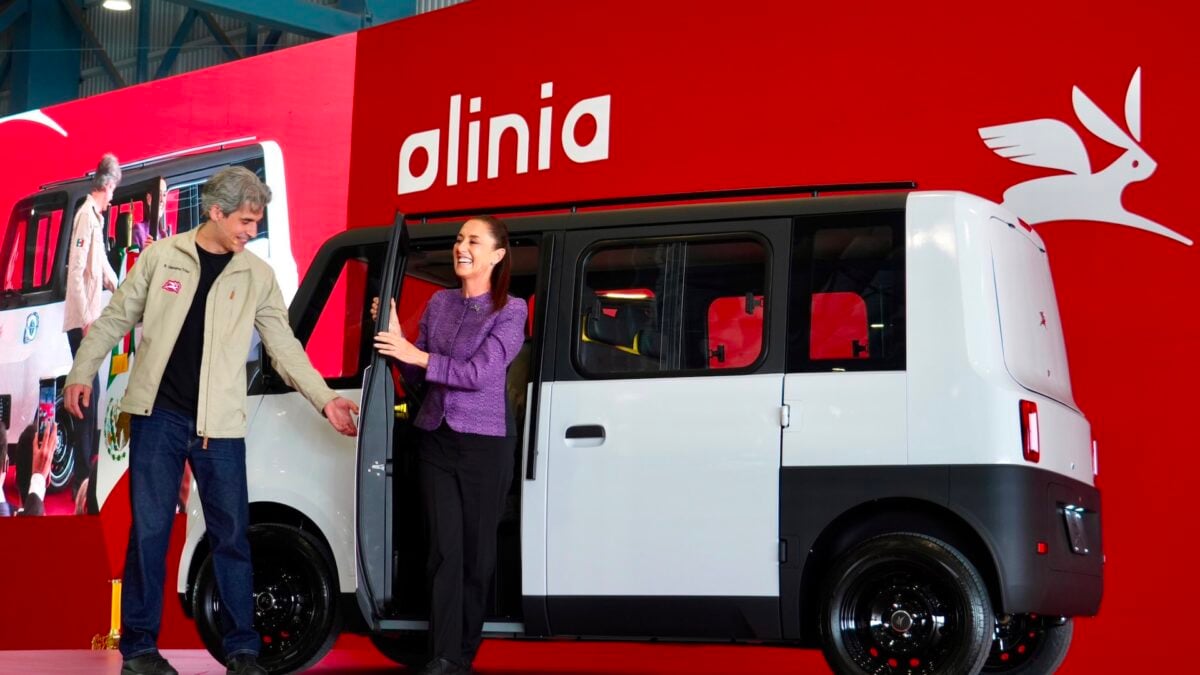
- There are a couple of partial interior shots on their home page: https://www.olinia.auto/by timbit42
- How foreign competition helps domestic firms: https://capx.co/how-foreign-competition-helps-domestic-firms
- This vehicle is what most Americans would call a "golf cart". If it doesn't have safety features and can't be driven on highways, it's not really competing with normal cars, so I'm not quite sure the article's analysis makes sense.
- It makes 100% sense for a Mexican commute, or in other parts of South America.
I live in Uruguay and one of the best selling cars here is pretty similar, a friend has it and it's great for the daily commute:
The best sellers are BYD models, which are a bit larger but still tiny by US standards.
https://en.wikipedia.org/wiki/BYD_Seagull
EVs have displaced ICE cars in Uruguay, and we usually are ahead of the trends, so I expect that to be the case in Europe and other places in coming years.
by GFischer - There is no way Olina will make it to market. It is another of the demagogic populist government's projects.by 725686
- Personally, I'm very happy about the increasingly competitive EV market. Hopefully they will start exporting those to the British market. Don't we all love cheap things?by derelicta
- My first thought when looking at it is that I doubt the vehicle could pass US safety regulations. Maybe I'm wrong.by elgertam
- Based on similar vehicles in Europe, it's probably not a car but some sort of motorcycle.by Symbiote
- In Europe these kinds of vehicles are treated as micro vehicles. You don’t even need a driver licenses.
https://insideevs.com/news/401218/citroen-ami-deliveries-jun...
by rawgabbit - Hoping this brings EV infrastructure up in the country. A road trip is still quite an ordeal due to the lack of fast chargers in highways and maybe that's why the range on the first version of Olena is low, as it's aimed to provide "ultra mobility" within cities and not outside of it but still, glad to see the MX government invest into renewable technology.by marinhero
- Would this be enough range for a typical bit of driving in CDMX? Seems like a painful road trip car, but you don't need so much range for a city car.by mekdoonggi
- I hope we don't see these on any highways. They can only do 50 kph.by timbit42
- "The car’s unvieling comes as some countries around the world continue to push EV adoption with better and more affordable options. The U.S., however, has taken the opposite track."
Lol, so true. I honestly don't mind waiting for an electric car since I hope to get more mileage out of my current one. If it lasts 10 more years, all the better.
The cars available then should be far better (other than new things I might not want- e.g. more automation).
by initramfs - > Ford CEO
I wonder how this compares to the late '60s and through the '70s, when small, higher-mileage imports were eating the US car manufacturers' lunch. It feels more existential, but maybe not?
by gcanyon - Here is the company's website:by dotcoma
- It makes a lot more sense seeing the image where they place it between a car and rickshaw/tuktukby sct202
- I think people are misunderstanding. This is a car for Mexico, nothing to do with the US.
On the website it says it's a car "designed in Mexico for Mexico" https://www.olinia.auto/
by lentil_soup - It's funny how we Americans jump to judging this vehicle by our own needs.by stvltvs
- > It remains to be seen whether the Olinia One will face similar pushback from the U.S. once it goes on sale.
> can travel up to 125 kilometers (77 miles) on a single charge
The US market generally rejects small-range EVs, except in very niche markets. In order to succeed in the US, it will need roughly 3-4x the range. In order for this to succeed in Mexico, their market will need different driving habits than the typical American.
(I know this as a former 2014 Leaf lessee. Short-range EVs only make sense when they are the only option in my price range, and I really, really want to drive an EV. Maybe the typical Mexican rarely drives far away from home? Or maybe this is for a niche of Mexicans who really, really want an EV and will tolerate a short range?)
by gwbas1c - This car is explicitly intended as a taxi. If - and it's a big if - the taxi can charge while waiting for jobs, that's going to be fine.by pjc50
- > can travel up to 125 kilometers (77 miles) on a single charge
This would be a big hit in European cities. I own VW e-Up! and it's a perfect EU city car. With it's 375KM range, I rarely charge it more than once a month.
by FlyingSnake - I was thinking it would make a good candidate for city taxis and other such urban usesby friarpuck
- Even a used Nissan Leaf with degraded batteries is a viable vehicle in many U.S. cities. I would not call these markets "niche", there are many mid-large metropolitan population centers where they are practical. To use "niche", is either a political denial or ignorance of the population distribution of the United States. They are popular where I live, I drove one as a primary vehicle for 8.5 years, and I have purchased another used Leaf for my teenager. The empty pickup truck is also a "niche" vehicle with this usage -- it clearly isn't an appropriate choice for every driving need and locale.by waffletower
- The limits on range and speed (reported 50kph) would make it a horrible deal for the average American.
150k pesos (~$8.6k) for a brand new wheelchair-accessible city van seems like a killer deal in the Mexican market. That would come on the market for less than a used air-cooled VW beetle (ended production in Mexico in 2003)
- "The car is designed for urban settings and has a top speed of 50 kilometers (31 miles) per hour."
I don't think range will be an issue at that speed tbh.
Cool little transport but not really a "car" in the way we think of them.
by CalRobert - This new EV is to replace motorcycles and scooters that are ubiquitous in mexico. If it succeeds in getting 100k people off of motorcycles it will have the side benefit of reducing healthcare costs treating motorcycle accidents.by fajmccain
- I know absolutely nothing about Mexico in terms of geography or driving so I wonder how feasible an EV that you presumably constantly have to charge is going to fare. In the US, a range of 77 miles is a complete non starter. You'd have to charge it every single day. If not multiple times a day in some peoples cases.
It's interesting that info about the car is only half the article. The other half is a commentary on how US politicians are desperately trying to keep foreign EVs out of the country, lest it hurt corporate profits.
by Rotdhizon - The Ford CEO is not wrong. Allowing foreign imports into the country at prices far below what US producers are able to make will decimate the local car industry in the US.
There are 4 possible solutions to this problem;
a) convince Americans that it's worth paying more for a locally built product. This is the simplest approach, but there's only so much margin here that the consumer will tolerate. At the moment this gap is too large.
b) Tariff foreign imports to raise their cost. So the US consumer pays more, whether they like it or not.
c) subsidize local production out of the "national interest to support this industry" budget. This has the effect of ramping up demand, hence production, hence production being developed, and eventually getting cheaper.
d) improve US products, and prices, so that they compete in price to the import - or at least fall inside the margins such that a) becomes effective. c) can help bridge the gap here until the US companies have caught up.
In the long run, not all these strategies win. If you go the tariff route, then it's hard to undo it later. Local products fall behind, and the harder it becomes to catch up. Not impossible, but hard.
If Ford wanted tarrifs to help boost EV demand, and so allow Ford to build out infrastructure and lower costs, then fine. But it seems it's more of a short term play to just keep ICE Fords selling in the short term.
This is one of those "the internet is a fad, it'll never catch on" moments. EV's are here to stay. They're going to win. That's pretty obvious to anyone paying attention. If the question is "how to maintain the US car production" then they should be all-in on EV development now. It seems to me though that the current strategy seems to be very short term thinking - trying to just hold back the tide.
by bruce511 - None of these strategies seem to address the other technological issue hiding beneath the surface, which is that EVs are fundamentally simpler (electric vs combustion motor) and hence should be cheaper than ICE cars when manufacturing pipelines are mature. This would result in lower profits across the car industry even in the absence of international competition. No US manufacturer so far has actually tried to build EVs cheaper than gas cars at scale (Tesla made a little noise and then got distracted), while Chinese manufacturers have no need to worry about cannibalizing the comparatively small domestic ICE market.
Letting the industry guide policymaking seems like it could lead to regulatory capture preventing EVs from reaching the (low!) price points that they should reach. Already the two-track emissions standards and chicken tax make cars too big and the "arms race" of having a bigger car than everyone else to stay safe (at the expense of others) prevents meaningful reform.
by scythe