
Join the discussion
Write your take first — we'll ask for email only when you're ready to publish.
- Hacker News
- I never looked into this, but why would a datacenter consume water for cooling in the first place? Sure, they use some. But just like you fill up the cooling loop in a car, once it is there it just circulates between the heat source and radiators and/or heat exchangers, with perhaps some minimal top off needed (since flexible tubing isn't 100% water proof).
Or are they for some unfathomable reason using evaporative cooling in data centers?
by VorpalWay - At the scale DCs are operating at, losses from flexible tubing are not negligible either.
1gw of power converts approx 400 liters of cold water into steam _per second_.
by danielheath - Yes, they are using evaporative cooling.by 1e1a
- Evaporative cooling is practically a cooling cheat code. Why unfathomable? What's more efficient?by 2OEH8eoCRo0
- the unfathomable reason is that it is significantly more energy efficient.by derac
- It’s very efficient. The net electrical energy saved using the latent heat of water is 30 to 100+ times greater than the energy required to desalinate or wastewater recycle the same volume of water.by dsp
- (ab)using fresh water in vast quantities is cheaper.
currently.
and also more energy efficient, because evaporating water away takes a lot of energy with it. you have to raise radiators to a higher temperature to keep up with that, or have much more surface area.
by Groxx - It’s usually open loop - closed loop, so closed loop goes through CRACs or liquid cooled equipment manifolds. That heated water circulates through an heat exchanger on the roof that uses open loop cooling to shed the heat to the surrounding environment.by rnxrx
- Evaporative cooling consumes less expensive electricity than air conditioning. Electricity is much more expensive than water (for the same cooling load) in most places DCs are located.by loeg
- Water use isn't a myth.
Our data center is mostly air-cooled, with 100F hot aisles and chilled water going to heat exchangers in every third rack position, although some of our newer GPU racks use chilled water directly. For most of the year that means we don't need chillers - the warm water return is sufficiently hotter than outdoor temp that heat "flows downhill" with a bit of pumping.
But we use an evaporative cooler to carry that heat away outside, because it's more efficient. If you look up the heat of vaporization of water, that means we evaporate about 10,000 gallons of water per day per megawatt of power dissipated. We're on canal off a large river, and we don't dissipate all that many megawatts, so I believe the water use isn't significant.
Using air as the working fluid to draw heat from your machines has a limitation - humans have to breathe that air whenever they work on the equipment, so the temperature is limited. Once the exterior temperature nears your hot aisle air temp, you either need active A/C to create a heat source hotter than ambient, or an evaporative cooler to lower the "effective" ambient temp to the dew point.
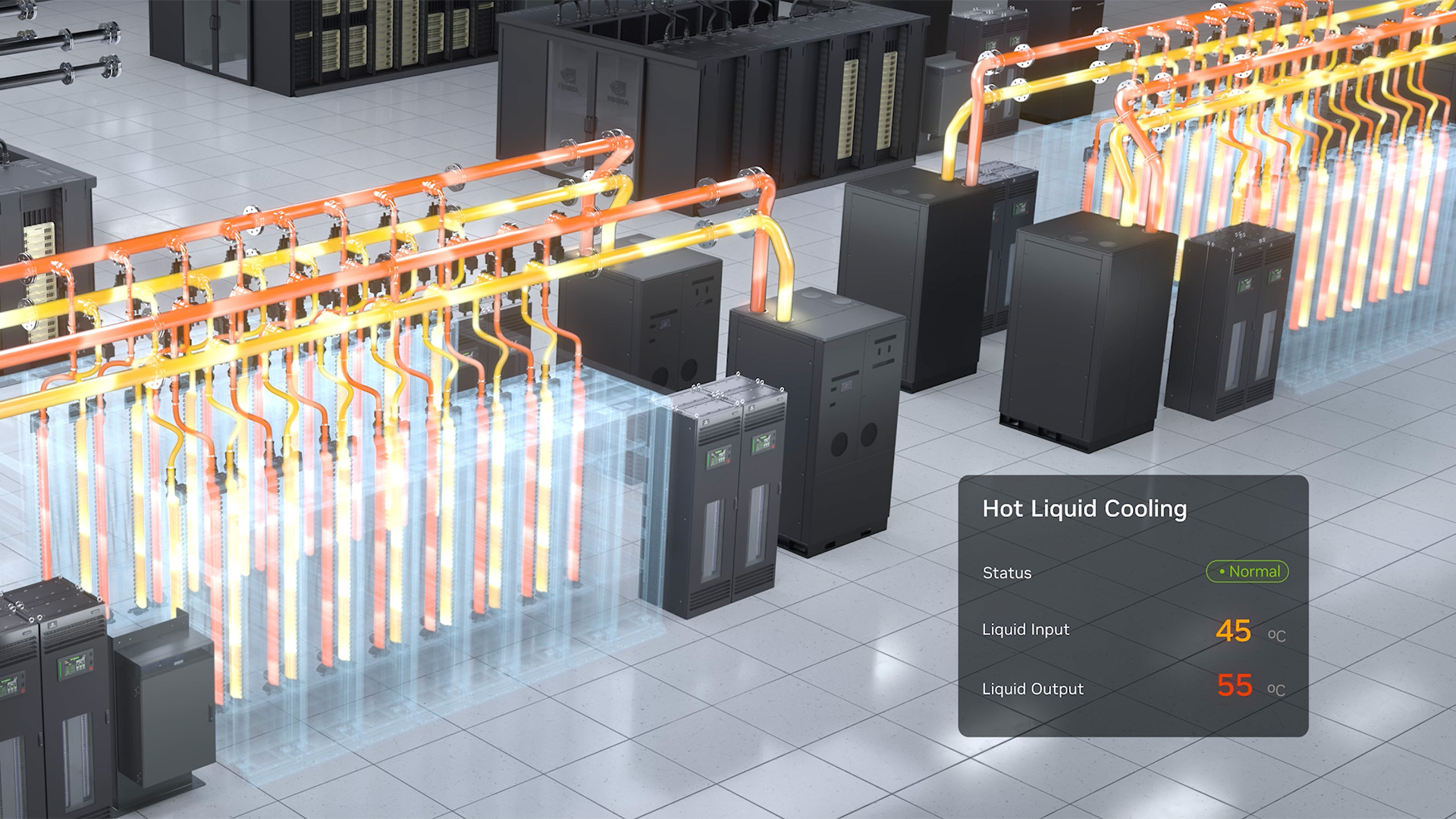
Liquid cooling lets you run your working fluid a lot hotter without killing folks like me who go into the data center, although honestly 45C sounds like an incremental improvement over the 100F places like ours are already running. (although to be fair, the warm water return from the heat exchangers is no doubt somewhat less than 100F) It also lets you run your "cold" side a lot hotter - if you "chill" your water down to 100F (38C) on a hot day, it's still cold enough to carry away a lot of heat at 45C.
(I'm skipping over the fact that there are multiple heat exchanger loops involved - e.g. any system with an evaporative cooler needs a heat exchanger to keep leaves and bird shit outside the building where it belongs)
by pjdesno - May I ask where this datacenter you're referring to is located? State and country would be super helpful.
I disagree if there is an assumption or premise that all datacenters use water for cooling. Datacenters are not built or operated the same, nor have a requirement for water cooling, or evaporative cooling.
Water use is partially a myth for sure, because it's not a certainty or requirement in every datacenter, ever.
If water is used for evaporative cooling, it's used in places that the cooling can't work above a certain temperature. Say, for example the US where it gets over 120 degrees farenheit.
The inability for cooling equipment to perform when it's extremely hot might be supplemented my multiple technologies cooling together, including evaporative cooling. So evaporative cooling might be common in the US or other regions like it.
There are many datacenters that don't need to consume water at all for cooling, except for a water cooler to drink from, and sprinkler systems for fire suppression. They are engineered and cooled just fine.
The demand for datacenters and money in this space will likely solve the water usage, if for no other reason, than to increase flexibility of locations.
If anyone is curious a bit more about how:
Datacenters locations optimize 3 main factors.. Power, Cooling, and Fibre.
We know the climate of location isn't the same everywhere in the world where datacenters are located.
One thing that can get missed among the water hyperventilating crowd is that datacenters are designed for the need of the location's climate, and what it takes to cool. Too many folks spreading the information are usually non-technical, and get their education about datacenters from social media.
There are many places in the world, including in Canada, where cooling is built in 6 months of the year to outdoor air. The temperature isn't high enough in the summer to warrant or require evaporative cooling. They can just vent outside, or capture the heat for other purposes.
In other areas still, proven building approaches such as countersinking the datacenter for some additional geothermal benefit, local power generation (Solar, Natural gas) and a unique path to the same datacenter is possible.
Of course, if foreign companies are wanting to build in a different country, they might by default build how they know for their region and assume it's ok.
There is a massive build out of datacenters occurring in Canada right now, they will be built according to how buildings are built in that climate, not importing cooling technology from regions where it's too hot, or evaporative cooling is the only, or most available option. In temperate climates, considerations have to be made for keeping keep buildings warm (not just cool) year round.
The nice thing is this is not hypothetical.
There is of course, equipment that can have liquid cooling, or we see those fun videos of equipment submerged in liquid operating. These seem to not be the common.
by j45 - I am pretty much doing the same but running the coolant at 40 deg C instead of 45 as my pumps are rated for 45 C max temp. Here is bit more about my setup https://sabareesh.com/posts/blackwell-waterblock/by sabareesh
- with efficient heat exchange you could get the coolant up to mash temperature (65C) and run a combined data center/breweryby t0mpr1c3
- It was already near zero compared to various other uses. It's always depressing to me to see a lot of effort put in to "solve a problem" (with subsequent fanfare) which is only a PR or image problem in the first place.
- "compared to various other uses"
You realize how that vague and open ended clause completely undermines any point you are trying to make, right?
by krupan - If anyone else is disappointed by the terrible AI slop article: It's about a fully liquid cooled data center design.
The usual way to cool servers is with air and heatsinks attached to the hot hardware, similar to how your desktop computer or laptop works. As the hardware gets denser and more powerful, you need bigger and bigger heatsinks and cooler air blown over them. At some point you can't make the heatsinks bigger because of space constraints, and you can't blow the air faster (because of noise and efficiency), so you need cooler air. That's when you start running chillers that evaporate water to cool your intake air. This is the huge water consumption that we'd like to avoid.
The next step is, obviously, liquid cooling. Again, this is similar to your fancy gaming desktop. You can dump a lot of heat to a liquid medium through a small heat exchanger inside, where you're space constrained, and you can run the liquid through a gigantic heat exchanger outside, despite the temp delta between your coolant and outside air being pretty small.
This article is about a system that's FULLY liquid cooled — CPUs, GPUs, memory, networking, the whole thing. That's the actual cool part (pun unintended). On top of that, their solution is optimized to be able to run the coolant quite warm — this obviously limits the heat flux at the hardware side, but it allows you to run the outside heat exchangers "dry", i.e. without wasting any water for its latent heat.
by Toutouxc - Points for effort, but this will do literal nothing to appease the opposition, since the "water use" thing is a myth anyway. It's probably good, it sounds like it will be more efficient and efficiency saves resources for other uses, but politically it's completely useless.by kingofmen
- Yeah and it's a myth that fracking makes water undrinkable.
I'll bet anything you'd be the guy that won't drink a glass of the "perfectly safe, completely unaffected" water while making such utterly absurd claims.
by sophacles - It always seemed weird - where does the water go, after all? I gather it isn't turned in to H2 and O2. I assume it leaves the data center hotter than when it came in, which seems like the real issue?by CalRobert
- Why is a data center suing for access to 750K gallons/day of Colorado river water?
https://www.kpbs.org/news/environment/2026/06/15/imperial-va...
by paulrudy - Do you have any references for this comment: '"water use" thing is a myth anyway'. I would like to show my kid who keeps complaining to me about AI water usage.by jmartrican
- Doesn't matter that's it's a myth, it's salient and has become a layperson talking point. This is an official post on nvidia.com that can be quoted: "The NVIDIA DSX reference design for AI factories has zero water consumption"by protoster
- The NASA Ames Research Center Modular Supercomputing Facility is highly efficient, both in terms of electricity and water use. The facility isn't air conditioned. The chips are water cooled, and the inlet water temperature is pretty high I believe - I think it's 90 degrees Fahrenheit.
https://www.nasa.gov/centers-and-facilities/ames/doing-more-...
https://www.nas.nasa.gov/assets/nas/pdf/ModularSupercomputin...
by metabagel - For those of us that use metric/SI units, 90F is 32.22C/305.37K.
Don't the US Military and NASA use metric now?
by rswail - > In favorable climates, NVIDIA’s 45-degree liquid-cooling architecture ....
What's a favorable climate, apart from, obviously, Greenland? The piece is a little light on details on the correlation between outside temperatures and efficiency & cost. It'd be nice to see even a broad-strokes discussion of that.
- Yeah, this is part of the issue to be honest. You'd need outdoor air to be below ~37°C to guarantee 45°C water outlet temperature. In most locations you still need cooling towers or compressors some of the time, so you still have to build all the infrastructure that comes with them; though reducing their use is still great, saving serious amounts of water or energy.
For e.g you might think of the outskirts of London as fairly moderate, but this week it's been hot enough that supplemental cooling would likely have been needed at points. For a data centre here you'd typically design the cooling system to cope with outdoor temps in excess of 40°C, which is not a conservative number anymore.
Also, while Nvidia might be happy with you supplying water at 45°C I suspect you will get better longevity of the hardware at lower temps like say 35°C. GPUs are expensive, and extending longevity may well be 'worth' a bit more water or energy to you. In practice you are also likely to have air cooled systems that sit 'beside' the AI compute like storage severs, any extra CPU compute and network switches. So you are likely to need a separate room and cooling system for that. Great progress though.
by matt-p - The university where i studied uses high temperature cooling since a few years. The weather on Germany ranges to quite high temperatures, but according to the tech stuff they only need active (as in AC) cooling for the higher end of the 30 degrees. The technology is quite fascinating.
https://www.kit.edu/kit/english/pi_2024_038_kit-supercompute...
- Maybe I'm being dumb, but I don't understand what the innovation is here.
I get that they're using liquid coolant at higher than usual temperatures, but why couldn't they do that before? Most of the comparison in the article is for air cooled datacenters but what about other liquid cooled ones?
Surely in all the previous datacenters that have been designed there has been someone doing the math and determining what temperature things need to run at, how much energy it will use, how much heat it all will produce, etc.
edit: just saw this:
>Previous liquid-cooled servers were hybrid: GPUs and CPUs got cold plates, but the rest of the system stayed air-cooled, with finned heat sinks designed to shed heat into moving air. In a fully liquid-cooled server, the cooling for these components needed to be completely redesigned to use liquid.
by why_at - Ai slop from Nvidia, who would have thunk.by voxelghost
- Is this not how it was already done? Huh.by taneq