
Join the discussion
Write your take first — we'll ask for email only when you're ready to publish.
- Hacker News
- HN automangled the title, should have a “how” at the beginning. The change makes the headline sound like this is news, but it’s just a description of neutrino detectors.by semiquaver
- Rehowed now. Thanks!by dang
- Related BBC radio 4. Featuring the lovely Frank Close (I added the lovely).by IndySun
- There is a good exhibit on this at the Miraikan in Odaiba, Tokyo. Detecting things and proving we detected what we detected we previously couldn't is always a fascinating exercise, especially whilst so much matter is still unrecognised.by ktallett
- Could a physicist comment on this? I've been reading on the CNO cycle [1], where it says neutrinos produced in the beta-decay steps can have any share of the resulting energy. Does it mean the Sun is shrouded in a rarefied cloud of such low-energy neutrinos which failed to achieve escape velocity?by gattr
- This is an interesting question, but it would be very difficult to verify.
Only neutrinos with an extremely low kinetic energy would have velocities much lower than that of light, and the fraction of such neutrinos from the total flux of neutrinos would be very small. If they did not escape Sun, most would be probably captured sooner or later by nuclei from the gases of the Solar atmosphere (i.e. chromosphere or corona).
by adrian_b - From the (captions under photographs) in the article: 'Located 2.1 kilometers underground in the Creighton mine in Ontario, Canada, the Sudbury Neutrino Observatory’s detector (left) was filled with “heavy” water, which features deuterium in place of hydrogen atoms. Its findings provided evidence that neutrinos can change, or “oscillate,” between different flavors.'
"China’s Jiangmen Underground Neutrino Observatory (JUNO), seen here under construction in 2023, is currently the world’s largest neutrino detector. It began collecting data in August 2025; one of its main goals is to determine the outstanding mystery of how heavy each flavor of neutrino is."
The second caption implies that some "flavors" of neutrino may be heavier than other flavors. The first caption says that neutrinos oscillate between different flavors. If the first caption is correct, then wouldn't each flavor of neutrino be just as heavy as the others?
by anonymousiam - In 1987 a supernova was observed in the sky.
In a great coincidence, just months after being put into operation, a new type of detector meant to study if protons are stable, detected instead the neutrinos coming from the supernova in a way that could be individually timestamped. No other supernova has been visible with the naked eye ever since, or is likely to be seen in our lifetimes.
https://sci-hub.st/10.1103/PhysRevLett.58.1494
The neutrinos arrived 3 hours before the supernova was first seen in the sky. This could mean that neutrinos travel faster than light: that they negative mass. It has not been ruled out yet, but it would take extraordinary evidence for any physicist to admit to a faster-than-light particle.
The core of supernovae are predicted to take around 4 seconds to explode, and during that time they release 99% of the energy that was binding the star together as neutrinos. Once this has happened, however, it takes several hours for the explosion to be visible outside.
If they had 0 mass, you'd expect the burst of neutrinos to last for about 4 seconds. The detected spread was of around 6 seconds.
It was likely that the model for supernovae was missing something. But perhaps neutrinos are slowed down as they interact with other particles on the way here from the supernova. Massless particles always travel at the speed of light, only massive particles can be slowed down. Perhaps neutrinos have mass.
In order to test the basic theory of nuclear fusion in stars, the "Homestake experiment" was set up to count neutrinos from the Sun.
https://sci-hub.st/10.1126/science.191.4224.264
The experiment consists of a big tank of perchloroethylene. Electron neutrinos (and only electron neutrinos) are expected to collide with the Cl-37 atoms to form Ar-37 in the reverse reaction to that of radioactive beta decay. Then the individual Ar-37 atoms can be separated into a gas and counted.
According to the brightness of the Sun, it was expected that around 50 such Ar-37 atoms would be detected every 100 days. Only 17 were observerd, on average. A third of the neutrinos went missing.
A new round of experiments was made, culminating in the fantastically sophisticated Super-Kamiokande, which is sentitive to all other "flavours" of neutrinos, and also capable of detecting the direction they are coming from.
https://arxiv.org/pdf/hep-ex/9807003
It was confirmed that the missing 2/3 of the electron neutrinos expected to come from the Sun had somehow transformed into the other flavours. What's more, muon neutrinos coming from cosmic ray decay in the atmosphere were detected half as frequently in an upwards direction, coming from the other side of the Earth, than in the downwards direction.
The conclusion is that neutrinos must change flavour as they move through space.
Particle accelerators were built in several sites, pointing towards the Super-Kamiokande across the earth's crust, sending a beam of neutrinos of a known kind to measure this "oscillation".
https://arxiv.org/pdf/hep-ex/0606032
Since they have mass, the artificial neutrinos are slightly dispersed by their passage through the Earth's crust. Their arrival time forms three different overlapping peaks, corresponding to three different masses.
The proportion of each kind changes along the path in a sinusoidal fashion, but the mass peaks remain.
The current interpretation is that the mass and the flavour of neutrinos are (almost) "conjugate" properties of the particles, in a similar way to the well-known uncertainty between position and momentum, or between time and frequency in Fourier analysis.
As a neutrino moves through space, its mass can be measured more and more accurately from the dispersion in arrival times. The better we know the mass of the particle, the more uncertain we are of its flavour. If because of the great distances the mass is well known, as is the case with the solar neutrinos, then the three flavours are almost completely entangled.
On short distances the flavour is well determined but the masses are uncertain.
by Giefo6ah - I also wonder this!
Some real physicist tell me what I’m getting wrong here:
neutrinos have mass but the magnitude is so infinitesimally small, and the oscillation smaller still, such that you’re bumping up against some fundamental properties of the universe and the oscillation is “borrowing” and “returning” some tiny amount of mass/energy from the vacuum.
by cobbzilla - They are weirder than you think. They interact with flavor, but these are a superposition of three mass states and it all oscillates. https://en.wikipedia.org/wiki/Neutrino_oscillationby nxpnsv
- For anyone wondering about the title, by "trap" they mean "detect destructively": there are no stable neutrinos in a bottle in this article.
- Damn it. Heart rate sky-rocketed from excitement.by Varelion
- That would be a wild thing to accomplish, given that neutrinos are created at relativistic speeds, have virtually zero mass, and don’t react with anything but gravity and the weak force.
Whatever gravity “trap” you make is going to pale in comparison to the gravity wells around us (earth, the sun, etc) and the weak force scales exponentially with energy. So a slow-moving neutrino would interact even less with the weak force than a relativistic one.
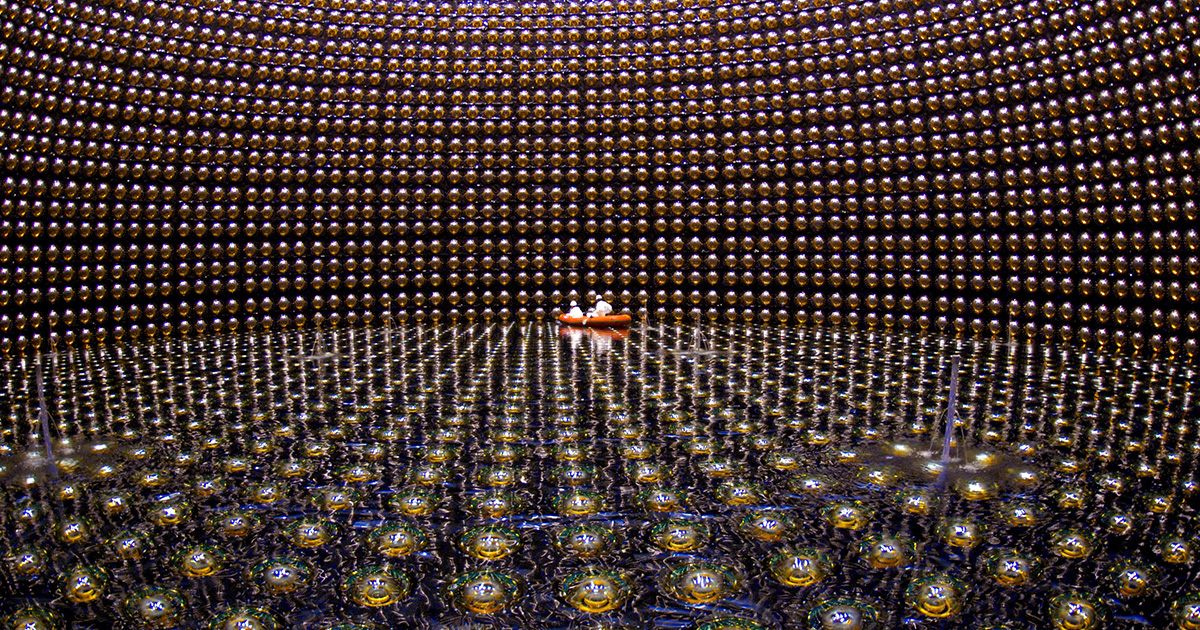
by stouset - Wonderful pictures!
The Super Kamiokande had a terrible engineering event where the delicate sensor bulbs shattered, and the pressure delta from one shattering caused neighbors to shatter, in a chain reaction that destroyed large amounts of sensors.
https://www.youtube.com/watch?v=YoBFjD5tn_E
Unrelated:
>Neutrinos come in three different “flavors” (electron, muon, and tau) and can oscillate, or switch, between them. To do so, neutrinos must have mass
Why? What actually is "Neutrino oscillation" and why does it require the neutrino have mass? My already feeble understanding of particle and quantum physics always breaks down at these sorts of points.
How are we sure that the neutrino is in fact a single particle that should use the same sort of mathematical machinery as all others? Am I even asking a question that means something? I know literally every physicist ever graduated has spent time thinking everything in physics is wrong and tried poking at such ideas, so I guess I'm more interested in what those kids end up finding that brings them back to "No this makes more sense" of neutrinos in the standard model.
by mrguyorama - It's kind of useful to only think of these things as "particles" in a nominal sense. You need to adopt a "quantum imagination". I tend to think of them as a wave or field of probabilities of energy. It sounds weird, but similar to "spin", "flavour" describes a particular relationship between waves or fields of probabilities of energy as it moves through space over time.
A simplified summary: The discovered mass emerges out of this relationship between detection and probability.
- I remember some of the videos in this playlist doing a very good job explaining neutrino oscillations, and what it means, but I don't remember which ones: https://www.youtube.com/playlist?list=PLCfRa7MXBEsqOlL_g6wTM...
Maybe this one? https://www.youtube.com/watch?v=eBT1-dV1BTM
by pavel_lishin - Disclaimer: I'm not a physicist.
For a particle to "oscillate", it must "experience" time. All massless particles travel at the speed of light. As a consequence of special relativity, they don't "experience" time.
Therefore, neutrinos must be traveling slower than light, and they must have mass.