
Join the discussion
Write your take first — we'll ask for email only when you're ready to publish.
- Hacker News
- Very impressive! I also highly recommend visiting Herculaneum.
A thought: I guess the days of scratch off lottery tickets are numbered?
by bobowzki - I always wondered about this, how was there not already tech for a liquor store owner to scan all the lottery tickets without scratching them? On the rare occasions I want to buy a lottery ticket, that's one more reason to only do one where I pick the numbers.by frollogaston
- The tomography was done at a synchrotron (ESRF), and with beamtime being very expensive it would be a net-negative to scan lottery tickets, unfortunately...by cl3misch
- I found once super old books in our lab (like hundreds of years) and was wondering what they were used for.
Apparently they did CT scans of closed books and read the content. Polevoy, Dmitry V., et al. "From tomographic reconstruction to automatic text recognition: the next frontier task for the artificial intelligence." Fifteenth International Conference on Machine Vision (ICMV 2022). Vol. 12701. SPIE, 2023. https://iris.unive.it/bitstream/10278/3687069/1/Albertin_et-...
So yeah, but lottery companies probably make it harder by engineering against it.
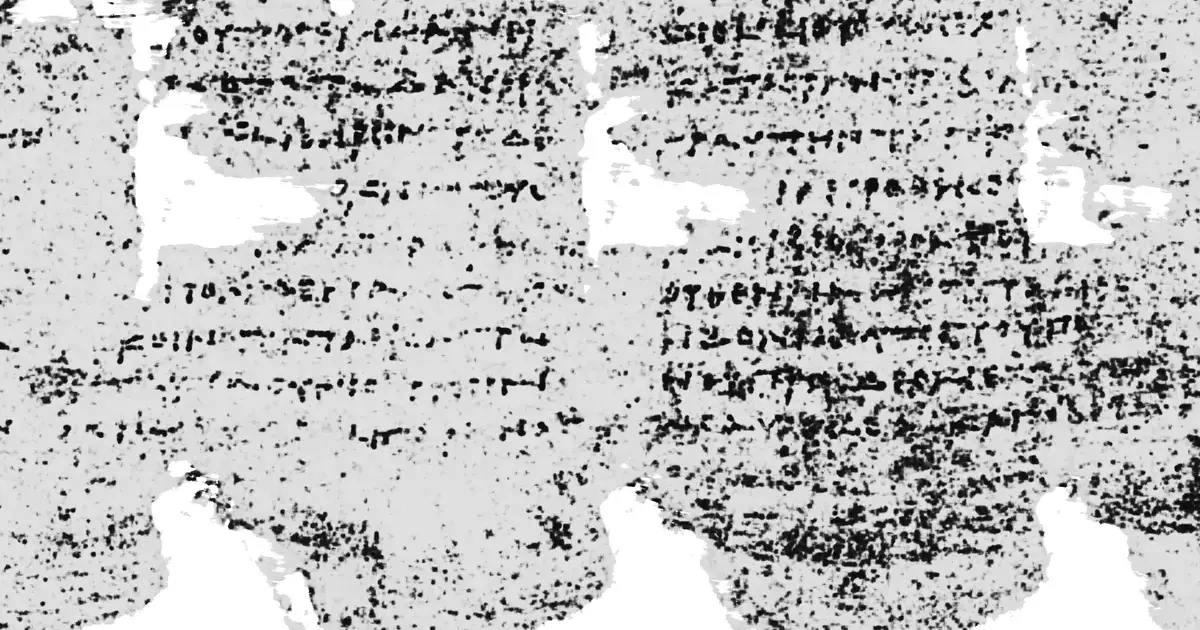
by roflmaostc - > "…we will inquire into something, but we will not grasp it, if in some way we depart from ourselves and from our own nature…"
Beautifully ironic, that we find this message.
by tern - When I read translations like these, I always wonder if the tone is translated. Did the writer mean to convey a very formal “to the utmost”, or was it a more casual “to the max”.
How much of the translators bias makes these seem like academic papers instead of social media posts.
- After sticking it into CharGPT I can tell you it's neither. The word upmost is coming from is a form of the compound verb ἐκπονέω.
* ἐκ- = “out,” “thoroughly,” “to the end”
* πονέω = “to labor,” “to toil,” “to work hard”
by charcircuit - It's philosophy, it's probably very dense prose. Formal Greek/Latin writing tended to have very long sentences with a bunch of subordinated clauses. People don't really write like that outside of academia or "highbrow" literature right now.
Casual letters and graffiti would be closer to tweets.
by sapphicsnail - Students find it hard to read poetry in Latin class, but common Romans of the time couldn't read it either. I'm guessing ancient Greek was even more like that. So would assume everything in there is formal and not how people really talked.
Have also heard of graffiti being cited as how people talked, but dunno about that. Our graffiti is definitely not how we talk.
by frollogaston - Sometimes there is very little to go on, but we really do have a lot to work with from the late republic and early roman empire.
Latin is also a very rich language and this is no snippet.
Translation is always hard, especially from a couple thousand years ago BUT this kind of translation comes with a lot of confidence.
- This is why I like literal translations & etymological dives, paired with asking what activities would constitute a life in that time. Ie, you may not need to be a competent archer, but it is a little easier to understand someone who used a particular style of bow if you can play around with that type of bow for a bit.by forshaper
- let's translate the ancient classic poem Mugger's Paradise by the poet Somewhat Frosty:
While I step through the valley of the shadow of death,
I contemplate my life and perceive that nothing remains.
For I have hurled weapons and laughed for so long that
Even to my mother, my mind appears to have departed.
Yet I have deceived no one except him who was worthy of it;
For me to be held as a coward—that indeed is unheard of.
Beware what you speak and where you set out,
Lest you and your companions be outlined in chalk.
by bibimsz - Any useful translation of an ancient text is accompanied by the text in the original language, so that the reader may assess how faithful is the translation.
For anyone who wants to read ancient texts, there are bilingual editions, for example those of the "Loeb library".
The translations that omit the original text are just for the people who want to have some idea about the content, but do not care about the correctness of the translation.
With a bilingual edition, it is easy to understand the original text even with relatively little knowledge about the original language.
The original text is important because frequently the translator is forced to introduce inaccuracies in the translation, because of the absence of exact equivalents in the target language, which would require a long explanation of the original meaning, instead of just a translated sentence.
Especially misleading are translations where several distinct ancient words are translated using the same English word, so some nuances are lost.
Equally confusing are the cases when the translator chooses to translate the same ancient word by different English words, because even if the meaning of a word may depend on the context, many translators fail to judge correctly the context, because they may lack specialized knowledge so their guesses are not necessarily better than of the readers who may be less competent in linguistics, but more competent in the science or technology needed to understand the context. Better translators prefer to use a one-to-one mapping between words, which makes it easier for the readers to discover the meaning intended by the ancient writer, after seeing multiple examples of usage.
by adrian_b - The person who wrote this was was closer in time to the technology that was able to unwind and read burned fragments of their text, than the technology that build the pyramids. pretty wild to think about.by lanthissa
- >technology that build the pyramids
You mean ropes and carts?
by sevenzero - Did anyone notice that anonymous donators[1] have the picture of Larry David, and the link points to the Curb Your Enthusiasm - Anonymous Donor Pt2[2] episode?
So geeky, so cool !
by melicerte - That is a nice easter egg!by verifex
- Ex-project lead here. The most incredible part is buried in a 7 hour long video. Last night they also unwrapped 140 columns of new text in the PHerc. Paris. 4 scroll: https://x.com/JanPaul123/status/2070304769273725278by janpaul123
- Can't stop Sean from segmentingby verditelabs
- And a new $1M Vesuvius Challenge Grand Prize will be announced in coming days: https://www.youtube.com/watch?v=96oTlQm0KBw&t=5405sby janpaul123
- For me, this is one of the most exciting things being done with AI right now. (This and medical research)
I'm kind of obsessed with the ancient world. I dream of being able to read entire pages of new text from ~2,000 years ago.
by kilroy123 - What's the most interesting le text from olden times that you would recommend?by xandrius
- I wonder what the parellel would be 2,000 years for now:
A Post-Great Solar Flare of 2484 Step Brothers DVD Has Been Decoded
- As I understand it, Pompeii was basically a city of vice and hendoism. Most of the scroll text so far seems to be the ancient version of porn fanfic. So things really never change.by citizenpaul
- Archeologists discover 2000 year old cultural link between badgers and mushroomsby alnwlsn
- Someone found a fossilized T-shirt that had the DeCSS code on it.by rzz3
- We have successfully uncorrupted audiovisual media of what we believe to be an oral retelling of the long lost ending to Chekhov‘s “The Three Sisters.” It turns out the light was on.by Waterluvian
- Discs of this era are frequently marked with a specific, unknown sequence of symbols: FCKGW-RHQQ2-YXRKT-8TG6W-2B7Q8. Archaelogists believe it may have religious significance.by Nition
- Only about 20% of the Herculaneum site has been excavated, so there is high probability that more scrolls exist. The current scrolls were not part of the main library, but more of a private collection at the time.
So imagine how cool it would be to find a full library with thousand of scrolls across many different topics, that can now be read with this technology.
by proee - This could eventually completely transform our understanding of Antiquity. It is estimated that only around 1% of the ancient works in Greek and Latin have survived to the present day, much less in other languages such as Punic [0]. Some works and some authors we only know by name because they were alluded to in later texts.
It's also well known that surviving texts survived because they were copied again and again on costly animal skin during the Middle Ages, by monks who had to make a choice and naturally favored topics that were of most interest to them.
This could quite literally change everything.
[0] https://talesoftimesforgotten.com/2021/09/25/are-there-more-...
by bambax