
Join the discussion
Write your take first — we'll ask for email only when you're ready to publish.
- Hacker News
- 5k Restaurant Menus, Years 2020-2026: [qr code][qr code][qr code][qr code]by NooneAtAll3
- That's not the menu, ya silly.by xandrius
- Must have been super weird working with such low absolute prices. If the food cost for your sando is 5c, your first step is a 20% margin. I imagine that had a decent influence on the dishes themselves.by goosejuice
- Interesting, these really old menus would not look too out of place at a restaurant today.by cs702
- Unfortunately in Europe printed menus almost entirely disappeared after COVID. Before, leather-clad, elegant, printed menus were commonplace, but nowadays every place just has a QR code.by ricardobayes
- The first menu I opened had tongue sandwiches and hot beef tea.
So some things have definitely changed!
by com2kid - And the other way around too - it sounds like you could have had a very similar dining experience as today. It always amazes me how very little difference there is between past people's lifestyles and ours. I know this on a factual level, but being presented with a tiny peek into the past like this is always very humbling to me.by 9dev
- Many of these, from the mid 1800’s, would have been printed on a press with metal letters.
A modern open font that might match the style is Old Standard TT.
https://fonts.google.com/specimen/Old%2BStandard%2BTT
I was curious how these were made back then and what modern fonts might look best.
by codazoda - Really cool. I have A Treasury of Great Recipes by Mary and Vincent Price and it is similar. It has recipes from all the restaurants that they went to all over the world but every section has a menu from one of the restaurants that gave a recipe for that section, which is the real charm of the book. Interesting to see how little has changed except the prices...by BashiBazouk
- Ha! I have a signed (after a talk in undergrad) copy for my mother that I gave to her. I guess my dad didn't want it after she passed away so it survived the fire at his house many years later.
Lots of classic restaurants. Many of which are no longer with us and, to be honest, many of which I wouldn't eat in today.
by ghaff - Whomever finds great enjoyment in reading this may also enjoy Jan Whitaker's blog 'Restaurant-ing through History'. [1] They are an old-school blogger with a particular interest in American restaurants, and enjoys email correspondence as well.by greyb
- Excellent link, thank you!by HardwareLust
- For those seeking another, historically oriented commentary I would recommend https://www.theamericanmenu.com/. The author makes note of significant, famous restaurants like Delmonico's in NYC, current events of the time, and also culinary trends and menu images.by longos
- Good stuff man, thank you!by HardwareLust
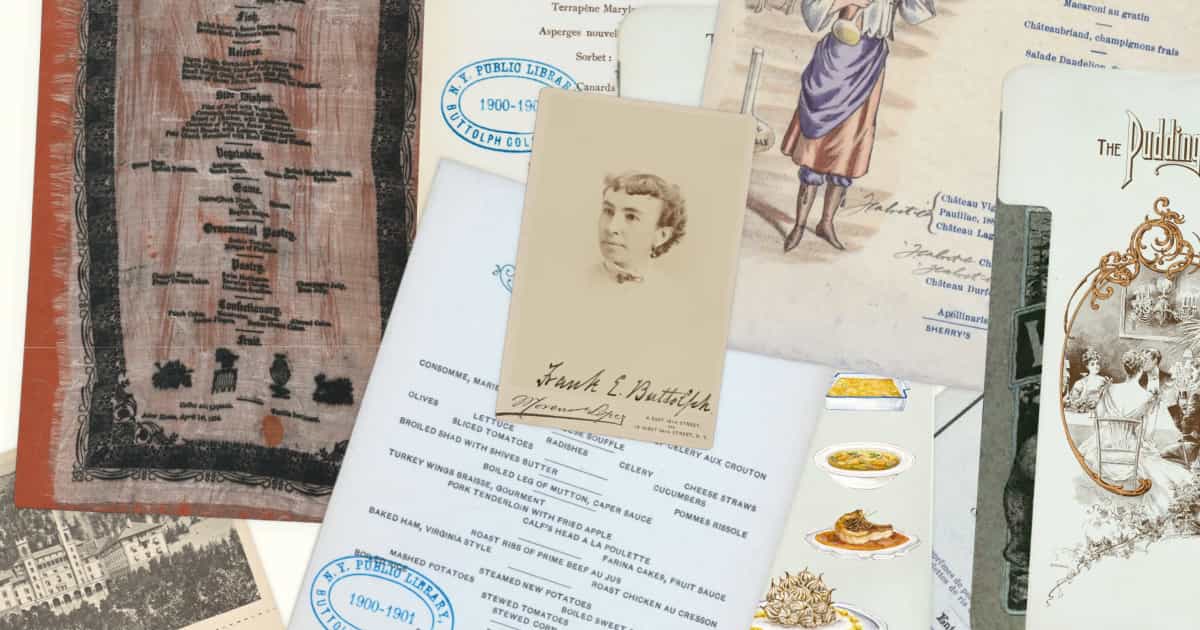
- Very cool. Recommend walking through the curated story here first then exploring the menu visualizationby monkeydust
- Thanks! I've made that the top link and put the collection link in the toptext. Could go either way really...by dang
- If you’re ever in NYC, many of the hole-in-the-wall takeout Chinese restaurants have awesome 2000s era menu aesthetics.
Word art, clip art Lamborghinis next to the takeout number, all kinds of coloring. I love them.
by wxw - As a foodie, I love this. In many respects, menus don’t seem to have drastically changed over the past 175ish years but it looks like a “Boiled” category was common early on, which I assume was because boiled foods were popular and/or easy for restaurants to make in bulk.by temporallobe
- One massive change is that there is almost no ethnic food on these menus (unless you include French). I looked at some of the LA menus and there were zero Asian, Mexican, or Italian dishes. It's impossible to imagine today that you could look at a bunch of hotel restaurant menus in LA and not find at least some dishes that were inspired by those cultures.
- Boiled would have included braised -- but there were meats that you grilled, because they were young and tender, and meats that you "boiled" to break down the collagen because they were mature and tough. Nowadays we rarely consume animals of that age, but then they often did so for economic reasons.by Exoristos
- > menus don’t seem to have drastically changed over the past 175ish
After looking at a dozen of the ones from the Boston area I have to say that my sampling disagrees with yours.
Turtle, Sweetbreads, Venison, Mutton are all things that would get a foodie OUT to eat today and seem to have been much more common then.
Also much of what I am seeing as "boiled" is going to range from "poached" (salmon) to "braised" (some of the tougher organ meats). Stumbling across a "boiled" chicken, served with rice and cucumbers in an 1800's menu made me jump to "Hainanese chicken rice". That preparation seems exotic to the modern American style but might not be as alien 100 years ago (Flavoring aside).
by zer00eyz - I noticed the prominence of celery, which might surprise a modern diner. I had reason some years ago to look into this and the history is interesting. Celery was at one time difficult to cultivate, growing only in select marshlands. In the absence of refrigeration it was also difficult to transport to city diners, so was considered a delicacy.
This also lead to the production of specific table items intended to display celery such as the vase shown in the menus above.
by pcrh - The second chapter of the included tour [1] is about celery: "In fact, it's the fourth most common item among the Buttolph Collection menus, after coffee, tea, and olives."
- Anyone interested in this might also like the tidbit that in Germany, they used to, and still count beer consumed as pencil strikes on the beer paper mat. Altering the number by the guest is legally considered forgery and the disappearance of the beer mat is also punishable by law.
https://de.wikipedia.org/wiki/Bierdeckel#Urkundencharakter (in German, English wiki doesn't have this info)
by ricardobayes - My grandfather told me that it was deemed time to stop drinking when you couldn't see over the pile of coasters.by CurtMonash
- In Málaga, Andalusia, Spain there is churinguito (a seafood place next to the beach) that doesn't really have a menu after 9pm. Waiters just walk in the dining area with a plate in hand and yell the name of the fish/seafood for peoole to ask for it. Each fish has a different kind of plate with a different price. When you ask for the bill, they just do the sum according to the plates left on the table.
They had to cement the dining area because people used to bury the plates in the beach sand.
by prmoustache - > In some breweries and countries, the beer mat placed on the glass signals to the waiter that the guest does not want to drink any more beer.
Interesting. I’ve always seen this as a signal that a person was stepping away, but coming back. The person would cover it while going to the bathroom, in part so it isn’t as trivial for someone to slip something in their drink. Implying that they intend to keep drinking it once they return.
I’d be interested to know where it means that the guest doesn’t want any more beer.
by al_borland - In the Netherlands that person would be considered an eetpiraat (food pirate) or flessentrekker (bottle puller). Those are terms used in court.
https://uitspraken.rechtspraak.nl/resultaat?zoekterm=Flessen...
https://uitspraken.rechtspraak.nl/resultaat?zoekterm=Eetpira...
by retired - Beer mat = "coaster" for the curious. I was originally thinking a paper tablecloth. It was pretty straightforward to understand via browser translation of the wikipedia article, thanks!by rconti