
Join the discussion
Write your take first — we'll ask for email only when you're ready to publish.
- Hacker News
- Interesting technique, horrible article. Manages to convey significantly less information than the X thread it mined for ad revenue.by gordonhart
- by tape_measure
- Not sure that's entirely fair - openculture.com is usually pretty good, and the article draws on multiple sources. But I take your word for it that the twitter thread is good and have added it to the top text.by dang
- An ad or something on this page attempted to load a link in an app I did not haveby rythmshifter
- I thought this was the name of a new startupby backlit4034
- It's cute because it's trees.
Somehow I keep thinking Mad Max where women were kept just to produce baby and milk, or Alien where alien "subtree" sprouted from human "tree".
I guess nature/human is cruel?
by wiradikusuma - Yeah I kinda feel bad for the trees but they probably don't careby squibonpig
- Im confused.. wouldnt this be suspect to a weight limit - as the full stem would weigh on the carrying "tree" - especially during wind and storms?
- When doing coppicing it's definitely something to be careful with. Once started, the trees needs to be cared for regularly. E.g. on the ash trees I have, it needs to be "harvested" every 8 to 9 years. If you fail to do that there's the risk of the tree splitting because of the weight but also branches breaking indeed in case of storms.by boudin
- It's not limited to Japan. The French call them 'trognes'
https://www.agroforesterie.fr/la-trogne-arbre-paysan-aux-mil...
Other countries do it too :
by petit_robert - In english this is called pollarding a tree. Historically it has been used for smaller wood pieces (firewood, etc). It's fuctionally different [from daisugi] because you don't get construction grade timber from it
https://en.wikipedia.org/wiki/Pollarding
[edit: clarification]
by quirkot - Isn't this just Pollarding and/or Coppicing, which have been practiced for at least 2000 years in Europe (and probably many other cultures as well), with a healthy dose of orientalism added on top?
- Yes it is.by grey-area
- Yes, it's exactly it. But call it 'giant bonsai', and it sounds like a new discovery.by broken-kebab
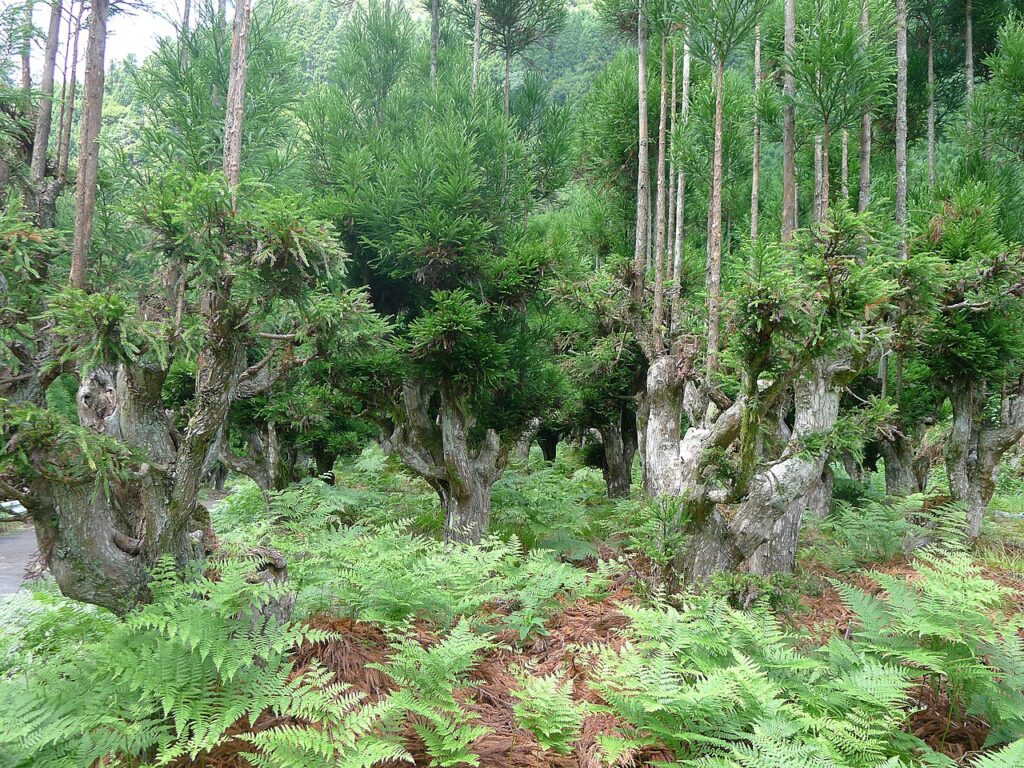
- Looks more advanced than simple pollarding. I have never seen this kind of straight, tall tree tops in Europe. If it exists I would like to know!by Dibby053
- Are coppicing and pollarding used at all to produce timber? I had the impression that it was done only to make firewood, and was cut repeatedly without letting it grow like described in the article.by stymaar
- Please link a photo of a coppice/pollard in Europe that's as straight as this, along with the location where I can see it.
If you do, I have got a great new travel destination. If you don't then everyone else (and hopefully you too) will understand why people think this is special enough to link beyond the fact that it happens to be in Japan.
- From the twitter thread this was stolen from:
“It is a little different, more like pollarding, and it doesn't work with any other conifers than saplings from one specific mutant cedar in a shrine near Kyoto.”
by cwillu - >with a healthy dose of orientalism added on top
Also known as 'Thing, Japan'. HN eats up articles like this every single week.
by thrownawaysz - https://news.ycombinator.com/item?id=37759366
Same discussion 3 years ago
by nerder92 - Thanks, macroexpanded, and another one...
Daisugi, the Japanese technique of growing trees out of other trees (2020) - https://news.ycombinator.com/item?id=37759366 - Oct 2023 (102 comments)
Daisugi, the 600-year-old Japanese technique of growing trees out of other trees - https://news.ycombinator.com/item?id=26941631 - April 2021 (171 comments)
by tomhow - (2020)
Some previous discussions:
- I don't quite understand -- what is it about this technique that makes the trees grow perfectly straight and why is
> the lumber produced in this method is 140% as flexible as standard cedar and 200% as dense/strong,
?
by wxw - It’s exploiting the natural tendency of trees to create “waterspouts” through a technique called pollarding. When a tree suffers an injury it creates a bunch of new twigs that tend to grow straight upwards if the injury is on the upper branches. The waterspouts grow more slowly and so in this species of cedar they develop those desirable properties.by Fwirt
- They grow straight because they are shoots/suckers, and that's how tree biology works. And they are pruned every two years to prevent knots and side branches.
The lumber is dense/strong because the shoots have a robustness advantage due to being part of a mature tree with all its resources.
by jibal - This article is just a rehash or summary. Check out one of the sources it links to (since the other is broken) for details on the technique: https://mymodernmet.com/kitayama-cedar-daisugi/
The strength & flexibility I would guess are attributable to the lack of knots and the straightness of the grain.
One thing both writers keep doing that's annoying is calling it a cedar. The tree is cryptomeria japonica, known as sugi, which in English is sometimes known by various misnomers such as "Japanese cedar" and "Japanese redwood," both of which should be taken as more poetic than scientific.
by rdiddly - The article is pretty light on details. Essentially, the tree is first pruned to create a wide and sturdy base; once that's stable, subsequent shoots from the branches are pruned to grow vertically. The technique relies on this particular variety of cedar which tends to grow vertically but can also be made to spread out a bit. It has some advantages in space-saving and efficiency but it's also very labor-intensive.by ksymph