Join the discussion
Write your take first — we'll ask for email only when you're ready to publish.
- Hacker News
- This is amazing! Most definitely headed in the right direction. The separation layer between front and back must be cut at the smallest possible 'slice'.
Lots of people here snarking would understand if they 'felt' the latency and additional overhead. Not enough thought has been put in carfully slicing the data for individual use cases.
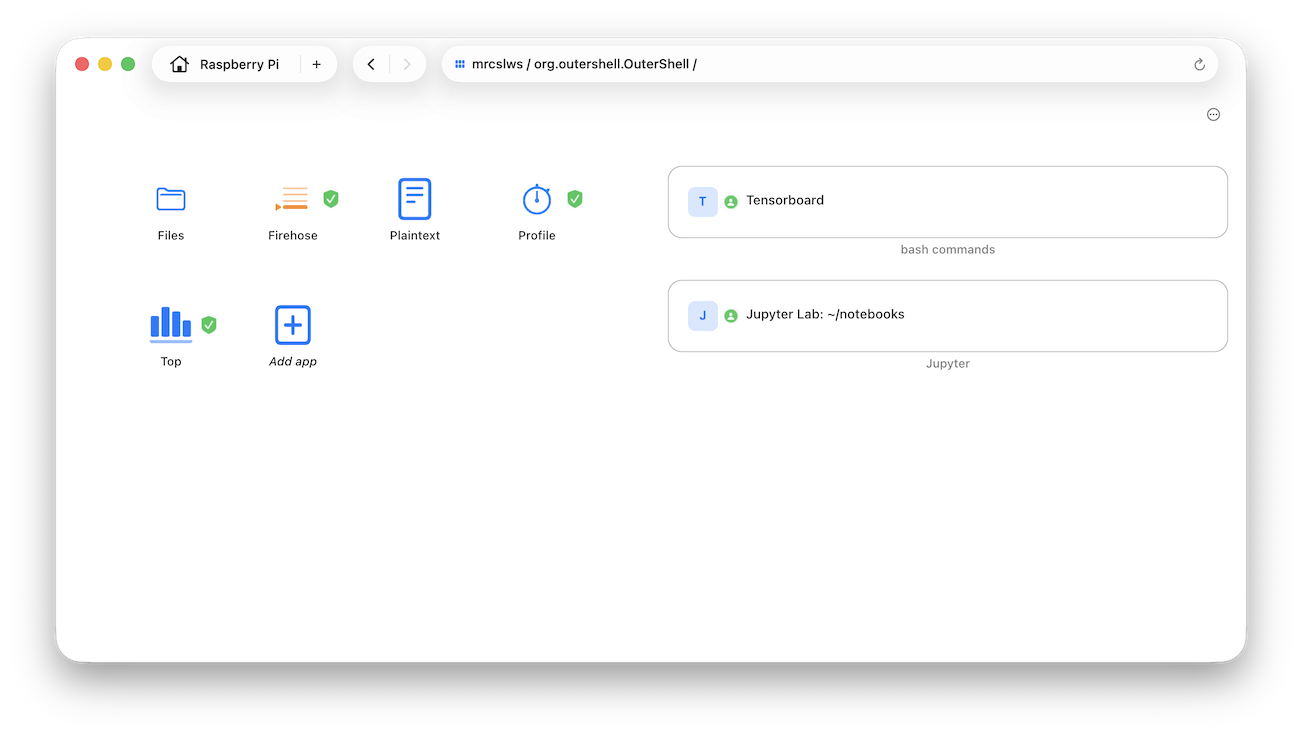
I'd go even further, in his demo of 'generating load by moving the config often' -- I think that 'top' app should have 'jit-ed' more of the rendering on the client such that the only information traversing pi<>client is compresed delta's of the ps hose.
by achille - Do not do this. There are many, many excellent long-standing security and "web control plane isolation" reasons browsers are not permitted generic socket permissions.
The closest mechanical analog that comes to mind is why 3-wheeled ATVs are a bad idea.
by calmbonsai - Lovely writeup! I'll bookmark this for my own research.
My terminal's "clickity clackity" features [0] are local to the machine so I lose graphical-ness as soon as we remote in somewhere.
That's starting to change a bit with offline replay [1] where the native GUI and TUI work in tandem to unlock some rewind. But there's quite a road ahead and I love seeing others experiment properly. (Terminals are massively underserved.)
[1] https://terminal.click/posts/2026/06/tui-stability/#:~:text=...
by abnercoimbre - Author apparently has never heard about Cockpit.
Everything they mention as "missing", or "novel" has been part of Cockpit for over a decade, from socket-based web server connection, backend-frontend separation for server apps and the whole idea of a server console with shell access itself.
To answer them: "Isn’t it weird that this doesn’t already exist?" - No, it's not, because it has existed for ages.
by guhcampos - i'm trying to understand how outer shell works here. on the website you give the following as your motivation:
> Apps like Jupyter and Tensorboard are not typically visible to standard web browsers if they’re running on remote servers, because it would be terribly unsafe to let the whole internet touch this app. Instead, they run on a local port on the server, which your computer can’t access directly.
> Classically, to get access to these, you had to open a new terminal and run:
> ssh -L 24601:localhost:8889 mrcslws@lambda4.mycompany.com &
> ssh -L 24602:localhost:6006 mrcslws@lambda4.mycompany.com &
is this true? isn't the normal thing just to do this ssh forwarding for prototyping, then for deployment, you set up a website like myjupyternotebook.com, and then set up auth so that others can't access it. HTTP basic auth is not too much work.
if you want SSH, not HTTP, to be what's publicly exposed, there's other options too, like putting it behind a VPN or tunnel.
all this to say, outer loop is super cool, but I don't get it. I must be missing something about why you built it, so could you help me understand?
by purplehat_ - I like the idea of separating the frontend and backend of a graphical app. But I feel like this is hardly a novel idea, maybe I'm missing something.
I take it you don't know about "X11Forwarding yes" or "html5 web app"
That is a security concern, that's why it isn't implemented. At least raw unix socks. You can have WebSockets and other ports only limited to http.For browsers, capabilities like connecting to Unix sockets have been dismissed as extremely nicheby trashb - This appears to me like a solution in search of a problem, like many others before it...the quote below seems relevant to this effort.
"Those who do not understand Unix are condemned to reinvent it, poorly." ~Henry Spencer
- It is pretty annoying to see all of the dismissive comments on this idea, in that it seems that the majority of HN audience are still stuck on the TUI-superiority mindset and they do not care about GUIs at all.
Two arguments:
- TUIs are not inherently superior to GUIs
- SSH, as a transport layer, should support not just forwarding a pty (as a TUI display layer), but a GUI display layer as well
In fact, these two arguments were already realized by UNIX 30 years ago, and we already have one solution: the X protocol and ssh -X.
Unfortunately, X did not win out. We did not get the promised future where one can ssh -X into a remote machine, run gnome-control-center, and a settings window pops up and I can configure my remote computer. (If you believe that this works, try it out yourself. It is an abysmal experience.)
However the above needs still needed to be satisfied by so much people, and apps that needed it started to be developed as web servers, stuff like jupyter notebooks. It turns out that the web’s document format coupled with a styling solution and a client-side scripting language, with all of its warts and drawbacks, became a viable solution as a display layer for interactive apps. In fact, since it started from remote documents, network transparency is built-in.
It would be dumb to not realize that the HTML/CSS/JS stack did win a dominant position for desktop apps, with all of the Electron apps, and utilize the web as a display layer for the above. I see the project in a similar vein, i.e. utilizing HTML/CSS/JS to provide a display layer for remote apps via SSH.
Also note that Electron apps has the same split with X, where the display server and the client are separated: it's called the "renderer process" and the "main process", and the two processes talk via IPC (where the display server would be the renderer process running embedded Chromium, the display client would be the Electron main process, and the stuff that the client sends to the server would be the contents of the renderer JS bundle). I think, theoretically, it would be possible to run the main process separated from the renderer process on a different machine, with an appropriate IPC transport. I think this would be not far from the above idea?
by goranmoomin