Discussion summary
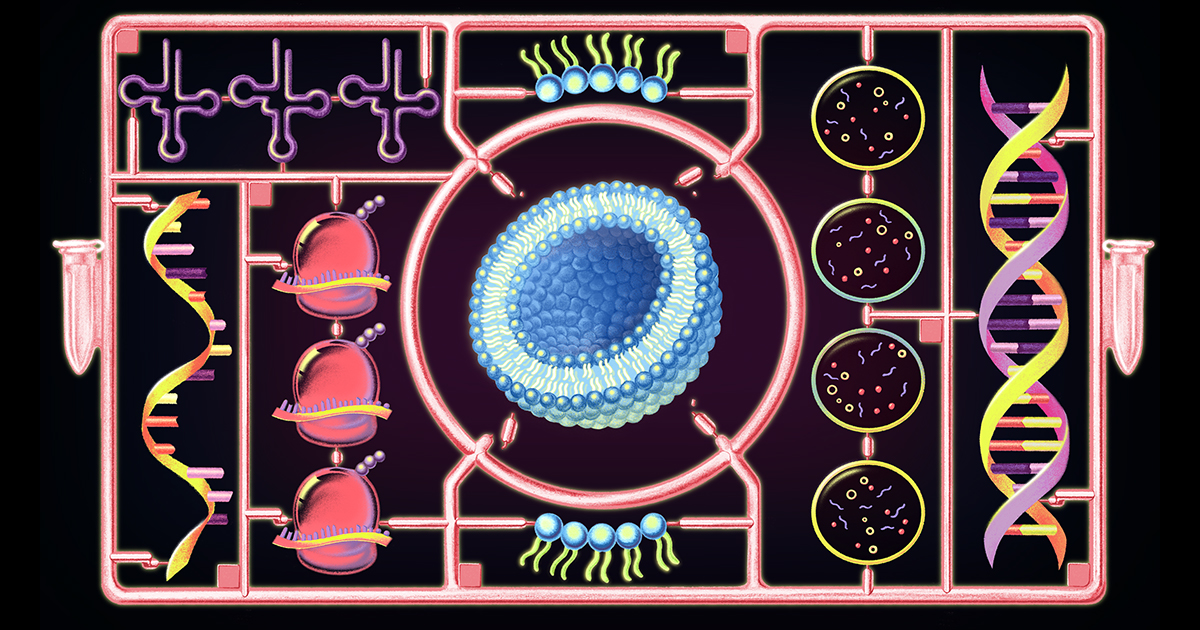
A recent experiment successfully created and observed a cell that grows and divides from scratch, sparking discussions on the nature of life and artificial creation.
What the discussion says
- Some see this as a demonstration that life can be generated from nonlife.
- Others compare it to early stages of artificial intelligence or synthetic biology.
- There are debates on whether such cells are truly alive or just mimicking life.
- Some believe this could lead to creating conscious artificial beings.
“It's the strongest demonstration yet that it is possible to generate life from nonlife.”
“This is closer to consciousness than AI will ever be.”
Join the discussion
Write your take first — we'll ask for email only when you're ready to publish.
- Hacker News
- I;m one of the co-founders, AMA :)by JanJedryszek
- Layman, so bear with me. I'm wondering where they got the amino acids and proteins from? I was under the impressino that cells needed them to be "homochiral" to function, and the artificial 'built from scratch' amino acids are 50:50 of each chirality. In my reading of the NYTimes simplification of this story they mention that the genes were "borrowed from a virus and the ubiquitous microbe Escherichia coli". Mainly just curious how far they managed to get to the 'from scratch' goal. Or is what they've done a bit more of an assembly of bits and pieces? Cheers all.by chubs
- The people behind it:
> Biotic is a public-benefit nonprofit research organization developing chemically and functionally defined synthetic cells. Biotic's mission is to responsibly enable and steward foundational advances in bioengineering. Our goal is to ensure that all people and the planet benefit from world‑leading biotechnologies soon enough to matter. We conduct and support public‑benefit research ranging from foundational science to how people interact with biotechnology.
It looks like this particular research is conducted at the University of Minnesota
by petcat - If anyone is interested in the actual manuscript, here it is: https://www.biotic.org/research/spudcell/spudcell-manuscript...by oliverx0
- Interesting that this is led by the same Dr. Kate Adamala who ended the right-handed-proteins experiment a couple of years ago. Given how close she was I'm not surprised she's made this work.by burnte
- You stumble upon a news article from 2226. You read it to see who, between Google, OpenAI and Anthropic, won the AI race.
Instead, your learn about Biotic.
It's now the leading polity in the solar system and its environs. It bought Alphabet, OpenAI and Anthropic in a single day back in 2084.
Humans are no longer desired. Their reproduction is capped to an optimal minimum assuring the survival of the species as a relic.
For productive matters, Biotec preferes to rely on its biomachines. Imagine drones giving birth to offspring when traffic is at a peak. It takes more energy, sure. But no factory, nor workers are needed.
If left alone, machines would multiply out of control, instead of rotting to waste like in the olden days.
- Science News has a more balanced take, with additional quotes from peers.
> Some have also grumbled about Adamala’s efforts to draw attention to the work, which she says was rejected by Cell after one reviewer said SpudCells were not real biology. She then sent the 190-page manuscript to journalists, under embargo, even before she had uploaded it to the preprint server bioRxiv, where her colleagues could read and assess it. She says her group will submit it to a new journal soon. “It’s an unusual way of doing things,” says Kerstin Göpfrich, a synthetic biologist at Heidelberg University.
https://www.science.org/content/article/lab-created-spudcell...
by merksittich - “This was where the field had been stuck for some time. Researchers before Adamala had figured out different ways to feed and grow synthetic cells and to replicate their DNA. But cell division is a different beast. A typical cell reorganizes its cytoskeleton — a network of protein fibers that provide structural support — to halve its DNA and split. Synthetic biologists could not figure out how to get their cells to undergo this complex process.
So Adamala decided to ditch the cytoskeleton. One day, while tearing through the literature, she came across an interesting mechanism in a paper (opens a new tab). By attaching protein tags to a cell membrane, the synthetic biologist Reinhard Lipowsky (opens a new tab) at the Max Planck Institute of Colloids and Interfaces attracted other proteins to crowd around and physically bend the membrane, forcing the cell to divide. Following this approach, Adamala tweaked a cell-membrane protein and tested it in her protocells. After several tries, it worked.“
This is the novel bit.