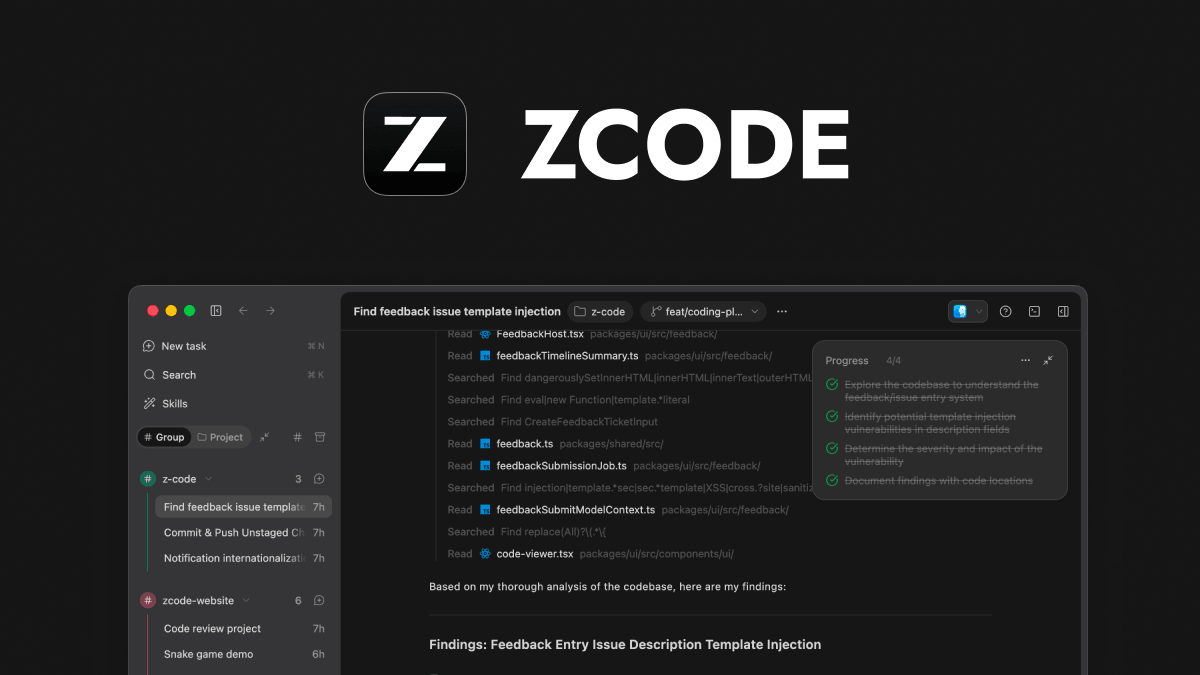
Discussion summary

The discussion revolves around ZCode's harness for GLM-5.2, with mentions of its open-source potential and market competition. Users express interest in CLI versions and concerns about telemetry and control.

What the discussion says

  • Some prefer open-source and local solutions over third-party tools.
  • Interest in CLI versions of ZCode harness is high.
  • Concerns about telemetry and data privacy are raised.
With Musk buying Cursor, it is good to have more alternatives.
elAhmo
I'd rather use something open source and local.
Nekorosu

Join the discussion

Write your take first — we'll ask for email only when you're ready to publish.

  • Hacker News
  • if you're going to try this one out, don't be surprised to get this message repeatedly, like 4 out of 5 prompts you're trying to send, 24/7, this is gonna be your new friend, then you'll learn to write the only prompt that matters: "retry", "retry", "retry"

    Here's the message: "Cannot connect to API: write EPIPE"

  •    For GLM Coding Plan subscribers, quota consumed via Coding Plan for GLM-5.2 in ZCode is discounted by the coefficients below — the same usage draws down less quota, roughly 1.5x the effective allowance.
       
       Peak hours (14:00–18:00 daily)  3x -> 2x
       Off-peak (remaining 20 hours)   1x -> 0.67x
    
    I wonder whether that is referring to local time, or CST (UTC+8)?
  • Peak hours are 14:00–18:00 (UTC+8)

    https://docs.z.ai/devpack/overview

  • From https://z.ai/subscribe#code-plans-container:

    > Explanation and Recommendations Regarding Usage for Plan-Supported Models

    > Note: Peak hours are from 14:00 to 18:00 daily (UTC+8).

  • I don't find a closed-source Chinese agent system trustworthy.

    It is essentially a black box with full user permissions, meaning you are just handing over your entire system to a Chinese-owned server. With OpenCode and its GLM provider, at least I can monitor which files were read, which were edited, and what commands were executed.

    Not to mention that Chinese national security laws legally obligate companies to cooperate with state intelligence and counter-espionage efforts [0]. If you have this installed on a corporate workstation, and your company is large enough, the possibility of them spying on you is not just a risk—it's almost a certainty.

    [0]: https://en.wikipedia.org/wiki/National_Intelligence_Law_of_t...

  • I'm in the US. The benefit of the Chinese spying on me vs a US company is the Chinese can't come to my door and take me to jail.
  • NSA can also legally force companies to spy. Secret spy courts and gag orders are a thing.

    Actually there are more such cases against the USA than China in public.

  • That's why I like to use Reasonix with Deepseek. Hitting cache makes requests basically free and that's through unsubsidized American providers like Digital Ocean or cloudflare.
  • How's that different from Codex (gui app) or Claude?
  • As someone who loves using OpenCode w/ local Chinese open source models, this is basically my take on this as well. There's no way I would ever put a piece of proprietary Chinese software that gets full system control on anything important. This is definitely something I would only ever run sandboxed in a lab environment for toy projects, not for serious work. I feel only marginally better about Codex/Claude Code, hence my strong preference for local LLMs w/ OpenCode, but a proprietary approach to Chinese models is a hard no from me dawg.
  • This is exactly the same with providers from the USA.
  • At least the model weights are open, I’m not American, so to me this is much more trustworthy in every possible way. You’re talking as if US intelligence are the good guys, and to me at least, they are not to any extent.
  • I agree. I don't find the US competitors trustworthy either. I think open source is the way here.
  • i like Chinese open weight model that offer cheap token but i only use it for my personal project.

    China have a history of stealing IPs/trade secrets and Chinese court favored its own local companies. while US have a robust court that can enforce IPs. if you want to risk your company's IPs/trade secrets/data for some cheap token. Go ahead and use Z.ai's services.

  • The US of A ditto
  • What's your top secret project?
  • FYI you can use Z.AI models on infra not in China...
  • For anyone who uses GPT-5.5/Codex as their daily driver, how does GLM-5.2/ZCode compare, esp in a codebase already set up for agentic coding?
  • TLDR GLM will take a lot longer to do a task, and maybe spend more tokens depending how complex it is

    Its a hell of a lot cheaper though, so for me its worth it. I have more claude experience though, and I would say its almost en par with Opus 4.1

  • I tried it for a couple of hours this morning and yeah, it's a bit slow, and I needed it in peak hours so it also often can't reach the server so that makes it even slower. And I'm not even sure it's just the model, it could very much be the harness. Stalled for 40 minutes on trivial tool calls like `find`, two times...

    It shows potential, answer/code quality was solid, but I would need more time with it.

  • GLM 5.2 is in an uncanny valley where it's too big to run at home, too expensive and slow in comparison to similarly capable model (a good chart here - https://deepswe.datacurve.ai/), and that's just comparing API prices.

    When looking at subscription offering by Anthropic and OpenAI, it's not even comparable, as a Codex $200 subscription can easily use a billion tokens per week on GPT 5.5 high/xhigh.

    It's an interesting model from the perspective of being the most capable open weight model. But it doesn't have a solid place in this marketplace right now.

    by gpt5
  • Does anyone use an agnostic TUI or harness for development tasks that can fairly seamlessly switch between providers?

    I'm wanting local context in the spirit of "here are 3 AI providers available, for coding tasks use this one... and for writing prose use this one... and for generating images use this one..." etc.

  • I use the one that I've been developing since 2023. It's intended to be used in exactly this spirit! Written in Go, has image support (which has yet to be fleshed out).

    It supports MCP (unlike Pi), sandboxing (with user-mode networking), and runs efficiently at huge contexts.

    https://codeberg.org/mlow/lmcli

    (The screenshot in the folder is a little bit out of date, but is still representative of the overall look)

  • I’ve been using Crush with Openrouter and have good success lately

    https://github.com/charmbracelet/crush

  • Circus Chief allows you to do this: https://github.com/ferrislucas/Circus-Chief

    (Full disclosure: it’s my project)

  • If you haven't yet you should give a chance to https://pi.dev

    I've been using it exclusively (and extending it, see https://a.l3x.in/ai) for months with mainly GLM-4.7 then 5.1 and now 5.2 and I could hardly be any happier.

    I'm still working on a "Github/Forgejo first" based workflow but also quite happy with it already, basically most of my sessions run as a ci/cd job (triggered by "/pi" comments) and generate PRs or push commits to PRs, see https://github.com/shaftoe/pi-coding-agent-action

  • You can do this with role-model, the model router I've built. It routes based on roles and tasks among other things. It has an extension for Pi that lets your coding agent specify request metadata for roles and capabilities etc.

    https://github.com/try-works/role-model

  • I’ve written a skill for codex and Claude code that designates an orchestrator on the primary worktree and is agnostic about what type of AI workers are on the N supporting worktrees.

    The orchestrator knows which AI client is running in any given worktree, so it would be fairly easy to designate which AI should receive what kind of tasks.

    You run either Claude or Codex in tabs for each work tree. I do have some AI TUI specific instructions, for instance codex is primitive at monitoring compared to CC. So, there are additional notes for Codex workers on how to properly monitor for new "mail."

    You work with the orchestrator on the primary worktree and allow it to delegates tasks to the workers and answer their smaller questions.

    It surfaces results and assisting them with context clearing when needed.

    The orchestrator and workers communicate using a simple shared file system under tmp/* and together they can handle a big and varied workload.

    I use iterm2, so I’ve also added iterm2 specific python that allows the orchestrator to “kick” a worker or perform tasks otherwise veto'd by the TUIs (ie /clear) by modifying the input and submitting it.

  • have used both pi and opencode for the last 6 months, haven't opened a proprietary harness (cc, codex, cursor) in that same amount of time. right now i'm on pi and i can switch seamlessly between any model across any provider i want, even mid session. can even point them at locally running models.

    i think people don't realize how much better life is over on this side, cc and codex rely entirely on vendor lock in imo.

  • https://opencode.ai/

    OpenCode was the first agent harness I used, and I have always like it. You can configure a wide variety of providers, but it's open source and has a number of core contributors.

    The other opinionated option is Pi (the Pi agent harness). This is a great lightweight option and also supports a number of providers. You can also use local model servers.