Discussion summary

Discussions focus on the shrinking hardware gap, the rise of personalized hardware, and the implications for software and user behavior.

What the discussion says

  • Hardware is becoming more customizable and accessible.
  • Concerns about privacy and control with personal hardware.
  • Potential social impacts like 'zombie stairs' and device usage.
  • Debate over who will develop software for personalized hardware.
It's much easier to avoid spending time loading drivers and error messages.
Losenok
People build their own applications now, but many are too busy to do so.
hollowturtle

Comments

Hacker News

I do agree that hardware gap starts to shrink, similarly to what Software gap once used to be. It is much easier to avoid spending time loading the right drivers and looking up what error message on that tiny device you are working on means. Especially if AI could run in terminal itself.

I tried building a health device few years ago and got completely lost in how to setup camera and touch display with a raspberry PI. Would imagine, with AI running in a command line, it would be much easier.

by Losenok

well my phone can do almost everything

by dominotw

anything but be owned by you

by tejtm

I love the slider UI element to switch between different examples on their landing page (https://geastack.com/)... not sure if satire or real.

by jo-m

It is real :)

by dashersw

That's… good. It's a page-snapping scrollbar. Much better than the common row of dots and arrows.

by kps

"So the interesting question isn't whether personal hardware is coming. It's who gets to write the software that runs on it."

It's not that I don't like your point of view. It's that I can't stand AI slop.

by sasaf5

> People build their own applications now

All the people that I know in tech and not in tech, don't do that, even if presented with the option they're too busy to also get into this endeavour that still requires a lot of expertise. I stopped reading there

by hollowturtle

Ehhh, maybe? I haven't heard many people wishing for devices that were within the realm of practicality (I.E. not a flying car). If someone has an actual good idea, then the cost of the components and tools and rework is the next major hurdle (soldering by hand is where cool ideas go to die). Meanwhile a commercial off-the-shelf device probably works good enough.

by phendrenad2

Instead of staring down at their phones in social situations people can pretend to pay attention wile looking at a screen. Can't wait for zombie stairs.

by MisterTea

I recently grabbed a cheap e-reader and installed a fork of the firmware so I could use it as a dumb terminal for an agent. Hackable firmware lets you totally change a product

by sarocu

With hardware/computers becoming locked, thin clients and unaffordable we're already forced to customize our devices cyber punk style.

You're lucky if you're in a region where these open-hardware companies sell their wares, even though many of them will go under in the current market.

by Abishek_Muthian

I feel like the article ignores the elephant in the room — production costs.

Producing PCBs (say, 5 or 10 units) is pretty expensive, and components are also costly on such a small scale. Combining these two requires additional money or time. Beyond that, you need to consider that you probably won't get it right the first time, and every attempt multiplies the cost.

It'll be a deal-breaker for many people — the risk is just too high.

by StrLght

Pcbs are basically rolling off a laser jet printer in shenzhen and they’ll do pnp for a few dollars more. Pcb cheap.

Have engineer sit there to design pcb is expensive

by engineer_22

I won't submit to data sniffing from corporation, so "personalized" hardware won't make it into this area here.

By the way, this is not new either. In the 1990s Microsoft tried to convince people how great it is if their fridge gives data to MS so MS can order needed food etc..

Fast forward some decades - many don't want to yield any more data to private entities, no matter which alleged "benefit" this would bring.

by shevy-java

And it's probably going the same way all the personalized software we've been seeing: used as a spam "I built this" post on reddit or hacker news and to never be touched again.

With hardware you get extra safety risks of fires and shocks, so let's see

by witx

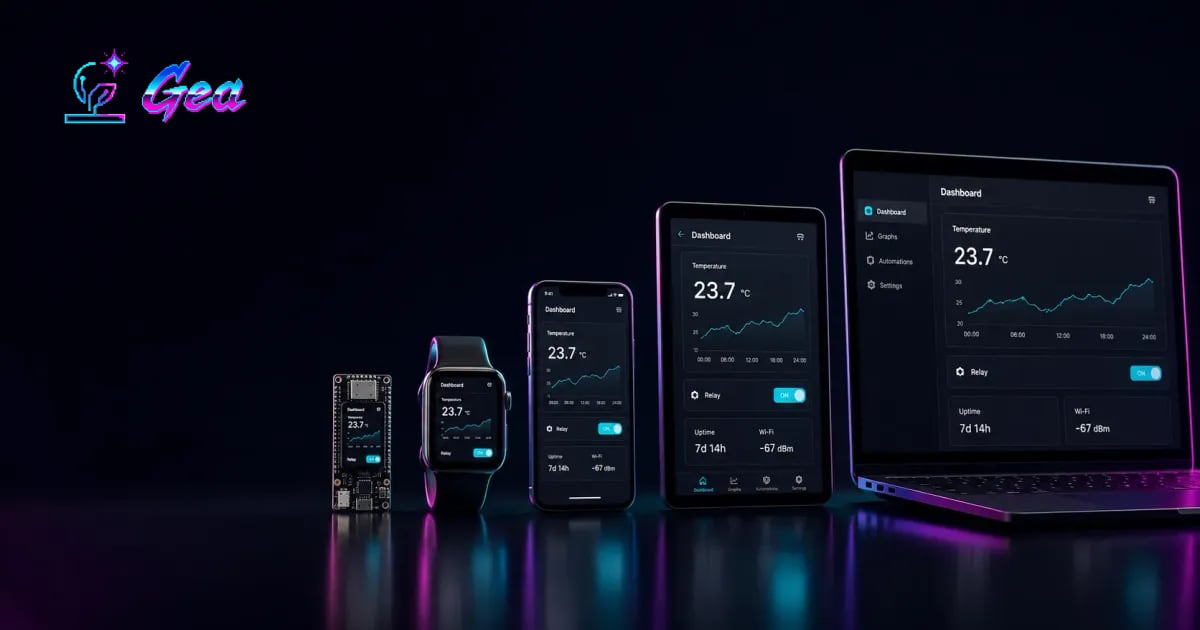
> Here's the catch. To put a decent interface on a seven-dollar board today, you still need C++, a board SDK... None of that looks anything like building for the web, so the way most people build interfaces stops at the edge of the device.

So they put a web browser in the device?

by Animats

Here is the author of Gea Stack. There is no browser in the device, none of these devices could run one with 512KB of RAM (+2-8MB of PSRAM). We instead transpile TypeScript and CSS into native code, so the UI you build with web technologies look and behave identical on a microcontroller.

by dashersw

I’ve had Claude build UIs from scratch in rust. No framework. I prompted it to make its own ImGUI style Ui system and a few minutes later I had texts, icons, buttons, sliders, scrolling lists, etc..

All my experience tells me it can do it with or without a GPU meaning if you don’t have one it can easily write a software render for a UI

by socalgal2

AI + hardware has really helped my wife and I get more sleep.

I had an esp32-box-3 lying around from a lapsed "voice agent" project from a year or two ago. Had a baby. Baby moved to another room, sleep trained. Baby either: 1. wakes up a few times a night, babbles for a bit, goes back to sleep OR 2. baby wakes up and fusses for N (=10) minutes, at which point parents need to go in and settle (that's the sleep training routine we use).

In either case, we do NOT want to wake up every time the baby does. Baby can go back to sleep easily, we adults have a harder time. A few rounds with Claude and the esp32 is now our new baby monitor. It tracks cry/fuss duration and publishes an audio stream (via a web UI or direct with, say, VLC). The audio only comes through AFTER N minutes of fussing have elapsed. It also posts notifications (to ntfy) after 30s and N minutes. My log says baby often wakes up 1-2 times a night and resettles almost immediately. We only wake up if the audio comes through, after N (10) minutes.

Also during the day it's really handy to be notified when baby has woken up from her nap. Let's us be out of the house, or in a distant room, and still keep track of what's going on.

It's fun to keep improving and adding features to this. Never would have had the time/energy to get this done without a coding agent. I ordered a set of 10 more of the esp32-box-3s to give them out to my friends (well, some are for other projects... so much potential).

(EDIT: Yes, I know this isn't AI designing hardware, but even writing code for embedded off the shelf stuff feels like a huge new potential.)

by pugio

Baby monitors fundamentally need to be safe and allow parents peace of mind. Knowing they can constantly hear the baby and communicate verbally to soothe, as if you were in the room with them, allows this. It already means you only have to respond and/or get up to tend if they are still unsettled after a period of time. Monitors also have volume control so you can stay alert without being constantly disturbed.

The traditional baby monitor system had three states (ON and functional, ON and non-functional, OFF). It provides a constantly available and instantaneous test for "functional" - as long as you can hear sound from the other unit, it's almost guaranteed to currently be in a safe condition. Monitoring is constant, human-first, and all human. The system is relatively fail-safe.

Your design replaces this with a multi-state system and algorithms (adding ON in listening mode, ON in delay mode with output off, ON and partially-functional etc.). It removes any reliable method to prove an obviously "functional" state at any given time. Monitoring is non-constant (for the human), machine-first, and human as last resort (like corporate customer services). The system is not fail-safe despite being machine-first and at higher risk of error or malfunction due to complexity.

The risks include a few failed notifications or incorrect delay timing leading to early developmental trauma, such as fear of abandonment. It doesn't take much. We are still learning to deal with this human-human, before adding invisible unknowns.

If nothing else, what are babies likely to learn in a pre-verbal state where the days are spent sensing and observing their environment to develop the brain? It'll probably be how to game the baby monitor algorithm.

> Also during the day it's really handy to be notified when baby has woken up from her nap. Let's us be out of the house, or in a distant room, and still keep track of what's going on.

If you are going out of earshot of the baby by doing this, you are fully relying on the technology being functional. That would seem unnecessarily risky, and not nice for the baby (they can sense this stuff). The odds of a catastrophe are low in a singular environment, but still enough to worry. Almost inevitably it would end badly if this were scaled to a mass consumer product.

The idea is interesting from an engineering view, but from a human one it feels dystopian to insert a machine between parent and baby to this extent. It removes/replaces a layer of human-human connection. Where does engineering the natural human experience out of life end? Automated feeding? AI nannies and teachers? Then onto AI therapist?

My suggestion would be to do a lighter version of the features in a system which focuses on safety (always being able to monitor no matter what, for example on the ESP32, you could have the second core independent and direct-output the feed if the first core hangs or crashes). Feature-wise, rather than not alerting for 10 minutes, you could apply a DSP algorithm which reduces harsh frequencies for this period, whilst slowly increasing the output volume of the monitor.

I like the idea of alerts because it expands the base features without risk, and crucially makes the babies life better, as alerts could be sooner for important things that do need attention quickly. As an experiment, you could add an SD card and record snippets of cries which ended up in alerts, tag them with an ordered list of what you did to soothe or what was wrong, and see if AI can make anything of the data. Maybe certain cries can trigger alerts sooner, or cries over an extended period may indicate fever.

by pardon_me

This actually feels like something that could be a popular app on a baby monitor.

by petra

This is one of the killer use cases of AI, build personalized stuff for your life, that no company does. It is kind of generalized „intelligent stuff“ that one can use. Like minecraft your life

by thatsit

This reminds me of the other article posted on here, https://isene.org/2026/05/Audience-of-One.html Everyday more bespoke dotfiles are coming online for an audience of one. I am not surprised that this is coming to hardware as well.

by arikrahman

Mmmmmmmmmm… sort of.

If you are keeping inside the LEGO level of complexity, almost. But just as with code, if the project is complex you need a real engineer herding the cats. That said, it certainly can extend the reach of an effort, and is a huge help doing board reviews and data sheet analysis, etc. but the real engineering decisions are very very hit and miss, just like with code.

by K0balt

The keyboard enthusiasts got to "personalized hardware" pretty early, so there might be some lessons there.

There's a whole continuum from "Buy an off the shelf unit" to "here's a barebones case you can slide ready made switches and caps into" to "mix and match custom PCBs and cases" to designing your own PCBs and/or cases. There are pretty clear pipelines and even some levels of tooling for "draw up the layout you want and get a bunch of files you can send to production houses"

Takeaway 1: A lot of this is grounded in economic realities. I did the full bespoke route (custom PCB, custom 3-D printed case) and figured it probably cost me about $500 all inclusive to get what I wanted, and that's honestly a lot of money for a keyboard.

AI won't solve any of the economic problems. They can't fix "the minimum PCB order is N units, so now you have a drawer full of spares you paid for". They can't make the expensive part you needed cheaper, especially if you're an individual buying quantity of 1/5/10 instead of an OEM buying reels and containers-full. They can't change the fact that a case for a large widget will be expensive to mill/3-D print/mould/etc.

Takeaway 2: Customers may have surprisingly limited imagination for bespoke gear. There are galleries (and even coffee-table books) full of exotic keyboards. But Micro Center is full of $50 interchangeable "tenkeyless with RGB lighting" boards; throwing on a random set of "custom" keycaps, and that's enough for a large part of the audience.

Will these customers want or benefit from more tools, or will it just give them rope to hang themselves on and give them an excuse to bail out of the purchase entirely? Even if you can provide them a gallery of vetted turnkey choices, there might be more choice paralysis than actual benefit.

Takeaway 3: Hardware is forever (relative to software). You have a lot of small firms and group-buy products that disappeared and now the owners can't get an exact replacement or repairs. Conversely, Unicomp can gut and rebuild a 1986 Model M with new innards in large part because they've been selling the same basic design since a 386DX/16 cost as much as a Toyota Tercel.

If your AI spawns a galaxy of 1-of-1 bespoke products, who services and supports them? That seems like it's only going to appeal to the enthusiast-hacker type who can keep them alive themselves, who is least likely to need AI help designing them. Design for disposability isn't a great look for anything but incredibly low-cost, limited-usecase items.

by hakfoo

While personalization is definitely the trend, I don't think people are going to build code just to personalize. A tiny few of all who bought the device could do that. A few more could flash the device with some open firmware that gives more features and personalization and most will stick with the range of the personalization provided by the vendor.

For the most people, the risks outweigh the desire for tinkering. Personalization will grow right at the vendor offering, not in the hands of customer. People don't even have the time to cook their own recipes. People have their own chores to worry about. I'm talking about bulk of the customer base, not the geeks.

by zkmon

> Personalization will grow right at the vendor offering

I think so. There will be a short period, like now, where many will attempt to build their own products and the five good ideas out of five thousand will be incorporated into products built by those who know what they’re doing.

An absolutely technophobic friend asked me what agentic AI was today. I think Charlie Munger said “When even your barber is talking about it, sell and run”

by willtemperley

I'd include the geeks in that.

I've been programming computers and tinkering with all sorts of hardware for more than 30 years. I first used FreeBSD in.....2001? and Linux not long after that. I've programmed OS code, I've grudgingly written VHDL, I've assembled a sound card for the Apple II I still have running - all this to say that I believe I'm in your tiny few.

And I'm so tired. Tired of having to debug all the things. Tired of having to pay attention to them. Tired of setting them up "just once" and then months later having to reverse engineer my own work because something failed.

So I don't. I leave nearly all my devices stock. I run Windows because I'm sick of debugging device driver issues. And I don't want personalized hardware with any electronics in it (bespoke wooden objects, those I love and make).

by Arainach

I don't think people have realized it yet, but AI can do hardware too. That's what I had hoped this was about.

I had Claude design an entire 4 layer rp2040 based PCB from scratch and PCBWay build it. It worked on the first go, other than some silkscreen overlapped, which doesn't hurt anything. That was before Fable.

Then I had it design a case for the new pcb to 3d print. Also worked the first go, but with minor cosmetic issues.

People have yet to even BEGIN to appreciate what these things can do with the right harness.

by mapontosevenths

Join the discussion

Write your take first — we'll ask for email only when you're ready to publish.

  • Hacker News
  • I do agree that hardware gap starts to shrink, similarly to what Software gap once used to be. It is much easier to avoid spending time loading the right drivers and looking up what error message on that tiny device you are working on means. Especially if AI could run in terminal itself.

    I tried building a health device few years ago and got completely lost in how to setup camera and touch display with a raspberry PI. Would imagine, with AI running in a command line, it would be much easier.

    by Losenok
  • well my phone can do almost everything
    by dominotw
  • anything but be owned by you
    by tejtm
  • I love the slider UI element to switch between different examples on their landing page (https://geastack.com/)... not sure if satire or real.
    by jo-m
  • It is real :)
    by dashersw
  • That's… good. It's a page-snapping scrollbar. Much better than the common row of dots and arrows.
    by kps
  • "So the interesting question isn't whether personal hardware is coming. It's who gets to write the software that runs on it."

    It's not that I don't like your point of view. It's that I can't stand AI slop.

    by sasaf5
  • > People build their own applications now

    All the people that I know in tech and not in tech, don't do that, even if presented with the option they're too busy to also get into this endeavour that still requires a lot of expertise. I stopped reading there

    by hollowturtle
  • Ehhh, maybe? I haven't heard many people wishing for devices that were within the realm of practicality (I.E. not a flying car). If someone has an actual good idea, then the cost of the components and tools and rework is the next major hurdle (soldering by hand is where cool ideas go to die). Meanwhile a commercial off-the-shelf device probably works good enough.
    by phendrenad2
  • Instead of staring down at their phones in social situations people can pretend to pay attention wile looking at a screen. Can't wait for zombie stairs.
    by MisterTea
  • I recently grabbed a cheap e-reader and installed a fork of the firmware so I could use it as a dumb terminal for an agent. Hackable firmware lets you totally change a product
    by sarocu
  • With hardware/computers becoming locked, thin clients and unaffordable we're already forced to customize our devices cyber punk style.

    You're lucky if you're in a region where these open-hardware companies sell their wares, even though many of them will go under in the current market.

    by Abishek_Muthian
  • I feel like the article ignores the elephant in the room — production costs.

    Producing PCBs (say, 5 or 10 units) is pretty expensive, and components are also costly on such a small scale. Combining these two requires additional money or time. Beyond that, you need to consider that you probably won't get it right the first time, and every attempt multiplies the cost.

    It'll be a deal-breaker for many people — the risk is just too high.

    by StrLght
  • Pcbs are basically rolling off a laser jet printer in shenzhen and they’ll do pnp for a few dollars more. Pcb cheap.

    Have engineer sit there to design pcb is expensive

    by engineer_22
  • I won't submit to data sniffing from corporation, so "personalized" hardware won't make it into this area here.

    By the way, this is not new either. In the 1990s Microsoft tried to convince people how great it is if their fridge gives data to MS so MS can order needed food etc..

    Fast forward some decades - many don't want to yield any more data to private entities, no matter which alleged "benefit" this would bring.

    by shevy-java
  • And it's probably going the same way all the personalized software we've been seeing: used as a spam "I built this" post on reddit or hacker news and to never be touched again.

    With hardware you get extra safety risks of fires and shocks, so let's see

    by witx
  • > Here's the catch. To put a decent interface on a seven-dollar board today, you still need C++, a board SDK... None of that looks anything like building for the web, so the way most people build interfaces stops at the edge of the device.

    So they put a web browser in the device?

    by Animats
  • Here is the author of Gea Stack. There is no browser in the device, none of these devices could run one with 512KB of RAM (+2-8MB of PSRAM). We instead transpile TypeScript and CSS into native code, so the UI you build with web technologies look and behave identical on a microcontroller.
    by dashersw
  • I’ve had Claude build UIs from scratch in rust. No framework. I prompted it to make its own ImGUI style Ui system and a few minutes later I had texts, icons, buttons, sliders, scrolling lists, etc..

    All my experience tells me it can do it with or without a GPU meaning if you don’t have one it can easily write a software render for a UI

    by socalgal2
  • AI + hardware has really helped my wife and I get more sleep.

    I had an esp32-box-3 lying around from a lapsed "voice agent" project from a year or two ago. Had a baby. Baby moved to another room, sleep trained. Baby either: 1. wakes up a few times a night, babbles for a bit, goes back to sleep OR 2. baby wakes up and fusses for N (=10) minutes, at which point parents need to go in and settle (that's the sleep training routine we use).

    In either case, we do NOT want to wake up every time the baby does. Baby can go back to sleep easily, we adults have a harder time. A few rounds with Claude and the esp32 is now our new baby monitor. It tracks cry/fuss duration and publishes an audio stream (via a web UI or direct with, say, VLC). The audio only comes through AFTER N minutes of fussing have elapsed. It also posts notifications (to ntfy) after 30s and N minutes. My log says baby often wakes up 1-2 times a night and resettles almost immediately. We only wake up if the audio comes through, after N (10) minutes.

    Also during the day it's really handy to be notified when baby has woken up from her nap. Let's us be out of the house, or in a distant room, and still keep track of what's going on.

    It's fun to keep improving and adding features to this. Never would have had the time/energy to get this done without a coding agent. I ordered a set of 10 more of the esp32-box-3s to give them out to my friends (well, some are for other projects... so much potential).

    (EDIT: Yes, I know this isn't AI designing hardware, but even writing code for embedded off the shelf stuff feels like a huge new potential.)

    by pugio
  • Baby monitors fundamentally need to be safe and allow parents peace of mind. Knowing they can constantly hear the baby and communicate verbally to soothe, as if you were in the room with them, allows this. It already means you only have to respond and/or get up to tend if they are still unsettled after a period of time. Monitors also have volume control so you can stay alert without being constantly disturbed.

    The traditional baby monitor system had three states (ON and functional, ON and non-functional, OFF). It provides a constantly available and instantaneous test for "functional" - as long as you can hear sound from the other unit, it's almost guaranteed to currently be in a safe condition. Monitoring is constant, human-first, and all human. The system is relatively fail-safe.

    Your design replaces this with a multi-state system and algorithms (adding ON in listening mode, ON in delay mode with output off, ON and partially-functional etc.). It removes any reliable method to prove an obviously "functional" state at any given time. Monitoring is non-constant (for the human), machine-first, and human as last resort (like corporate customer services). The system is not fail-safe despite being machine-first and at higher risk of error or malfunction due to complexity.

    The risks include a few failed notifications or incorrect delay timing leading to early developmental trauma, such as fear of abandonment. It doesn't take much. We are still learning to deal with this human-human, before adding invisible unknowns.

    If nothing else, what are babies likely to learn in a pre-verbal state where the days are spent sensing and observing their environment to develop the brain? It'll probably be how to game the baby monitor algorithm.

    > Also during the day it's really handy to be notified when baby has woken up from her nap. Let's us be out of the house, or in a distant room, and still keep track of what's going on.

    If you are going out of earshot of the baby by doing this, you are fully relying on the technology being functional. That would seem unnecessarily risky, and not nice for the baby (they can sense this stuff). The odds of a catastrophe are low in a singular environment, but still enough to worry. Almost inevitably it would end badly if this were scaled to a mass consumer product.

    The idea is interesting from an engineering view, but from a human one it feels dystopian to insert a machine between parent and baby to this extent. It removes/replaces a layer of human-human connection. Where does engineering the natural human experience out of life end? Automated feeding? AI nannies and teachers? Then onto AI therapist?

    My suggestion would be to do a lighter version of the features in a system which focuses on safety (always being able to monitor no matter what, for example on the ESP32, you could have the second core independent and direct-output the feed if the first core hangs or crashes). Feature-wise, rather than not alerting for 10 minutes, you could apply a DSP algorithm which reduces harsh frequencies for this period, whilst slowly increasing the output volume of the monitor.

    I like the idea of alerts because it expands the base features without risk, and crucially makes the babies life better, as alerts could be sooner for important things that do need attention quickly. As an experiment, you could add an SD card and record snippets of cries which ended up in alerts, tag them with an ordered list of what you did to soothe or what was wrong, and see if AI can make anything of the data. Maybe certain cries can trigger alerts sooner, or cries over an extended period may indicate fever.

    by pardon_me
  • This actually feels like something that could be a popular app on a baby monitor.
    by petra
  • This is one of the killer use cases of AI, build personalized stuff for your life, that no company does. It is kind of generalized „intelligent stuff“ that one can use. Like minecraft your life
    by thatsit
  • This reminds me of the other article posted on here, https://isene.org/2026/05/Audience-of-One.html Everyday more bespoke dotfiles are coming online for an audience of one. I am not surprised that this is coming to hardware as well.
    by arikrahman
  • Mmmmmmmmmm… sort of.

    If you are keeping inside the LEGO level of complexity, almost. But just as with code, if the project is complex you need a real engineer herding the cats. That said, it certainly can extend the reach of an effort, and is a huge help doing board reviews and data sheet analysis, etc. but the real engineering decisions are very very hit and miss, just like with code.

    by K0balt
  • The keyboard enthusiasts got to "personalized hardware" pretty early, so there might be some lessons there.

    There's a whole continuum from "Buy an off the shelf unit" to "here's a barebones case you can slide ready made switches and caps into" to "mix and match custom PCBs and cases" to designing your own PCBs and/or cases. There are pretty clear pipelines and even some levels of tooling for "draw up the layout you want and get a bunch of files you can send to production houses"

    Takeaway 1: A lot of this is grounded in economic realities. I did the full bespoke route (custom PCB, custom 3-D printed case) and figured it probably cost me about $500 all inclusive to get what I wanted, and that's honestly a lot of money for a keyboard.

    AI won't solve any of the economic problems. They can't fix "the minimum PCB order is N units, so now you have a drawer full of spares you paid for". They can't make the expensive part you needed cheaper, especially if you're an individual buying quantity of 1/5/10 instead of an OEM buying reels and containers-full. They can't change the fact that a case for a large widget will be expensive to mill/3-D print/mould/etc.

    Takeaway 2: Customers may have surprisingly limited imagination for bespoke gear. There are galleries (and even coffee-table books) full of exotic keyboards. But Micro Center is full of $50 interchangeable "tenkeyless with RGB lighting" boards; throwing on a random set of "custom" keycaps, and that's enough for a large part of the audience.

    Will these customers want or benefit from more tools, or will it just give them rope to hang themselves on and give them an excuse to bail out of the purchase entirely? Even if you can provide them a gallery of vetted turnkey choices, there might be more choice paralysis than actual benefit.

    Takeaway 3: Hardware is forever (relative to software). You have a lot of small firms and group-buy products that disappeared and now the owners can't get an exact replacement or repairs. Conversely, Unicomp can gut and rebuild a 1986 Model M with new innards in large part because they've been selling the same basic design since a 386DX/16 cost as much as a Toyota Tercel.

    If your AI spawns a galaxy of 1-of-1 bespoke products, who services and supports them? That seems like it's only going to appeal to the enthusiast-hacker type who can keep them alive themselves, who is least likely to need AI help designing them. Design for disposability isn't a great look for anything but incredibly low-cost, limited-usecase items.

    by hakfoo
  • While personalization is definitely the trend, I don't think people are going to build code just to personalize. A tiny few of all who bought the device could do that. A few more could flash the device with some open firmware that gives more features and personalization and most will stick with the range of the personalization provided by the vendor.

    For the most people, the risks outweigh the desire for tinkering. Personalization will grow right at the vendor offering, not in the hands of customer. People don't even have the time to cook their own recipes. People have their own chores to worry about. I'm talking about bulk of the customer base, not the geeks.

    by zkmon
  • > Personalization will grow right at the vendor offering

    I think so. There will be a short period, like now, where many will attempt to build their own products and the five good ideas out of five thousand will be incorporated into products built by those who know what they’re doing.

    An absolutely technophobic friend asked me what agentic AI was today. I think Charlie Munger said “When even your barber is talking about it, sell and run”

    by willtemperley
  • I'd include the geeks in that.

    I've been programming computers and tinkering with all sorts of hardware for more than 30 years. I first used FreeBSD in.....2001? and Linux not long after that. I've programmed OS code, I've grudgingly written VHDL, I've assembled a sound card for the Apple II I still have running - all this to say that I believe I'm in your tiny few.

    And I'm so tired. Tired of having to debug all the things. Tired of having to pay attention to them. Tired of setting them up "just once" and then months later having to reverse engineer my own work because something failed.

    So I don't. I leave nearly all my devices stock. I run Windows because I'm sick of debugging device driver issues. And I don't want personalized hardware with any electronics in it (bespoke wooden objects, those I love and make).

    by Arainach
  • I don't think people have realized it yet, but AI can do hardware too. That's what I had hoped this was about.

    I had Claude design an entire 4 layer rp2040 based PCB from scratch and PCBWay build it. It worked on the first go, other than some silkscreen overlapped, which doesn't hurt anything. That was before Fable.

    Then I had it design a case for the new pcb to 3d print. Also worked the first go, but with minor cosmetic issues.

    People have yet to even BEGIN to appreciate what these things can do with the right harness.

    by mapontosevenths

Related stories