Discussion summary
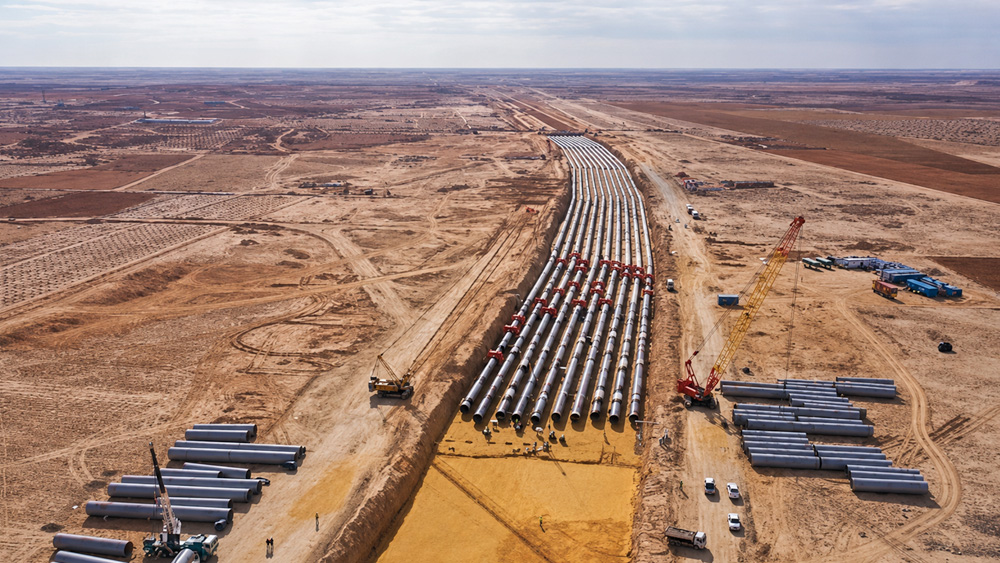
Discussions revolve around a new Nile project in Egypt, with skepticism about its details and potential environmental impacts. Concerns about Egypt's rapid population growth and sustainability are also prominent.
What the discussion says
- Some believe the project could significantly impact regional weather and rainfall.
- Others are skeptical about the project's existence or details due to source credibility.
- There is concern about Egypt's ability to sustain its rapidly growing population.
“This could completely terraform the weather for the entire region.”
“Egypt is trapped in mega projects death spiral.”
Join the discussion
Write your take first — we'll ask for email only when you're ready to publish.
- Hacker News
- I don't believe it.by 2OEH8eoCRo0
- This could completely terraform the weather for the entire region. Possibly even increasing the amount of rain in the middle east overall.by hparadiz
- Aren't they already on Terra, or did I miss something?
- Egypt is trapped in mega projects death spiralby gl-prod
- With a such rapid demographic growth they have no choice. The population of Egypt doubled in last ~35 years. (quadrupled in the last ~60 years)by betaby
- How is that even sustainable, like housing, education, electricity, running water, etc. how can they scale those with that fast growing population
- That's true for now, although their rate of population growth appears to have peaked several years ago and like most other countries the birth rate has since declined sharply.by nradov
- Do we have a better source? This article contains repeating text which makes me suspect copy-pasted slop.
EDIT: This [1] is better.
[1] https://meobserver.org/nutrition/2026/05/18/egypts-new-delta...
- I'd suspect it's a transcript of a video on his (excellent) YouTube[0], hence the repetition.by kristjansson
- Egypt is also hard at work transforming the Sinai Plain and the vicinity of Mount Sinai itself, into a tourist magnet, and a thriving hotel/resort region. The monks of St. Katherine's monastery are nonplussed about these developments.
(Many monasteries and convents in modern times are renowned, and/or an open secret, for their peaceful hospitality, and gladly welcome pilgrims and tourists for overnight stays, especially in places where the hotels are in short supply, and especially in places like Republic of Ireland, where the monasteries' populations are dwindling, and losing donors, while the tourist trade is stronger every day...)
- The article makes a good point about food imports to Egypt. I think a lot of people don't realize that Egypt has been an innocent victim of Russia's invasion of Ukraine which disrupted wheat exports.
Recent strikes by Ukraine on Russian oil refineries are in turn disrupting Russian grain harvests due to shortages of diesel fuel. While this is a legitimate defensive tactic by Ukraine, as a side effect it's likely to cause further food price inflation in Egypt.
by nradov - Maybe the Egyptian government could pressure Putin to stop killing innocent people and sending young men to the front to needlessly die, how about that ?by bamboozled
- This is not the first project like this Egypt has tried. All have failedby daedrdev
- State and financial capacity is much stronger in Egypt today versus previous attempts.
Egypt's developmental indicators have finally caught up to where the CEE was 5-10 years ago but with a better demographic profile, and Gulf and Asian capital and technology partners are much more hands-on.
by alephnerd - To be fair, Egypt and Mexico made major reforms to their water usage in the past and succeeded. Compared to India, which failed abjectly.by a34729t
- This article has several passages repeated verbatim. Either bad AI or bad editing, not really a great advertisement for the product (“Brilliant”) it seems to be selling.
Example: “The construction of the Aswan High Dam, completed in 1970, brought clear benefits. It provided a steady supply of hydroelectric power and allowed water to be regulated for year-round irrigation.” appears twice, word for word.
by ojbyrne - I skimmed through the article. Several pictures are also repeated. Would this kind of thing happen before 2020? I don't think so.
Either way, I got taught in high school geography that parts of rivers get rebuild all the time. The Maas (Meuse, as Dutch is my native language I say Maas) gets longer due to the corners getting more sharp (due to water and wind erosion). Then at some point, the water might actually go straight between two corners, leading to the part between the two corners (an extra 180 degrees of two corners, though might look like one) getting cut. Sometimes, that doesn't happen (quick enough) and humans need to help nature a bit. Because sometimes, the new part of river tends to reach villages or other parts of society humans want to preserve. So, we interfere. Near Maastricht, there's also a canal next to the Maas, and this can help with deficit or excess water in the Maas. But sometimes, even an extra part of river next to the old river is build. IIRC they do that because the erosion destroyed such parts, that the outcome of the erosion keeps coming back and back in too short amounts of time. So then, it makes more sense to look for a more long term solution.
The water and wind erosion were interesting to me back in the days. So, from memory (and I surely am forgetting something here, possibly related to the chemistry of the water/earth), the way it works on low water level the wind on the corners erodes the corners, while on high water level the water pressurizes against the corner, leading to basins in the (wind eroded) corner which itself is part of the domino effect. In other words, it is bound to happen, given time. The river snaking around is bound to happen, and the breach is bound to happen as well. But the breach usually means the river goes to its original pathway (although temporarily).
So for a large river as the Nile, it also comes as no surprise Egyptian government (Egypt being the country who benefit from the Nile delta) invests in the Nile. But the main problem the Nile faces is AFAIK related to drought which is related to climate. I'm not sure how they want to fix that.
by Fnoord - Wiki:
"A feddan (Arabic: فدّان, romanized: faddān) is a unit of area used in Egypt, South Sudan, Sudan, Syria, and Oman. In Classical Arabic, the word means 'a yoke of oxen', implying the area of ground that could be tilled by oxen in a certain time. In Egypt, the feddan is the only non-metric unit which remained in use following the adoption of the metric system. A feddan is divided into 24 kirat (Arabic: قيراط, qīrāt), with one kirat equalling 175 square metres."
So 2.2M feddan works out to 9240 km^2. That is: roughly same area as a square with 96 km sides.
"Officials indicate the system will utilise roughly 10 million cubic metres of surface water daily alongside approximately 7.5 million cubic metres of treated drainage water per day, reflecting Egypt’s growing reliance on advanced water-recycling and smart-irrigation technologies amid mounting regional water pressures."
Article isn't clear on where either component comes from. Not an amount you could divert from somewhere without huge environmental effects elsewhere.
(Edit: quote is from the ME Observer article a commenter linked below. Original post seems to have more details)
Anyway sounds like an ambitious project. And understandable given Egypt's population vs. resources pressures (esp. water).
by RetroTechie - 10 million cubic meters per day is roughly 100 cubic meters per second. Aswan discharges 2800 m3/s on average. So around 4% of the flowby yread
- So similar origin to the Imperial acre; which it is very close in size to:
You have: 175*24m^2 You want: acre * 1.0378426 / 0.96353724by aidenn0 - A lot of where they are getting water from right now is an ancient underground aquifer - there's not a lot of water there though, so the plan was it was a stopgap while the water recycling plan comes online.
Although the aquifer water plan itself is largely failing. The underground water was much more saline than they originally thought, so from space you can see lots of failed irrigation circles.
by legitster - It's practically a project of the Egyptian military who will mostly own the land. They will grow cash crops for export to gain a source of income.
This will also drain the ancient and non-renewable Nubian Sandstone Aquifer. This is water that has been trapped for thousands of years. It is the world's largest fossil water system and is of immense scientific value.
Not to mention the historic Nile Delta wetlands that will be lost from diversion and the massive increases in CO2 emissions necessary to pump the water at the elevation of the desert (which is higher than the Nile basin). Also the inevitable salination of soil means any economic benefits to this project are on a countdown.
by culi - "Sounds like a great idea" -- Modern Humansby bamboozled
- I'm curious as to why they aren't considering (solar powered) desalinization as an additional source of water, to pump water directly from the ocean?by atonse
- Draining (or even using) the aquifer was never part of the plan. The goal has always been to have two streams of water come in from treated sewage/desal plants and the Nile itself. The problem being that the area they are trying to irrigate is higher than where they are pumping it from so they have something like 13 pump stations pumping the water uphill. Hopefully they figure it out and can eventually power the pump stations with solar+batteries so they don’t have to drain the aquifers. For alignment, the current status is dismal with almost all the water coming from just the aquifers.by dyauspitr
- > It's practically a project of the Egyptian military who will mostly own the land
It's a public-private project with Gulf and Asian financing and execution.
Sisi is a dictator, but he can and does execute. Look at how Egypt's developmental indicators have shot up over the past decade - that was not guaranteed, and he deftly took advantage of non-Western partners to push the reforms Egypt needs.
by alephnerd - Here’s the source of the problem https://en.wikipedia.org/wiki/Grand_Ethiopian_Renaissance_Da...by netdur
- I’m not sure why the military running it makes this project inherently bad.
You can always point to some geological or ecological reason why a resource shouldn’t be developed. Here in western Kansas there is some endangered chicken grouse that is constantly used to prevent wind turbines from being constructed. It’s just an excuse to block development, as is the concern you’re raising.
I doubt the people who need water to survive give a damn about CO2 emissions. There will be environmental damage, for sure. It will be worth it to these people who will live better lives because of it. Ultimately, Egyptian leadership gets to make that call, not you or I.
If you really care about the environment, you should support these kinds of projects that will raise incomes to the level where Egyptians can afford to care about environmental conservation.
by MisterMower - Any large government project in Egypt is a project of the Egyptian military. That’s the result of being under a military dictatorship with a fake civilian president.by Revanche1367