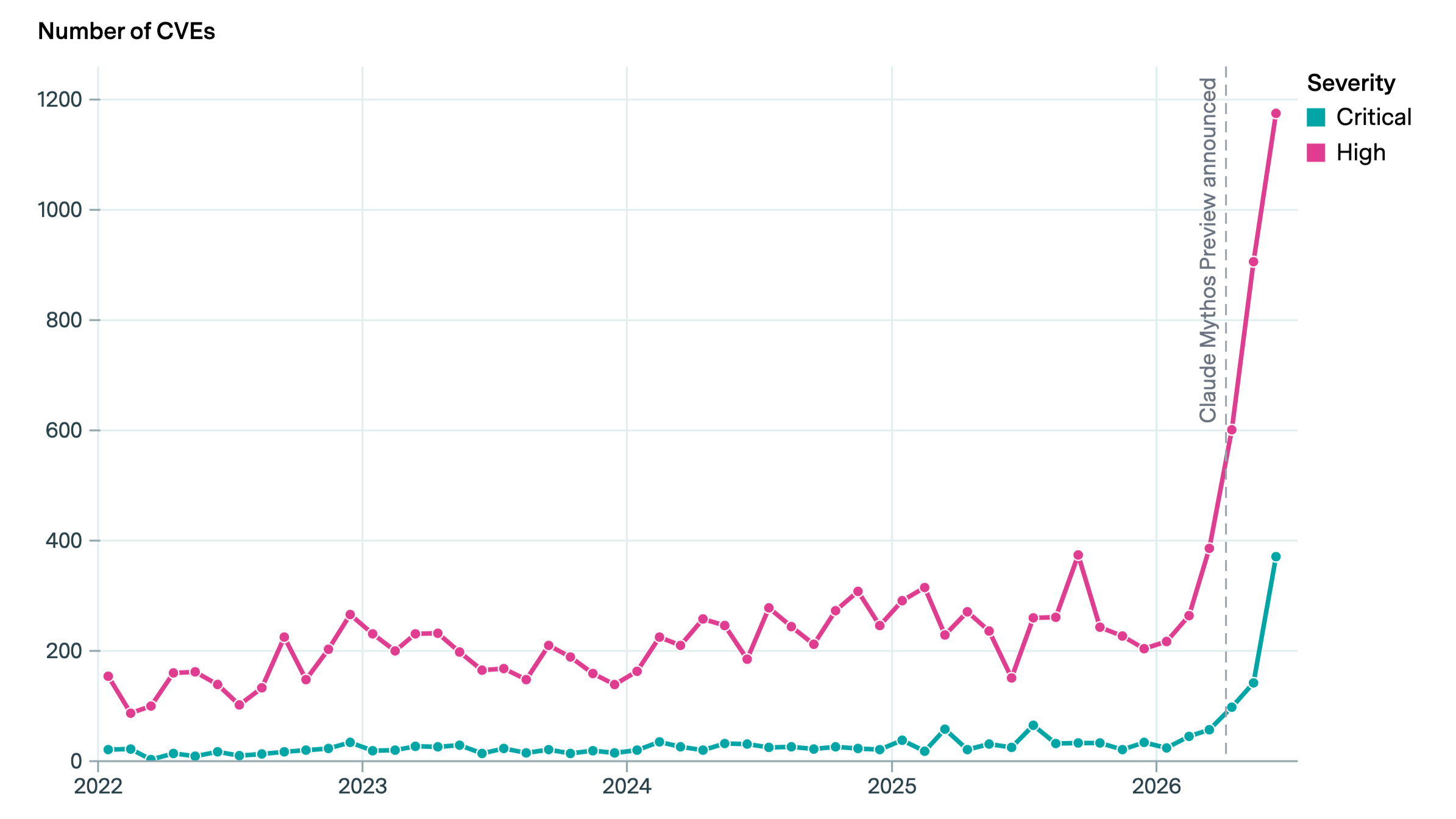
Discussion summary

Recent vulnerabilities surged around the release of Claude Mythos Preview, sparking debate on whether LLMs are better at finding bugs or if increased usage causes more vulnerabilities. Some see this as a positive for software quality, while others note it may be influenced by external factors like geopolitical events.

What the discussion says

  • LLMs may be better at finding vulnerabilities.
  • Increased use of LLMs could lead to more vulnerabilities.
  • Vulnerability patches also increased, indicating more bug discovery.
  • Some see this as a sign of improved software security.
  • Others suggest external factors like geopolitical tensions may influence these spikes.
It's almost like... Finding bugs is a good thing.
nullbio
Poor quality software gets outed and maybe fixed.
6d7770

Join the discussion

Write your take first — we'll ask for email only when you're ready to publish.

  • Hacker News
  • those spikes in march and june? war with iran. interesting...
  • How many are valid and reproducible ones and how many are just mythical unicorns?
  • …are we really drawing conclusions on this starting at April? When it was released in June?
  • Not really special, which was the point, its a general model. This is really good marketing as all other LLMs are able to do the same work.
  • Glass wing was announced April 7th.
  • Mythos is from April, it was just limited to a small number of organizations.
  • So basically there are two plausible explanations:

    1. Someone with early access to Mythos leaked it to the bad guys.

    2. Cybercriminals are getting enough mileage out of alternatives to Mythos to create exploits far more quickly, even though they don't have access to Mythos.

    My own guess is that it's a combination of #2 plus vibe-coding degrading software quality at multiple layers, open the door to sophisticated exploits, but I have no insider access to Mythos so am just guessing. Maybe someone with Mythos access might say why they think this vulnerability spike happened when it did.

  • Disclosure of a vulnerability doesnt mean a bad guy found it.
  • I think it's rather this:

    3. People were already sitting on vulnerability reports from their own tools and threw them over the wall.

    They were worried about getting scooped. They had to consider Mythos' alleged capabilities as a tool, and Project Glasswing potentially establishing a well-run disclosure and remediation process. Both could devalue preexisting results.

  • I might be missing something here, but why do you assume this spike in CVEs is from bad guys? I would assume it's at least largely good guys finding and reporting vulns, not based on in-the-wild exploitation by bad guys.
  • Bad guys don't report vulns, they use them.
  • Maybe a bit of both Mythos helping find bugs and engineers relying on AI shipping more bugs. Both can be true.
  • I predict once the responsible disclosure period is up we will see a lot more
  • How are these reports verified to be valid? If there are too many some could be hallucinations too.
  • The best case scenario for AI companies is, people receive those bug reports, look at the model that produced it and not even look at the details, just apply the fix mindlessly

    This gives Anthropic a staggering amount of power. Oh it came from Mythos? We will just lose time trying to analyze it, better apply the fix ASAP

  • We (Project Glasswing users) follow a proof-of-concept approach. We create the exploit and verify that it behaves as the AI claims. Given our experience as security engineers (many of us with 10+ YoE) we don’t simply report every critical bug Mythos claims to have found. We verify each one carefully.

    At least, that’s what most of the high-visibility users in Project Glasswing are doing.

    There are bad apples everywhere, and this initiative is no exception.

    If it makes you feel any better, many of us regularly meet to stay calibrated and hold each other accountable, so I’m confident in the quality of the work produced by this particular group of employees across some of the partner companies mentioned in the article.

    That said, I know several people who blindly report everything Mythos finds, which is foolish, especially since the harness is a critical part of the project's quality metrics. Some of the harnesses I’ve tested are quite weak, which leads to poor results.

    For example, yesterday morning I was pulled into an ad hoc meeting where a CVP was grilling me about several supposedly critical bugs that my team had reported against one of the core components of iCloud. I was genuinely surprised because we’re very strict about validation. We often even downgrade the severity of bugs when our harness can’t prove what Mythos found. After reading the reports, I realized they weren’t ours. They came from another team that had recently been given access to Mythos. They built their own harness and were using different vulnerability criteria. Fortunately, they had only started earlier this week, so I was able to stop that work.

    That incident showed that not everyone involved in Project Glasswing follows the same standards. Most people do their best, but priorities differ, so it’s expected that you’ll find a few bad apples.

    I wish AI labs would stop the theatrics and release their models without restrictions, but I also recognize that’s not the world we live in. For every person who wants to use these technologies for good, there are many others who would use them for harm.

    In any case, while I agree that some experiments contain genuine noise, the CVE count is real.

  • This is hardly news? We've known for months that a flood of AI-assisted vulnerabilities was coming; I posted on Twitter in March calling 2026 the year of a million CVEs: https://x.com/i/status/2035045573116789002
  • It's also unclear what's cause and what's effect. Given the massive amount of overhyped scaremongering around Mythos, it could just mean that people ran their code through some other AI, or even just panicked and started taking security a bit more seriously without any AI involved. That was certainly the case at one company I know of, the mgt. suddenly pushed some resources towards identifying security issues.
  • In pretty much every single HN post on this topic, there are a number of commenters claiming it’s false. Continued quantifiable data like this seems very important at hopefully resolving the ongoing disagreement about the facts.
  • I do maintain dozens of C/C++/Perl projects. I got massive amounts of new good vulnerability reports, more than with the latest fuzzing waves. Fuzzing is still the majority overall, but Opus dominates now. Haven't got any Mythos/Fable vuln yet. And with the help of Sonnet/DeepSeek I can finally get around and weed out all the still existing fuzzing bugs. It has nothing to do with Mythos for me, just people getting Anthropic Max accounts.

    And CVE's: People actually do that now, which before they didn't. Github allowing it now, certainly does help massively. This is a good thing

  • On my hobby coding with C++ I also cross check with CoPilot, alongside the usual VS analysis tools.

    Which was certainly an improvement, given that Github is in no hurry to add modules support to CodeQL.

  • Are CVE really a good thing for open source projects?

    No doubt is it a good thing to have issues reported and fixed, but CVE feels a bit like blackmailing maintainers - either you fix the issue or we get your project flagged with "security scanners".

    I guess, my distaste mostly originates from randomly assigned high CVE numbers that don't reflect the actual threat. And the fact that it gives the companies which use the code "AS IS" an imaginary stick to hit open source maintainers, until they fix the issues for the company (for free of course).

  • One of the major differences between Amodei’s and Hagseth’s views is that Hagseth said that in their world they don’t distinguish between “defensive” and “offensive” capabilities.

    In other words, a weapons missle defense system is equivalent to an attack one.

    I think that applying this thinking to software is a mistake. A lot of commercial software uses open source libraries under the hood, and and while the large corporations might have access to Mythos/Fable/gpt 5.6, the open source library maintainers typically don’t. That leaves them vulnerable to foreign adversaries who do have access to AI models. Attackers don’t need Mythos-level capability then, they just need to outperform whatever the maintainers are using.

    Which means that Anthropic’s decision to restrict security research on even Sonnet makes that gap (and thus an attackers opportunity) even larger.

    I say this as a coder who wants to release some of my internal libraries to open source. The risk now is that I open up my own products (which use those libraries) to vulnerability scanners while not having those kinds of detection methods myself. This, it’s safer to not release and keep internal than to risk increasing my own attack risk.

    Hopefully we will come to see that software is not equivalent to missle defense — writing safe code is different than attacking others’.

  • You're right on that, https://www.hurstpublishers.com/book/full-stack-spies/ goes over it in much more lucid detail.

    Hegseth is to blindisded by macho-ism to value anything that requires patience and planning (see iran) If Fable is able to cheaply (ie less than $40k) find serious CVEs in common software, then it costs america much more to defend against it. especially as they are keeping the price of zero days artificially high.

  • How much money do you think a nation state has to spend on exploiting an OSS library? More or less than the owner of the OSS library? There's your answer.

    Furthermore, of course Glasswing participants are scanning their dependencies as well. Why would you think they aren't!?

  • Wouldn't open source enable review from people with access to the scanners prior to release?

    Seems like there is a fair chance that it will mostly be an actual spike, where's a bunch of existing vulnerabilities get cleaned up and then published software mostly has less vulnerabilities going forward.

  • If we take the noise about Mythos' capabilities as read, then releasing it freely into the world could result in chaos, as attackers find myriad new vulnerabilities and use them, and code owners frantically hunt for them and fix any that are exploited. (Noting, of course, how legendarily quick and agile large corporations aren't, compared to motivated individuals or small groups.). Eventually, given unfettered access to Mythos and sufficient time, things would settle down again once everything was patched, but who knows what would happen in the process?

    So I suspect this has less to do with the underlying ethics or logic, and more to do with Anthropic not wanting to be held responsible for unleashing a potential period of chaos onto the world.

    Of course, if someone has access to a tool that can find vulnerabilities in code, the process is identical whether the ultimate intent is to fix or exploit them (which may be Hegseth's underlying logic?). So to avoid this 'world chaos' scenario, Anthropic needs to somehow restrict Mythos access, avoiding bad players. And the only heuristics available at scale are either task-based assessment by AI (with downgrading of anything marginally risky to older models) or selection of trusted organisations by humans.

    (By the by, to your point, it would also make sense to expand Glasswing to open source maintainers, at scale. I can't tell to what extent this has been part of that project?)

    by mft_
  • OpenAI gives access to cyber models for open source maintainers

    https://openai.com/index/patch-the-planet/