Discussion summary

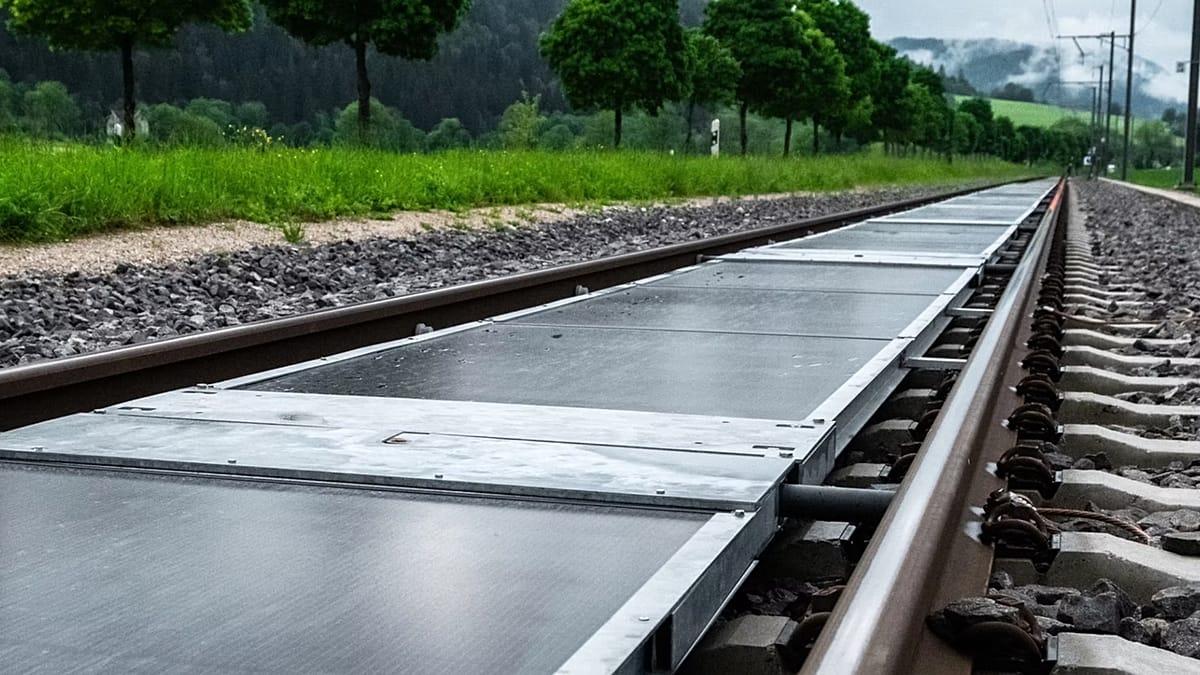
Switzerland tested solar rail technology, which could become common in Europe. Opinions vary, with some praising the idea and others criticizing its practicality.

What the discussion says

  • Supporters see it as a way to generate renewable energy efficiently.
  • Critics argue it's an inefficient use of space and resources.
  • Some believe it distracts from better solutions like rooftop solar.
  • Concerns about technical feasibility and cost are raised.
Solar rail could be a new way to harness renewable energy.
user1
It's an inefficient use of space compared to rooftops.
user2

Join the discussion

Write your take first — we'll ask for email only when you're ready to publish.

  • Hacker News
  • Bad website. No photo, only a video, and that wants to start with an ad.
  • I don't know why people fall for this stuff. It doesn't make any kind of sense. You put the panels in a rectangular array in any convenient place. That's what wires are for.
  • Putting solar panels in familiar places is always popular as an idea, but rarely better than putting them on the usual roofs or as rectangular arrays on the ground.

    > the railway was fitted with 48 specially-designed solar panels with a combined power of 18 kWp.

    18 kW is less than what gets installed on a lot of houses. It took 100 meters to do this. The farther the panels get from the interconnect, the higher the losses along the line.

    It’s easy to set up 18kW of panels in one spot. Covering an entire railway with panels would require a different transmission setup to get the power back to somewhere useful.

    I really wish we could just forget all of these ideas to put solar panels in places that are highly trafficked and serving double duty. Just put them in unused space that isn’t used for anything else: Rooftops, empty fields, or over parking garages. I often get downvoted for saying this because a lot of people like these ideas of putting solar panels in space that they see, like sidewalks or roads or railways, but we have so much unused space that isn’t near foot traffic, road traffic, or railways that is so much cheaper and easier to use for solar. These projects usually turn into political grifts to get government funding because the ideas are not economically viable alternatives.

  • > It took 100 meters to do this.

    Thankfully, Switzerland has lots of meters of railway.

    > Covering an entire railway with panels would require a different transmission setup to get the power back to somewhere useful.

    There's caternary on 99% of Swiss rail, every few dozen meters, that already transmits power.

  • I'm in the south UK, live off grid, and have a bunch of solar panels, none of them are flat aside from the 640w of panels on my van, which generate almost nothing during the Winter.

    Panels on the sides ot trains might be a better solution.

  • WTF is the downvote for?
  • It makes more sense than the road, because at least the train isn’t driving directly on the thing. I wonder if the power could be delivered directly to the train. Although the only savings really would be transmission costs, not sure how big of a deal that is…
  • > at least the train isn’t driving directly on the thing

    It’s just kicking up dust and dripping lubricant onto it.

    Maybe this makes sense. I’m deeply sceptical. Especially when you could just be putting vertical panels to the sides.

  • This has some more photos of the solar panels and the laying of them https://www.swissinfo.ch/eng/emissions-reduction/solar-energ...
  • This is a great example of the solar ecosystem finding new niches. Tracks are likely good because there is already constant maintenance and inspections on them as well as ready hookup to the grid or, as the article mentions, directly providing power for trains. The point here isn't that this is 'the most efficient way to use solar' it is that it works and provides benefit. It is like agrovoltaics. The solar production is lower than a dedicated solar installation, but the dual use of the land and potential secondary benefits make it worth while. It looks like this could even get to the point where solar could actually power the trains completely assuming this expanded a little beyond just the track surface which could be interesting for the design of trains.
  • Solar Naysayers are so odd. "If it's not a 100% PERFECT solution we shouldn't do it"
  • What are the economics of this? Cost to install vs other available options? Durability will certainly be an issue I’m sure. Genuinely curious and not because I think it’s a bad idea. I want solar on all underutilized areas, I just prefer low hanging fruit from a cost perspective at the current time.
  • Seems likely that safe access for maintenance makes this unappealing economically. Likely easier to have wider rail right of way and then put a panel farm on the side.
  • This might be exactly what you are asking for: low cost and low hanging fruit.

    On paper, this should be pretty cheap. Normally, you need some mounting infrastructure to put the panels on, land preparation, etc. In this case, the train track provides the supporting infrastructure. You can bring in the panels via train wagons. Installation should be pretty quick and straightforward. And for cleaning, you could just do that from a rail wagon as well. Not having to truck in anything seems like it should be a big bonus here.

    Durability might actually be fine. Solar panels are pretty reliable. And it's not like the train is in direct contact with the panels. The vibrations might be a challenge but presumably that would have shown up in the trials. It's something you could engineer solutions for. And so what if a small amount of panels fail?

  • I imagine that the cost to install is fairly low since train tracks require regular monitoring and maintenance so it's fairly cheap to add the installation and maintenance on top of the existing schedule.

    The manufacturer claims that durability should not be an issue. Time will tell.

  • This will never work, and it's ridiculous: https://youtu.be/7vItnxhWRqw
  • And yet it did work, with positive results shown over a year, right? It seems that the reasons why this "could never work" like cracks, dust, and vibrations might have perfectly reasonable solutions. Solar panels have gotten so cheap that it might not be as important to install them in perfect conditions, and other factors like real estate, ease of maintenance, access to the grid come into play in interesting ways. I suppose long term results are yet to be seen, but it doesn't seem ridiculous to me.
  • If you don't think about it, it doesn't seem like a bad idea. If you do, you realized how incredibly complex the whole thing is
  • I've been nerd-sniped into google fueled napkin math.

      18kw/100 m = 180kw/km
    
    The most powerful Swiss electric locomotive [1] maxes out at 7900kw. That's 44km of track.

    The most common Swiss electric (4/4) typicaly maxes at 6100kw requiring up to 34km of track.

    Switzeraland has about 5000km of track and 180 is about 200, so a million kilowatts if all the track has solar panels.

    Assuming 3000kw per locomotive and 100% efficiency [2], that's 300 electrical locomotives running simultaneously. The Swiss fleet is about four times that.

    ---

    Of course I am no expert.

    [1] https://en.wikipedia.org/wiki/List_of_stock_used_by_Swiss_Fe...

    [2] and ignoring the 10 per year efficiency loss of the panels mentioned in the article

  • You don't need peak power all the time. The point of trains is that they're extremely efficient; most of the time they're essentially coasting, they only need a lot of power when accelerating or ascending.

    If you want hard numbers, SBB used 1685GWh for passenger trains in 2025 [0].

    The bigger problem with this idea is solar in Switzerland. It's fantastic during the summer but close to nonexistent during the winter [1]. Trains need to run year-round, so you'd need to overbuild solar monstrously to power SBB during the winter, or you'd need to solve seasonal electricity storage, which isn't easy. Pumped hydro is great but Switzerland has already built about as many artificial alpine lakes as the population is likely to tolerate.

    [0]: https://reporting.sbb.ch/en/sustainability?=&years=5,6,7,1&s...

    [1]: https://energiedashboard.admin.ch/strom/produktion

  • That video is good - seeing the train-car dropping the panels into place makes it clear that you have some immediate labor savings on the initial deployment. Not sure if the post-installation labor was significant or could be automated away.

    Still not sold on the idea. For something with a 20+ year life span, the initial deployment effort seems kind of irrelevant and should be better located somewhere that does not require ongoing activity. Train ballast requires replacement every N years which is going to require ripping up all of those panels.

  • Solar cell is the only practically viable power source with no moving parts. Stop trying to attach it to moving things. Movements breaks things. Just put the panels by the rail, e.g. as vertical sound barriers in reasonable distance (to lower the pressure waves from train) from tracks. Or on a nearby field where it can be protected and inspected all at one place.
    by dvh
  • Did you read the article?
  • >rolling out 100 metres of photovoltaic (PV) panels in between active tracks in Buttes

    RTFA

  • > Solar cell is the only practically viable power source with no moving parts

    Did you forget about batteries and fuel cells?

  • Protecting the panel from the freak large hail storm from inside the track also seems a lot harder than having it in a field with angle adjusting mounts/software.
  • > Stop trying to attach it to moving things. Movements breaks things. Just put the panels by the rail

    Literally, they are not being attached to a moving thing and are being put by the rail lol. Just in between the tracks.

    Like you say, PV cells don’t have moving parts and don’t need much maintenance. So mass produced cells you can slap anywhere are really not a bad idea.

  • It does seem kind of silly to put the panels between the rails, more prone to damage there from stuff falling off the trains, derailments, etc. and not angled for optimal sun exposure though I guess it's easy open space.

    Before I read the article I was thinking the electricity from the panels would power the trains but doesn't sound like the output is enough.

  • I'll never understand why people latch onto these kinds of solar "solutions" in search of problems. Like that solar roadways fiasco a decade or so ago.

    Just normal-ass solar is already safe proven and effective. Why do we need to remix it when there are still so many easy wins to be achieved?