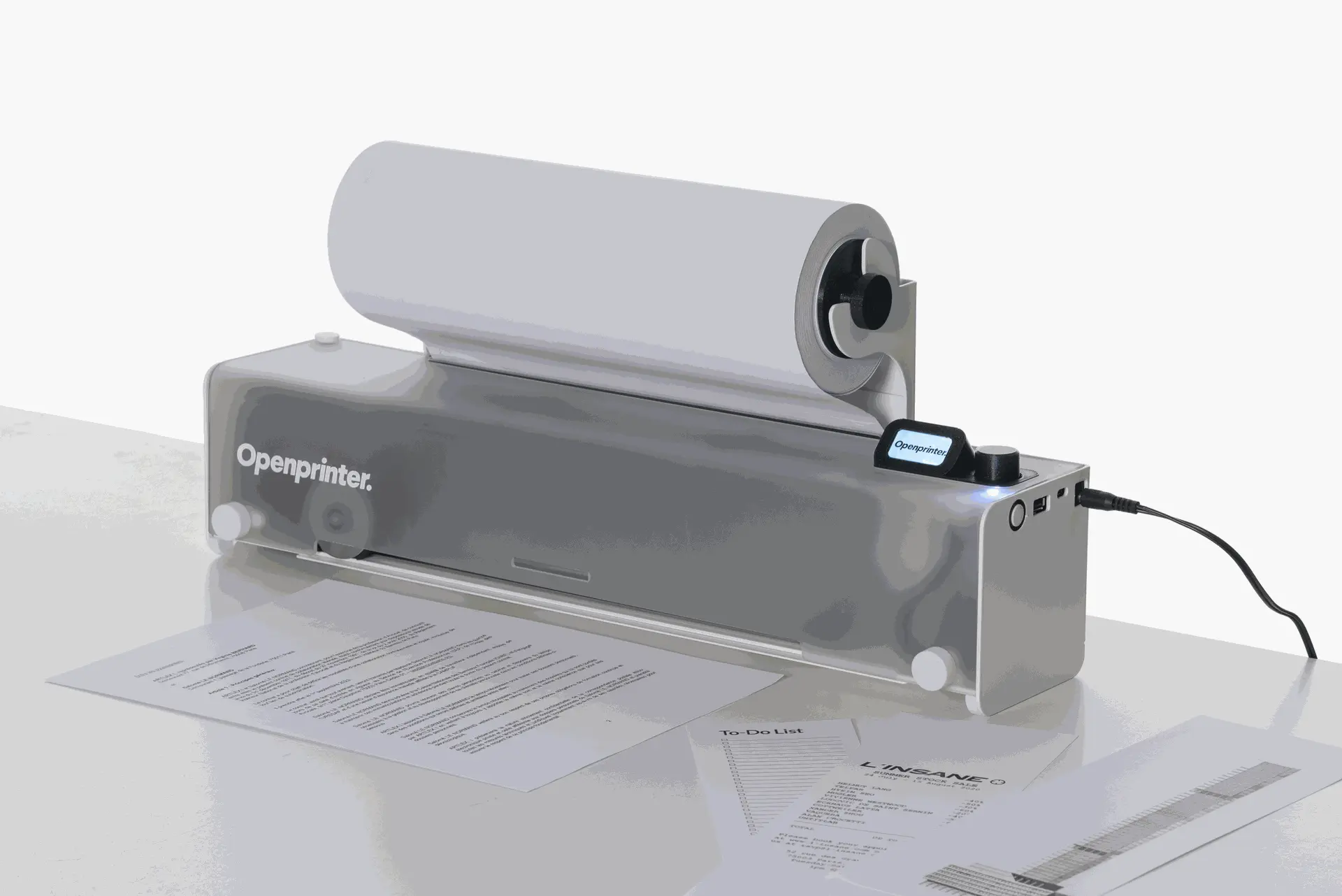
Discussion summary
A discussion about HP potentially making money on printer sales and the possibility of open-source printer firmware. Users compare HP printers to other brands and discuss repairability.
What the discussion says
- Some users are skeptical about HP's plans and want to see proof.
- Others are hopeful for repairable, professional-grade printers.
- Users compare HP printers to Brother and other brands.
- Concerns about print quality and paper curling are raised.
“I'll believe this when I see it on GitHub”
“It’s about time a company makes a repairable and pro consumer printer.”
Join the discussion
Write your take first — we'll ask for email only when you're ready to publish.
- Hacker News
- I had an Epson Ecotank for a couple of years. The printer heads got clogged all the time. We bought a series of cleaning products to address it, they often solved the problem for only a few prints. We finally gave up and bought a Brother laser printer.
This project seems like it's trying to address a similar market to the Ecotank. What assurances can the project team provide that OpenPrinter will have better reliability?
by williadc - > Open Printer is distributed under the Creative Commons BY-NC-SA 4.0 license.
So not open source.
by ssddanbrown - From their FAQ:
> Open Printer is distributed under the Creative Commons BY-NC-SA 4.0 license.
The non-commercial clause makes it non-open by the commonly accepted term of "open" in this context.
by abetusk - This is interesting, but it seems to be a crowdfunding campaign only. I wish them the best of luck (the cause is worthy for sure), but buyer beware at this point.
(I myself don't 2D print enough that an ink based printer makes sense for me. Ink tends to dry, so for me a laser printer that can sit for months at a time makes more sense. I use the scanner as well as my 3D printer far more often.)
I wonder how they will handle the nonsense around yellow tracking dots[1] etc. Hopefully that doesn't become a problem.
by VorpalWay - Unless I'm missing something using this in a commercial application would be a license violation:
> Open Printer is distributed under the Creative Commons BY-NC-SA 4.0 license.
> This means that everyone is free to use, share, and modify the project, provided they credit the original author, share derivatives under the same license, and do not use it for commercial purposes.
It's also not opensource yet, there's a vague mention of "when its ready" it'll be released.
by esskay - > With Openprinter, you are free to choose between standard sheets or a roll of versatile paper.
A few other comments have concentrated on the printer head and ink cartridge, but the roll vs sheets interests me. Manipulating sheets of paper is actually quite a difficult problem to solve - and there is only a demonstration of paper placement. Loading page after page is actually really not easy at all. There is no example of it printing.
I see they got a nomination for a design award [1], which in my personal experience has been a negative signal for successful projects. On the same page they mention that they also mention that they don't even know how much this will cost yet:
> We know this is your most frequently asked question! Final pricing depends on a moving puzzle of production volumes, BoM costs, industrialization expenses, regulatory certifications, and final engineering developments.
On the crowd funding page it mentions for parts [2]:
> Main board: Raspberry Pi Zero W
> Cartridge board: STM32 MCU
Not a specific MCU variant, and the specifics of the Pi variant (i.e. RAM) are not mentioned. I would expect these parts would be locked in by now. I have a feeling that this is not quite as ready as made out - I think there is still R&D going on.
[1] https://www.crowdsupply.com/open-tools/open-printer/updates/...
by bArray - I think the top-ranking comment about complexity is off base: they're not inventing inkjet printing from scratch. It's basically a bunch of existing modules in a new package, presumably with the promise that you will not need to buy subscriptions or DRMed ink cartridges.
Is robustness and reparability a compelling pitch? If I'm counting right, I owned eight different printers in my life. Dot matrix, dye sublimation, inkjet, laser. I don't think a single one ever required any serious repairs beyond replacing consumables, clearing paper jams, and pulling out lint. I upgraded as the technology improved. My first laser printer needed about 4x as much desk space as the current one.
by zerobees - Interesting comment from last time this was posted https://news.ycombinator.com/item?id=48093670
Inkjet printing requires orders of magnitude more engineering expertise, materials science, industry experience and financial resources than most people imagine. That is the reason, open inkjet printers don't exist despite having been consumer products with the same drawbacks for more than forty years. That is why this is a pre-crowdfund landing page without a demonstrating a working prototype. I would like to be wrong, but I expect you to be waiting a long time. An inkjet printer is not a collection of off the shelf parts. It is a machine that operates at the edge of chemistry, fluid dynamics, and electro-mechanical design...you have to place tiny tiny drops of liquid ink on commodity wood pulp with precision under arbitrary environmental conditions, get that ink to dry on the wood pulp, but not in tank or nozzel, while producing acceptable color, durability, and ease of use. Also lawyers...there are patents.