Discussion summary

A user completed a computer science degree on Coursera, receiving positive comments and questions about their experience. Discussions included the value of online learning, exam practices, and math preparation resources.

What the discussion says

  • Some users praise the achievement and its CV value.
  • Concerns about the effectiveness of online exams and proctoring.
  • Suggestions for math learning resources like Khan Academy.
Uni is there to teach you how to learn/think about problems.
sscaryterry
I'd love to know how this person filled the gaps in their maths knowledge.
pipes

Join the discussion

Write your take first — we'll ask for email only when you're ready to publish.

  • Hacker News
  • I did this too for my BSc! Prof. Yee King is a great teacher, and although I was mostly doing it for the qualification and knew most of the course materials going into the degree, his explanations of web app architecture still really helped solidify my understanding. It's a great course in general, especially if you like data science
  • > The exams themselves are done remotely using Inspera proctoring software.

    Then it's almost trivially easy to cheat with a VM, or, failing that, a KVM switch with real hardware.

  • Pure computer science, you can teach it on a chalk board, without ever touching an electronic device.
  • You can teach it like that, but you can't learn it like that.
  • Its technically true but it can take a long time for it to solidify for people and it would have taken way longer for me if I didnt have an IDE/compiler to experiment and experience it in real time and life
  • That's more expensive than I expected. In South Africa you can do a 3 year degree at a top university (in SA terms, top 300 in the world) for about that, including lodging, food and other expenses. Mind, not foreigners, that's the tax subsidised cost for locals.
  • Wow, I'm surprised that doing an online course through coursera is still that expensive - £17,000 or $22,000 USD over 3 years!

    Interestingly it does seem comparable with what it would cost through The Open University - https://www.open.ac.uk/courses/computing-it/degrees/bsc-comp...

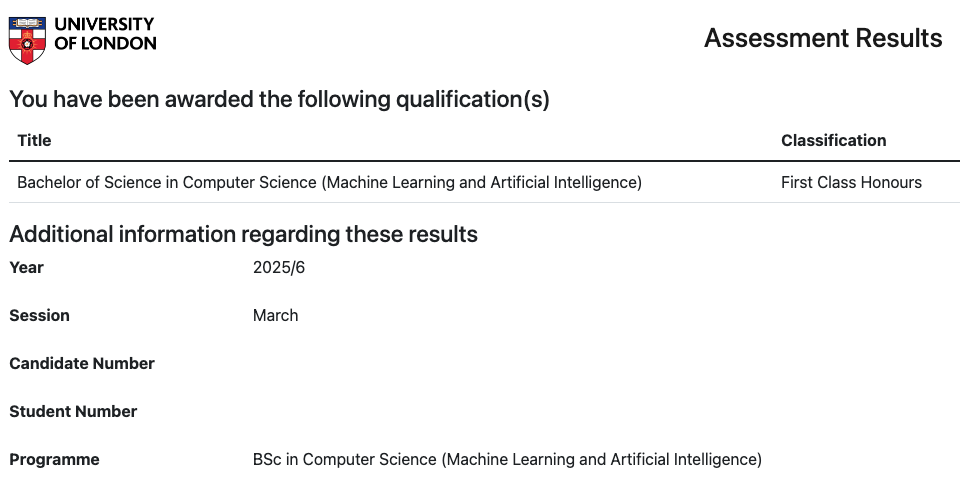
  • The diploma doesn't say it was earned through Coursera. And it's probably still cheaper than doing the program in-person.
    by f6v
  • I got the MSCS from U Illinois on there. It was more work than I expected even with one class a semester. I definitely learned a lot I could use in my current role.

    I was in the inaugural class and it was pretty smooth other than one professor there who was an asshole and felt that online classes were beneath him. It felt like we got scraps from the table (then Covid happened and online was everywhere). Also, one prof quit just before the semester on a required class that seniors had to take and a replacement couldn’t be found in time. They offered us alternatives which weren’t really good class replacements.

    Strongly recommend if your time and money is limited.

  • I did masters in a similar way, just to get some credentials and fill in the gaps and learn something new. There is an idealistic part to it which is quite romantic as you spend the nights learning and doing the assignments. The structure of such online based learning systems is great for a determined person. However the “other” part of such courses are cheating and ai use. It is depressing to know that the specific credentials prove little because of it. So the only valid signal is: this person did not quit and they know how to write a report, use references. You’d need to test them to fully validate the credential.
  • Congrats on sticking with the impulsive decision and congrats with your first class!
  • Thank you!
  • I got a Bachelor, Master, and PhD in Computer Science, with a total of 11 years of education. It's the biggest waste of time of my entire life.

    As I progress in my professional career I'm more convinced that pretty much everything in tech is on-the-job learning, and universities are little more than a social club. Nowadays you can learn everything you do at university and far more online and for free.

    Universities (elite ones particularly) still give you credentials that have some value getting a job. However I wonder for how long that will still be true. Learning by doing and building a portfolio sounds like a better way of getting in the industry today than getting a multi-year degree with nothing or little to show for it.

    Nowadays I wouldn't recommend anyone to get a tech degree in a university unless it's a world class one. And even then, I would focus on networking and finding like-minded people rather than necessarily getting good grades.

  • > I got a Bachelor, Master, and PhD in Computer Science, with a total of 11 years of education. It's the biggest waste of time of my entire life.

    I disagree: I have fond memories of my university time. I also do really like programming. The problem rather is that there are hardly any job where what you learned and loved at the university (and why you studied - in this case - computer science) is of much use. Keep in mind that your degree was a huge part why one was selected for the job.

    I honestly ask myself quite often why employers are so fond of university degrees for programming jobs. If they put much less relevance on this criterion, employers would have a much bigger group of applicants among which they can select - and this means employers could use this to level down salaries.

  • > I got a Bachelor, Master, and PhD in Computer Science, with a total of 11 years of education. It's the biggest waste of time of my entire life.

    In CS, for Bachelor, I can understand. You perhaps do it just to show the paper and get a job.

    For Masters, I can somewhat understand, as the Masters is becoming the "new Bachelor's"

    For PhD: It's all on you. No one makes you do it, and the downsides are well documented. In many (other) disciplines, you do a PhD because you want to do research, and you'll never otherwise have the time to dedicate to a research problem. You don't do it for the certificate - unless you want to go into academia.

    So: Why did you waste your time on the PhD? Why did you stick to it if it wasn't furthering your goals?

    I spent years pursuing it, and eventually quit when I realized it wasn't taking me where I wanted to go. So what's your excuse for sticking with it?

    It just sounds very silly to complete a PhD and complain about it. It was your bad decision, after all.

  • Note to everybody: this is a very exotic position and the vast majority of people I've met during career would strongly disagree with that. I don't have a Master or PhD, but my Bachelor degree was absolutely worth my time and was essential to enable me to have a successful career where I earned millions and retired early.
  • > Nowadays I wouldn't recommend anyone to get a tech degree in a university unless it's a world class one.

    I'm in Europe where education is mostly free or inexpensive so it may be different in the US, but it sounds like terrible advice. In most fields, it will be virtually impossible to get a job without a degree, and even in tech it'll be hard. I work in a big tech company, and as far as I can tell, most SWEs do have a degree of some sort. I'm sure there are exceptions, but they are rare.

  • You already have a lot of replies here and the comment is provably divisive. I'll toss in that while only you can judge whether it was truly a waste of time, a lot of that factors in how you used it. If it benefited you in interview material understanding, increased the probability that you could extend your network with someone, or other somewhat intangible signals then I'd say it wasn't as much of a waste as you say.

    I have no degree and that is arguably worse and there are exceedingly fewer people with my background in technology on the coast. On the other hand, I spent a lot of my career writing applications that solved Software Operations problems. I spent a lot of time working in small teams rather than huge ones, I often did not have product or project support. I used to loathe that chapter of my career because of how toilsome it was in my memory. Lately I've come to appreciate it a lot more because I am much more self reliant and I often have the skills and familiarity to run much larger teams as a tenured engineer.

    Long way of saying, the value of an experience or thing is often not immediately realized or appreciated.

  • I think the biggest thing is most software "engineering" jobs are in no way engineering and are closer to a trade like being a mechanic or (imo) a doctor.

    It's fairly rote - you need good judgement and to stay current in latest state of the art but generally speaking you're not researching (nor should you be) cutting edge algorithms or anything.

    Add a new button, add some parameters to this analytics call, implement dark mode. These are the things that everyone is doing at their six-figure tech jobs.

  • I won't try and argue the merits of Bachelor's and Masters. But if you honestly believe that you can pick up the same experience from PhD on the job, then is seems like you learned little from that PhD that you were supposed to and your supervisor failed you. PhD is not about learning content. It's about picking up research independence, confidence, and a strong capacity for critique. It is supposed to be suffering of a special kind, an experience in grinding and radical unproductivity when the problem really is that hard. Maybe you did get that but you aren't using it in your job; if so, then maybe you didn't need that PhD, but that's hardly the fault of the degree.
  • Computer science is a weird degree because it was meant to produce computer scientists. Theory of computability, graph theory, discrete math, formal logic, etc. But the world just doesn't need as many computer scientists as it needs people who know JavaScript.

    Over time, many CS degrees shifted toward producing software engineers, and it sounds like this person's experience was closer to that. But the problem is that as an engineering discipline, software engineering is just profoundly underwhelming. There are basically no universally-respected design best practices, no governing bodies, no calculations of safety limits, no nothing. You grab left-pad from npm and run with that. Or, now, Codex does that for you.

    So CS is weird because it's what you're supposed to get if you want a job at Google, but it's also not very useful. It's a very inefficient and expensive way of testing if you're "serious enough", can complete assignments on time, etc.

  • “ I was ready to enter the workforce and become independent as early as possible. I got into tech through certifications like MCP, MCSA, and A+ (they were all the rage back then), which was enough to land a helpdesk job at 18.”

    Same sentiments, if you had an MCSE you were hirable everywhere. A+ put you ahead of the pack and was lifetime back then.

    The early 00s were def a time. This is how I started too and also just recently completed my bachelors and now doing a masters.

  • Congrats!

    > Group projects were also a common complaint. You were randomly assigned a group, but it was often unclear if the participants were even doing the course - many people were in completely ghost groups.

    I see that nothing has changed in 20 years. Even when attended the courses physically in person, group project usually had 1 or 2 people doing all the work and the rest nowhere to be found, or just hanging out. :p

  • An important lesson.
  • I still remember in a varsity project, we're a group of three. I took over the design and coding. Another guy was bad at coding, so he took over all the documentation etc. The last guy was doing db design and write some basic SQL for the CRUD.

    We were supposed to integrate everything a week before submission. Project was assigned about 6 weeks before submission. The last guy kept saying he's working on it and we don't have to worry.

    Then a week before submission, he has nothing to show. Didn't type one word.

    I had to scramble and get it done myself. Time was not enough anymore; we got B instead of A. I was already known to get A grade in every project where teachers would give me A++ if that was a grade. The teacher of that course was so disappointed...

    Since then I did all projects solo. Had to fight a little with some teachers to get that approval; esp when there were really big projects for 5/6 people group. Still did solo and got rated as best project in every single one of them.

  • I once had a group project during a masters course where one guy disappeared halfway through the semester. Didn’t respond to phone, email, anything. The rest of us were discussing how to let the professor know after he had been over a month MIA (we didn’t need him but didn’t want him to get the group grade) when the professor emailed us to say he had heard from the guy, who had been literally hit by a truck and was still in hospital; medical withdrawal.
  • I have a similar trajectory. I attended two very competitive military schools in Brazil but never finished and moved to America.

    Today I’m a senior software engineer at a FAANG company. The lack of diploma has never been a barrier and I progressed very quickly in the company from junior to senior (4 years).

    But this has always been a perceived pain point and limiter for me so I decided to get a CS degree during COVID online from a college from Brazil. Just finished last week :)

    I do look for a stronger school name on my resume and got accepted at Johns Hopkins Masters in AI (online). Anyone had any experience with that program? Thoughts?

  • So you got into one of Faang before 2020’s hype? Not surprising that you could do that without any degree. Nowadays there are so many smart guys from unis and colleges like Standord or MIT who couldn’t get into even a small company. “No degree but no problem” sounds like totally ignoring your own luck.
  • I had an unrelated undergrad did my MSCS online (not JHU but same idea). It was great. But if you’re already senior at FAANG I’m not sure you need further legitimacy.
  • Congrats! I am also an autodidact who desired a stronger school name on my resume after a long run in startups, so I took a senior engineering role at Johns Hopkins.

    I'm not affiliated with the engineering school or familiar with their curriculum. It may not be as famous as the schools of medicine or public health, but in general they are quite good.