Discussion summary

A discussion on improving customer support highlights challenges like non-reproducible issues and resource constraints. Participants suggest solutions such as better communication, phone calls, and focusing on solutions.

What the discussion says

  • Making calls can help but isn't a complete solution.
  • Empathy and effort in responses matter.
  • Switching from problem to solution mindset is effective.
  • Subscriptions may contribute to customer dissatisfaction.
When you have an unsatisfying answer, customers may not appreciate the effort.
pinkmuffinere
Making a call might help but won't solve all issues.
hasudon7171

Join the discussion

Write your take first — we'll ask for email only when you're ready to publish.

  • Hacker News
  • > We have never heard this before. User can provide details for us, but if others aren’t experiencing it, it’s unlikely to be prioritized

    > We have heard this before, but we cannot see it or replicate it. The user gets to do work for us and/or get no resolution

    Well, if you're not willing to resolve individual customer's problem then don't expect to build goodwill with just prompt reply on support!

  • Hmm fair comment I guess I could've elaborated. I've definitely done a lot of this, but you would be surprised how often you don't build goodwill even when you do resolve the problem.
  • The CEO/founder as the L1 support is not the flex it may appear to be.

    As a user, if the CEO/founder is answering my questions, I honestly will wonder if this is a one man fly by night operation that will be gone next week.

    Also, a satisfactory support experience may not be the fastest one. If I ask for something, L1 says "no", but then escalates to sales, sales say "no", but escalate to the founder, the founder says "yes", the user may feel more "heard" and has a better sense of achievement than if the founder is the L1 who says "yes" immediately. The outcome is the same, but one will feel "earned".

    by cdf
  • I built and ran a couple of large games and sites for which I was the sole coder, the daily show runner, and the buck-stops-here responder to support requests for everything from bugs to feature requests to fan mail to "my computer crashed and I got kicked out of the game".

    Building rapport is not the reason for doing this. Being liked by everyone is an impossible goal. And yes, there is a class of customers who are power users who think their input should dictate the development roadmap. And yes, there are users who become psychologically reliant on you as their personal Geek Squad. And yes, there are non-technical people who encounter hard to reproduce bugs, who it's worth taking the time to work with if they can help you isolate the problem.

    But doing it for "likes" is a terrible idea. I was once put out as a coder to be a public face of a big AAA game, on their dev forum, to interact with fan requests, and I think that was catastrophic both for my own sanity and for the company that chose to field fan mail that way.

    With your big fans, you see what you can do about their feature requests. Never promise anything. With people who encounter real bugs or otherwise provide signal, try to turn them into sleuths and get them to beta test your next release. Draw boundaries. Letting your users be your testers is enormously valuable, so respect them and don't stop listening to their feedback. But the overarching goal here is to get value out of the process. Explicitly not to waste your time on being "liked". Because the kind of people who become obsessive over your CS responses are actually the worst customers who don't want to pay for anything anyway, and expect everything to be free.

    What I'm saying does not mean to pull back on customer service, at all! It means that the goal is to improve your product, not to suck up to all those categories of customers in the hopes they'll like you more. They will or they won't like your product, and in the end, whether they personally feel that affinity for it is based on their enjoyment of it. If it's based on their sense of importance at being able to order you around, they're not your real customers anyway.

  • The author hired someone with technical knowledge, but that's not enough.

    Technical knowledge and people skills are different things.

    If someone has taken the effort to contact you, they likely already have a bad first impression of you. If your response is focused on "educating the customer" or is too conscious of what's fair for the business itself, it will probably not impress.

    Great customer support is the kind that might result in a customer sharing their interaction with friends or social media. The support the author mentions in this post isn't likely to do that.

  • > If someone has taken the effort to contact you, they likely already have a bad first impression of you.

    Quite the opposite. If somebody has a bad first impression, they will not bother contacting a business. They'll find an alternative.

  • Too late to edit my comment, but here is one example of going above and beyond for this business:

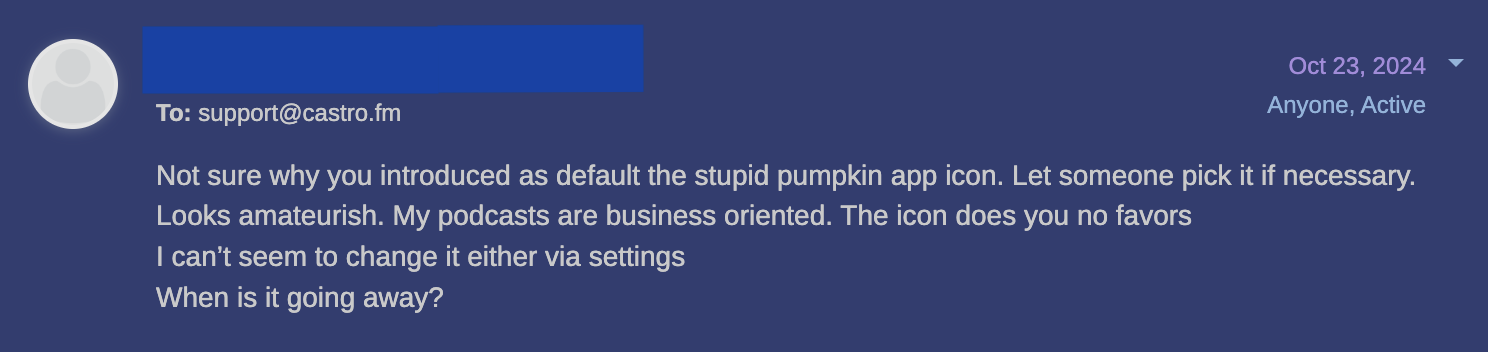
    Uncommon Apps should create and maintain a pdf document with fair, useful information about competing podcast apps that do not use the subscription business model.

    When someone complains to Uncommon Apps about the subscription model, if Uncommon Apps cannot change the person's mind (which will be the usual case), then Uncommon Apps can offer to forward a list of alternatives.

    This would allow Castro support tickets to end with something useful. Uncommon Apps is losing this sale regardless, but at least there is some reputational gain.

  • Lots of worthwhile observations in the article, but I think the framing is a bit off. It sounds transactional and by the numbers.

    I think it's fairly well understood that vocal users aren't necessarily representative. The bulk of your happy users will never contact you for support. But they are some of the most important users to talk to to improve the product.

    You need to build your own model of who your users are to provide a basis for interpreting user requests: is the support request signal or noise? if the request is coming from someone in your target market, and expressing a pain point, that's potentially an important signal. If the request is to charge only 20% of your current price, that's only useful if you're prepared to consider restructuring your offering (receiving many such emails might signal an opportunity for a budget product with specific feature subset) -- otherwise: "Thanks for your email, we don't have any plans to change our price right now." move on.

    By the way, I'm impressed that this is even a conversation for a developer selling through the App Store. I always felt that Apple killed the ability to maintain customer relationships by injecting themselves into the process. Never published on the Mac App store myself.

  • > I think the framing is a bit off. It sounds transactional and by the numbers.

    It's really not possible to avoid that when, at the end of the day, you're doing it to make a living for yourself and your employees, not doing charity work in your free time because you enjoy it.

    > The bulk of your happy users will never contact you for support. But they are some of the most important users to talk to to improve the product.

    Yep, but that's then called market research, not customer support.

  • Thank you, @dabluck, for sharing what failed. I think stories of failure are incredibly valuable, and more useful than stories of success, which are often post-hoc rationalizations.

    I’m sorry all the airchair geniuses in this thread feel compelled to express how they’re so much smarter than you and would never fail… or at least, never admit it.

  • The key point of the article is this:

    > In other words, the best approach for us is what most companies do.

    Every inexperienced entrepreneur starts with a promise that their support will not be terrible like Google, Comcast, or other big companies. And that will be their path to success.

    But in the end, you learn that you need to offer the same level of support that other companies in your market offer. And if your support is really better, nobody will really notice. It does not matter.

    And inexperienced entrepreneurs are stubborn (a good trait). So they usually have to learn that lesson on their own.

  • I think this is spot-on for the business of shipping podcast players.

    But big-company-style support is only inevitable if your company must scale. Many markets can sustain players with higher margins and a premium product+support.

  • Maybe it doesn’t matter, but I tend to tell people when I have the rare good support experience.
  • > 99% of the time, no matter how carefully or kindly it’s explained, the reply will be more negative than the initial email.

    When I was in a product leadership position I liked to spend time doing some of the customer support work. This is a common experience. Customers who write angry emails do not care about your reasons. They want something from you (cheaper rates, a specific feature they need, a discount, a freebie) and they do not care about anything else. It’s the digital version of the “I’d like to speak to your manager” customer who thinks that if there’s a 10% chance of getting what they want by being a jerk then it’s worth pushing as hard as they can.

    Some times you’d get a little satisfaction from someone who realized there was a person who cared on the receiving end of that email address. Made it feel worthwhile.

    Most of them are just doing some transactional game where they think that they can exercise some power over the company if they complain loudly enough.

    This also has a lot of cultural differences. Some of the customer contact we’d get from one of the countries we served were out of control mean. There were casual threats of violence from time to time and 90% of them came from one country, which I’m not going to name but I’ve added it to my mental list of places not to visit. It was weird that it was so consistent.

  • > Some of the customer contact we’d get from one of the countries we served were out of control mean.

    genuinely curious. Which country was it?

  • Having worked in product/technical support on and off for almost two decades, I also have noticed some interesting parallels in support interactions with customers from certain countries.

    Not all of them were negative, they were just different. Some countries lead with praise and then tangentially ask for a discount. Some countries contact for a legitimate issue/bug which is resolved, and then expect some kind of remuneration for the inconvenience (even if they caused it!), and finally some were almost verbosely thankful and appreciative, re-opening tickets every single time to thank someone vs. just letting the conversation end.

    It has really made me rethink customer/client interactions when I have them in person, and also how other countries view my own.

  • > “I’d like to speak to your manager” customer who thinks that if there’s a 10% chance of getting what they want by being a jerk then it’s worth pushing as hard as they can.

    Throw those people out immediately. Not only are they bad customers themselves, they also drive away the good ones.

  • When I was in college, I worked at a bakery and actually made some long-term friends by talking to customers that came into the store. I later used this job experience to get an email support job, answering questions that users had about our software plugin. Never made any long-term friends with customers there, even if they emailed us once a month.

    The difference is that email / online support has no “human downtime moments.” At the bakery, I usually would talk to people while we were waiting for their order to be finished heating up / cooking / etc. So there was a moment or two people standing around waiting, which naturally leads to a conversation. Or at least it did a decade ago when cellphones weren’t quite as omnipresent.

    I wonder if having a monthly Zoom “open office hours” type thing would replicate some of this feeling in a software context. Probably not, but it might be better than just answering emails.

  • There's also the fact that, email / online support leave records. You really don't want to leave a written record of you asking someone about their life, as when/if it gets audited - you can possibly get into trouble.
  • Thinking about customer support as a ‘differentiator’ or a way to drive profit is depressing. You should simply strive to do what’s best for your customers. The sort of feedback you’re getting is golden and in the right hands can be put to use rather than be dismissed. Assuming that people who disagree with your pricing model just don’t understand how business works is really telling. You have to accept that your pricing model sucks to a group of people (who are likely experiencing subscription fatigue) and decide if it’s worth losing or never getting their money.

    Your support strategy is missing an outlet for needy users to ask questions, effectively blaming customers for a structural flaw in your own setup. You could easily spin up a forum where power users help each other and devs can occasionally jump in to help or note pain points. Furthermore, your development and QA processes clearly need scrutiny. The reason bug reports feel like a ‘waste of everyone’s time’ is likely because you don't have the right error logging or telemetry built into the app itself. Having to wait for a manual bug report from a user is already a failure.

    It’s completely okay to define your product however you want and to reject feature requests, but to say you’ve singularly thought through every problem in an armchair, in comparison with the distributed minds of the rest of us, is pretty arrogant.

  • > You could easily spin up a forum where power users help each other

    tell me you've never run anything without telling me you've never run anything...

  • > You have to accept that your pricing model sucks to a group of people (who are likely experiencing subscription fatigue) and decide if it’s worth losing or never getting their money.

    I think the article was very clear that they had already accepted that, and had already decided it was worth never getting their money.

  • OP's post clearly described his thought process and experience. What are experience are you basing your assertions on?
  • > you don't have the right error logging or telemetry built into the app itself.

    Which is exactly why HN's anti-telemetry stance is so unjustified.

  • None of these categories seem to build any meaningful rapport. Any honest answer I give is deeply unsatisfying to both parties, and we typically have better data from telemetry or crash logs than the emails provide. It’s certainly useful for us to receive them, but there’s not a helpful response I can give.

    I don't know how you read the blog post but it seems your interpretation is uncharitable to say the least.

    He wrote he already has good enough telemetry, there is just not much he can write in an e-mail to customer, besides generic "we know the issue thank you for the report" that would be useful for the customer and for themselves.

    by ozim
  • > The reason bug reports feel like a ‘waste of everyone’s time’ is likely because you don't have the right error logging or telemetry built into the app itself. Having to wait for a manual bug report from a user is already a failure.

    Yes and no.

    You want enough logging and telemetry that you can roll out an update to 2% of users and know if something is terribly wrong before you roll it out to the other 98%.

    On the other hand, you probably don't want enough telemetry to detect that customer Jim Smith has trouble with WebRTC when joining calls without a microphone while using Firefox and Cloudflare Warp with split tunnels enabled.

  • I find this:

    > but to say you’ve singularly thought through every problem in an armchair, in comparison with the distributed minds of the rest of us, is pretty arrogant.

    Somehow incredibly ironic when applied to you comment itself...

  • > You have to accept that your pricing model sucks to a group of people (who are likely experiencing subscription fatigue) and decide if it’s worth losing or never getting their money.

    And for some subscription situations, you can probably offer them a price that works for both of you.

    There's a 'PhotoSync' app that offers a premium option for either $1/month or $24 for life. Presumably because they looked at the average subscription duration and found it was in the region of 2 years. Modulo the time value of money and per-transaction processing costs.

    Personally I much preferred the one-off purchase, even though it's not clear I'll be using the app in 24 months, because it fits a lot better with my (somewhat chaotic) way of managing my money.

  • I know this isn’t a very interesting comment, but just to provide some balance to the mostly negative comments I’m seeing:

    It’s interesting that you did the experiment, and I appreciate you sharing your results. It all seems reasonable, even if a bit depressing.

  • Same here. I feel it's what every software owner thinks, but no one is willing to admit because of the backlash.