Discussion summary

The discussion centers on whether DayQuil and similar drugs should be legal, with some advocating for full drug legalization and others questioning the safety and efficacy of certain ingredients like phenylephrine.

What the discussion says

  • Some argue all drugs should be legal, emphasizing personal freedom and harm reduction.
  • Others highlight safety concerns, especially regarding ingredients with high addictive potential.
  • Several participants discuss the role of regulation, marketing, and the effectiveness of certain medications.
Drug prohibition has caused magnitudes more harm…
nekusar
I'd rather have choices available in a marketplace rather than a nanny state.
CodeWriter23

Join the discussion

Write your take first — we'll ask for email only when you're ready to publish.

  • Hacker News
  • > Historically, Sudafed has contained pseudoephedrine, the wonder drug equally good at clearing congestion and making crystal meth.

    It's much better at clearing congestion than at making crystal meth. And, as the joke goes, it's easier to make an effective decongestant from meth than it is to buy it from a store.

  • In Canada if you go to a drug store, the shelves are literally filled with literal homeopathic medicine. You have to carefully confirm that what you’re buying isn’t water, and there is no signage or other differentiation between actual medicine and magic.

    Completely unrelated, I noticed recently that tire detailing spray that makes your tires look black, and the recommended lubricant for my garage door weather stripping, which both cost $15 or more for a little bottle, are just silicon oil that costs pennies for that amount. I have no moral problem with charging higher prices for convenience plus clarity of what the use is. I do think it’s amoral, obviously, to be involved in snake oil sales and unbelievable that the government allows it.

    Edit: this is the first result from a Canadian pharmacy searching for cough medicine. Worse it’s for kids: https://well.ca/products/homeocan-kids-0-9-cough-cold-day_88...

  • In Canada all homeopathic medicine must clearly identify itself as such and must also state that it's based on traditional form of medicine and not based on any kind of scientific evidence.

    The very "medicine" you linked to in fact displays it right on the cover.

  • Silicone oil can actually vary a lot. Some are safe for certain plastics or rubber materials and not great for others.

    The tire stuff might be the cheap shit that's not so safe just because tires are so thick and robust. Or maybe it's actually designed for tires.

  • Ugh yup. My regular pharmacy is a pharmaprix (shoppers drug mart), which is one of the biggest chain pharmacies in canada. The cold and flu isle is right in front of the pick up counter, so when I was sick a few months ago one of the pharmacists flagged me down when they noticed me hovering around the cough drop/coldfx/oscillococcinum part of the isle. The amount of proverbial snake oil on the shelves is bad enough that she was apologizing for how confusing it was. Got me set up with OTC pseudoephedrine instead! (There's some combo PSE/acetaminophen meds they sell in front of the counter, but they're mixed in with the sugar pills.)

    It's really worth talking to your pharmacist even if you know what you're buying. There's so many more options behind the counter and they're really knowledgable.

  • Dextromethorphan is definitely not a placebo. Take enough and you'll go to space and meet God. Smaller doses produce euphoria and dissociation, which, even if they don't make the cough go away, makes it easier to tolerate a cold -- same reason antitussives have historically contained alcohol, cannabis extract (which may incidentally work as bronchodilator but was not the reason I imagine it was in antitussives)

    Funny amphetamine used to be an over the counter cold medicine, which the article doesn't mention despite talking about the meth precursor?

    Fine article but these two details stuck out to me while reading it.

  • Very relevant username
  • Came here to say this, the author is hating on dextromethorphan like he never robotripped before. But then, overdosing dxm isn't all that healthy and I'd recommend ketamine if you want to experiment like that.
  • The left enantiomer of methamphetamine (exact same chemical formula and structure, just mirror symmetry) is also an OTC decongestant.
  • Yup. The only upside to being sick is that I get to take NyQuil before going to sleep and have trippy as fuck dreams.
  • > Dextromethorphan is definitely not a placebo.

    It definitely works for me. It'd be wild if for all 44 years of my life, it's only worked because of the placebo effect.

    The article mentions phenylephrine, and that shit definitely doesn't work. Not even a placebo.

  • I think there's one thing most people agree on: drugs should be safe and effective.

    DXM is fine but oral phenylephrine should be banned. The only reason it's in any of these drugs is because they don't want to lose sales when the real version that works is locked behind the pharmacy counter after hours. It's a scam to keep sales up.

  • I think it’s outrageous that pseudoephedrine has become difficult and annoying to purchase while they put that ineffective garbage out through all these combo drugs.
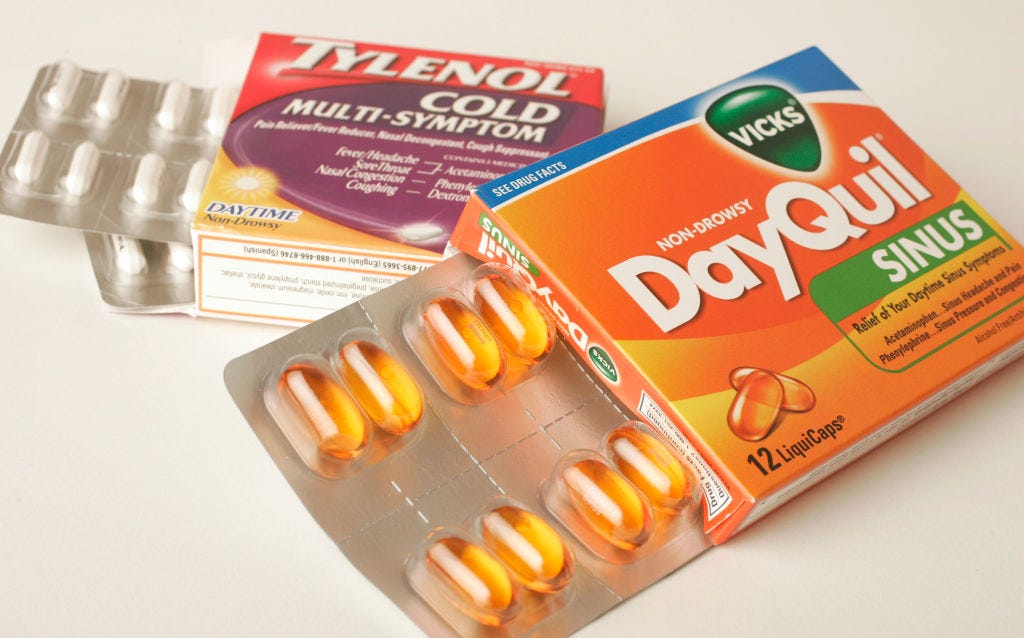
  • > So the only ingredient that’s doing anything in that bottle of DayQuil makes up just 2% of the bottle: the roughly 8 grams of acetaminophen

    this argument makes very little sense. Plenty of very potent drugs are in the single digit mg range in a tablet that weights hundreds of mg.

    More importantly, as always, it is a problem of incentives. There is no strong, commercial entity focused on removing ineffective drugs from the market, but plenty of commercial pressure to keep them. The FDA has zero incentive to clean house. The magic hand of the market is supposed to be consumers choosing not to buy these drugs because they are ineffective, but for many reasons (choice, placebo effect, basic scientific literacy) this does not happen.

    I don't know what the most effective entity is. I cannot personally imagine a commercial structure to support this, but perhaps one could be built.

    by Hasz
  • The other ingredients would be doing other things: making the pill/drug easer to swallow/consume, extending shelf-life, etc. You need enough of the drug for it to be effective, but not too much to overdose or exhibit side-effects.
  • The mass of the acetominophen isn't really important, it's just vivid writing. The point is that 8g is obtainable for orders of magnitude less when it isn't wrapped in misleading marketing.
  • I just can't get super upset about this. Sure, OTC companies are duping customers with marketing, but what's new about that? As the person holding the money, it's my job to look at what is effective and what the active ingredients are in any given product. Or ask my doctor/nurse/pharmacist what to do, if I can't be bothered to make the effort myself.

    When I want to get irrationally angry about something in a department store, I'll walk over to the shampoos, which for some reason always have a whole entire aisle dedicated to a single product, when they all do literally the same exact thing, just with different scents and advertising budgets baked into the sticker price.

  • If someone buys an overpriced shampoo, it only negatively affects them, but the are costs to overall society if people suffer health issues, addiction, etc.

    In the past, a lot of people unknowingly ended up addicted to morphine, as it turned out both companies and individual doctors were happy to mislead them about the contents of medication.

  • I think I have two opinions on this, from different angles.

    I think the phenylephrine stuff is absolutely messed up. I personally had no idea it was ineffective, and I've bought medicine with that included, believing it would do what it says it does in the active ingredients list. To me, this is criminal, and these companies should be taken to court for outright lying about their products. (And the FDA should be slapped, hard, for not having done something about this by now.)

    But when it comes to the CVS brand of acetaminophen costing $5 and the NyQuil brand costing $10, that's just... the result of normal market forces. I'm not a big "free markets" guy (because we don't, and can't, have truly free markets, and if we could and did, it would be a disaster), but it's pretty normal and common for people to pay more for something just because some company did a better job advertising it than their competitor did. That's just life.

    It's funny, because when I go to a pharmacy, the store brand is usually shelved right next to the big-name brand, and there's even often a little card next to the store brand (or even printing directly on its packaging) that says "Compare ingredients to $BIG_NAME_BRAND!" And yet, people still buy the big name brand. ::shrug::, that's life.

  • Not totally accurate - there are a handful of foaming agents and surfactants that are mixed and matched to make shampoos, so really it's nearly the same except that no one has ever overdosed on applying too much sodium lauryl sulfate to their scalp.
  • While I can appreciate the principle of not blindly trusting OTC medicine marketing, it is not realistic to expect every person to be highly competent in fully understanding their medical choices. It is far more reasonable to expect the companies marketing healthcare products to be honest to their customers.

    If anything, you need honesty from healthcare companies in the first place if you're even going to begin making an informed decision. You're putting the cart before the horse here: people absolutely should be doing their own research before medicating themselves, but it is the OTC companies that obstruct that.

    And, secondary to all of this, your analogy about shampoo is misinformed. Still, it is fitting for this scenario, but not in the way you intended. There are lots of different hair types, including ethnic hairstyles that require specific treatments. There are also a number of lifestyle choices that can change your hair treatment needs. As a result, the shampoo aisle actually is stocked with a wildly varying assortment of haircare choices, but actually figuring out what product works best for your needs can be challenging because it is walled behind layers of marketing nonsense that don't inform the consumer adequately on what makes each product different. This isn't much different than the problems in the medicine aisle.

    It took a lot of secondhand research to find the ideal hair care product for my thick, curly hair that would mitigate the damage of thrice-weekly swimming in a chlorinated pool. I can assure you, not everything in the shampoo aisle is exactly the same. It was especially hard figuring this out as a man, when so many products are arbitrarily marketed to specific genders.

    by RIMR
  • > As the person holding the money, it's my job to look at what is effective and what the active ingredients are in any given product.

    But I don't have time to do that. I would rather have a retailer do that curation for me and provide me with effective high value products, and stand behind returns when they miss the mark. Then as a customer I can reward them for that value added work.

    That's why Costco is great most of the time. Although they sometimes miss the mark with certain products they stock.

  • That shampoo opinion is a sure tell that you're not a woman with long hair (men with long hair tend to be less picky). My hair behaves noticeably differently with different shampoos/conditioners even within the same brand, and depending on your specific porosity, oiliness, texture, and humidity of the local climate, different hair care products and routines make a big difference if you have hair past chin length and want it to look healthy.
  • > When I want to get irrationally angry about something in a department store, I'll walk over to the shampoos, which for some reason always have a whole entire aisle dedicated to a single product, when they all do literally the same exact thing, just with different scents and advertising budgets baked into the sticker price.

    Somewhere on a shampoo forum people are complaining that all computers do the same damn thing. I guess they probably just don't know what they're talking about.

  • > As the person holding the money, it's my job to look at what is effective and what the active ingredients are in any given product

    That ignores over a century of law regarding drug safety and efficacy, and false advertising.

  • Yeah, intentionally misleading consumers should always be at least somewhat illegal. Sure caveat emptor, but consumers having accurate information is implied and a cornerstone of a competitive market.
  • In the US at least, medicine is so highly regulated/gate-kept that I don't think caveat emptor really applies. What's happening here is more like deception of the public by the state, or by groups granted special status by the state. It's morally somewhere between fraud and treason.
  • "Caveat Emptor" and "Do your own research" is not a basis for a functional society. Providing reading material is not a sufficient substitute for regulation in a country like the USA where 54% of adults read below a sixth-grade level. And letting marketing decide what counts as "accurate information" is just letting the fox guard the henhouse.
  • "DXM does nothing", proceeds to link a study whose contents describe significant decreases in cough severity versus placebo.

    I am convinced that many people ask LLM's "give me a citation URL" and don't bother to read it.

  • It's the same people who just googled a couple keywords and used that as a citation without reading the link, pre-AI.