Discussion summary
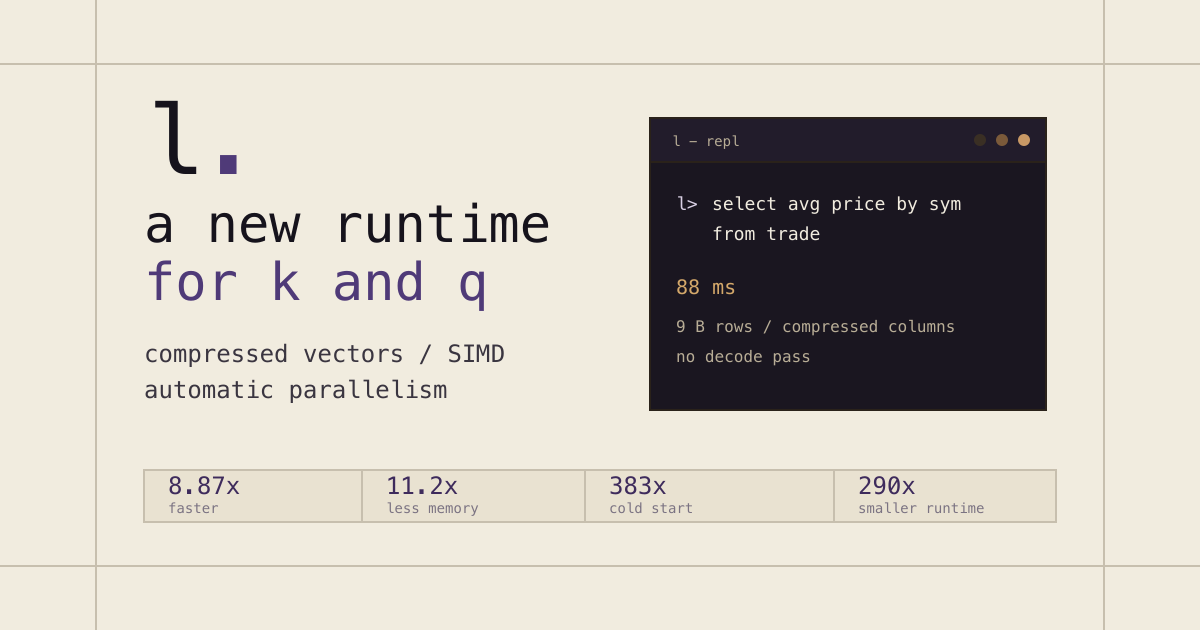
A discussion on a new runtime for k and q, with some users defending the website's design and content, while others criticize its clarity and style. The conversation references concepts from APL and related languages, and touches on the website's aesthetic.
What the discussion says
- Some users find the website fine and see meaning in the content.
- Others criticize the language as pseudoscientific or grandiose.
- There is a debate about the clarity and purpose of the site.
- Some mention the influence of Ken Iverson's work on the language.
“The site has all the hallmarks of Claude Design.”
“K and q made the vector the unit of thought.”
Join the discussion
Write your take first — we'll ask for email only when you're ready to publish.
- Hacker News
- benchmarks at https://github.com/l-labs unlike klong/ngn/bqn et al (which are GREAT) this has the goal of full production database compatibility (and full language compatibility).by jloveless
- q is the programming language underpinning kdb+ by Kx Systems - often claimed (by Kx) to be "the fastest database in the world". Possibly also the most expensive? L is an independent implementation of a q interpreter. To those who reluctantly commercially license kdb+ - this will be a welcome alternative.by jazza68
- Not sure why all the hate (sure site may be vibecoded, not all of us are front-end masters and it's at least not spartan)... I've always found k to be fascinating, and cool idea to try and roll a new one. Wish it were wholly open source, but cool to have a new variant that seems to bench well.
- if you k you k ;-) for the uninitiated, this looks like some wallstreet quant's new startup. Initially I thought it was the rebrand of shakti, Arthur Whites most recent rewrite of an array language. It's purpose built tooling for computing tick data for financial markets, but the best way I can describe it is codegolf for experienced programmers who don't want to give up the keyboard. these tools combine dataaccess and the ability to compute against that data with as few abstractions as possible.by chews
- First, this is an incredible achievement. I hope that the author(s) can monetize this project. I guess they can try to undercut kx.com's current insanely high subscription costs. Is that a goal? I ask because I cannot find the source code for the project, only downloadable compiled binaries. (No hate on that -- you are free to make lots of money from your hard work and apparent genius!)
Second, in my personal experience, most quants refer to the platform as "kdb+", which uses the languages q (directly), k (indirectly), and qSQL. Is there a reason why the website landing page does not mention kdb+? I assume this is intentional.
- Closed source (and vibe-coded) software, especially for a language runtime, is a non-starter for many people including myself. But proprietary license is actually common in the APL and K family of languages. They are fascinating though, and plenty of free/open implemenations exist, for example: https://ktye.github.io/by lioeters
- Quite cool, but for a new runtime of an existing language it might make sense to compare to, y'know, the other[0] runtimes of that language? Even if one has to omit the best, closed ones for lack of access / permission to benchmark?by kristjansson
- yeah the site's clearly vibecoded and isn't opensource, but i also think this is a genuinely interesting design space and more people should be building in it. APL (https://www.dyalog.com/), BQN (https://mlochbaum.github.io/BQN/), J/Jd (https://code.jsoftware.com/wiki/Jd/Overview), Klong (https://news.ycombinator.com/item?id=10586872), Kerf (https://news.ycombinator.com/item?id=9782520), RayforceDB (https://news.ycombinator.com/item?id=45889607), k/q (https://kx.com/) glad there's a new entrant.by enduku