Join the discussion
Write your take first — we'll ask for email only when you're ready to publish.
- Hacker News
- It's hard to read this because it's AI written, and at least three times as long as it needs to be.
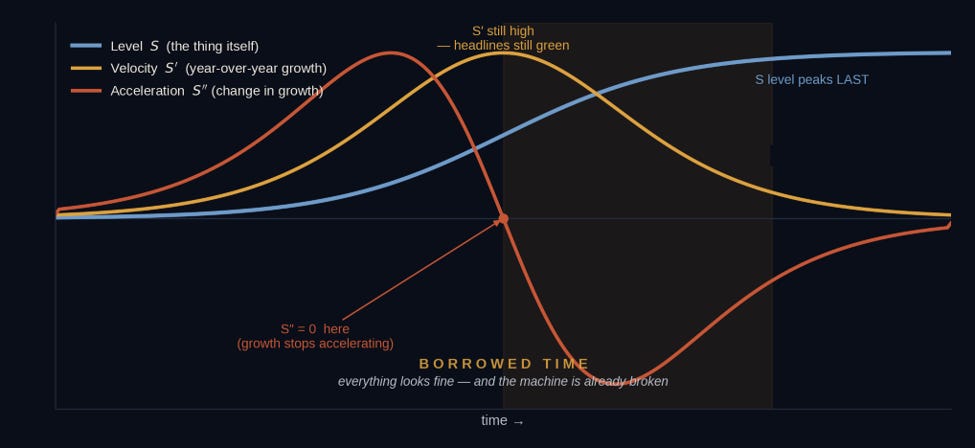
TL;DR: A lot of credit crises happen because of a decrease in acceleration (the second derivative) rather than a decrease in point in time slope (first derivative), or absolute value. The author (or at least the person who prompted AI for the article) says they think AI capex has to continue to accelerate in order for the frontier model companies (and associated) to continue to pay their debts.
I think the theory is sound, but I'm also bullish on LLM/LBM market size being very undervalued today.
by Schiendelman - I dream of a world where I can just read a prompt behind some slopicle and cut the middleman entirely.
> The bulls and I do not disagree about AI. We disagree about which derivative the structure is written on. They are watching the level. I am watching its acceleration. That is not a difference about technology. It is a difference about arithmetic - and arithmetic, eventually, does not take opinions.
Regardless, 2nd order (and higher) derivatives are nothing new in finance and are a part of any decent university’s curriculum. Corporate debt is not an options contract. Using Gamma risk to explain AI bubble mechanics is a poor fit.
by antondd