Join the discussion
Write your take first — we'll ask for email only when you're ready to publish.
- Hacker News
- That's pretty cool. The phrase "3D-printed engine" stuck out to me as neat, too.by bovermyer
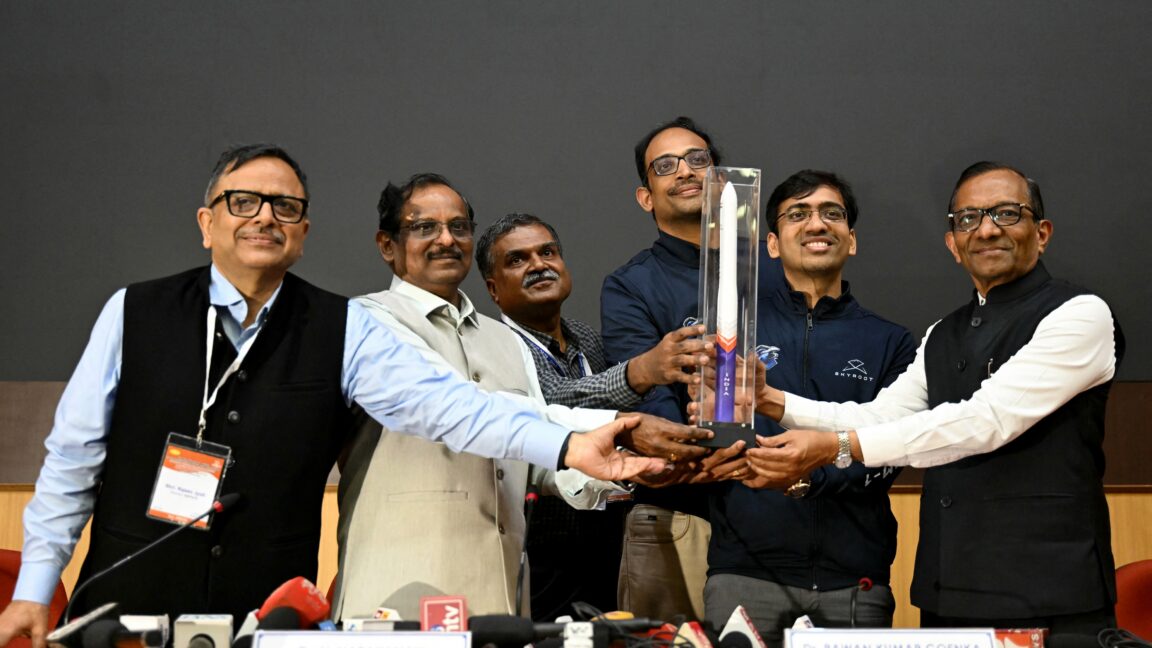
- Extremely strong performance from India’s Skyroot with their Vikram-1 rocket. I can say that many in the space industry are looking for new launch capacity to LEO.by jdiez17
- A small but bright light in an economy where manufacturing jobs are hard to come by (https://archive.ph/Haj8n).by ghm2199
- For those interested, just read a great book on this topic: When the Heavens Went on Sale by Ashlee Vance: https://www.goodreads.com/book/show/62050244-when-the-heaven...
It profiles: Astra, Firefly, Planet Labs, and Rocket Lab
by josefresco - Only the third country to achieve this. Kudos.
There's another startup trying reusable rockets.
by sidcool - And with $160MM in funding at a $1.1B valuation? I don't know about their debt, but to get to LEO in 8 years on that little money is extremely impressive.by zbentley
- There is just so much that can go wrong with rocket launches if you do cursory reading about these things. A few random examples: The lowest stage cant just be "turned down" or modulated because they work by burning an inner solid rubber lining that's like an annular cylinder. The first three stages are roughly doing the job sequence: `lift off the ground -> reach target altitude -> reach target orbital velocity` and each stage is modulated for atmospheric pressure, gravity. Another limit is you can't really design it for a human in the middle(like a jet plane), so the rocket's computer needs to do everything, and when the rocket's pitch or yaw or roll(in a manner of speaking) go off beyond a nominal range its game over.
ISRO has a very good track record of launching rockets with solid state engines. I do wonder if almost all of their expertise was used for the first three stages(and they are not 3d printed)? And how much more difficult it is to make the last stage as compared to the first three, which as I understand, was the stage designed and tested by skyroot itself(manufactured by Wipro 3D).
by itissid - Regarding Indian private space sector, In addition to skyroot solid rocket, following are noteworthy
Agnikul is planning to launch semi-cryo kerosene rocket pretty soon. Their engine is 3d printed and use electric pump fed 25kN small engine. Planning to launch 4 clustered engines as first stage and already did suborbital test, with some parachute splash down reusability claims.
Astrobase is recent entrant. With decent funding and former ISRO scientists as core team, developing 800kN FFCS methalox engine. FFCS is called holy grail of liquid engines. They have acquired largest metal 3d engine and planning VTVL 1st stage reusability
by mayama