Join the discussion

Write your take first — we'll ask for email only when you're ready to publish.

  • Hacker News
  • Different people should use different words.

    I don't think a content creator would naturally describe themselves as a content creator. The word is useful for contexts where you need to generalize over all the different types, but that's not useful when speaking about yourself. So a writer says "I'm a writer", not "I'm a content creator." But writing this paragraph, I needed a word to generalize.

    P.S. The closest alternative word might be artist, but it's not quite right--some writers are artists and some aren't.

  • I agree, and the audience also matters too. A writer speaking to writers at a writing workshop? "I'm a writer." A writer at an independent business conference? "I'm a content creator", as a means to relate to people making videos, blog posts, photographs, tweets, etc.

    Some 'content creators' might also do: videos, blog posts, photographs, tweets, and a lot of other activity that drives the same business: getting user 'engagement' for sponsorship or advertising revenue.

  • Surprisingly it was quite easy to read the blog post and well written. However, the author definitely has the gift of gab in writing in terms he can write about anything, but at the same time convey nothing meaningful
  • It’s AI slop, that’s why.
  • This is the most polite diss I've ever read
  • In Molly Lambert's "Jennaworld" podcast, she says that Playboy . com was the one of the first places to use "content" in the way it gets used these days. I definitely believe it; there are a lot of euphemisms in that world!
  • "Asset" also has an, uhm, meaning in that world that is compatible with the bizspeak use.
  • I’m reminded of other writers, like Seth Godin. He takes a different tone when he speaks of the privilege to share ideas with others.

    https://en.wikipedia.org/wiki/Seth_Godin

  • So the main issue here is that corporate language is dehumanizing? Well, "human resources" might have been a hint, I suppose!

    I have to agree. It is dehumanizing. But, it's unfortunate, because the language of business is the language of business. We have this one. We don't have a separate, identically shaped one, made up of nicer sounding words.

    Would be nice if we did, though.

  • > We don't have a separate, identically shaped one, made up of nicer sounding words.

    We do though. It is a kind of virtue signaling to use the evil version.

    E.g. "Human Resources Department" is called "Personnel Department" in non evil business speak.

    To be fair "HR" is going the way of Thermos nowadays though.

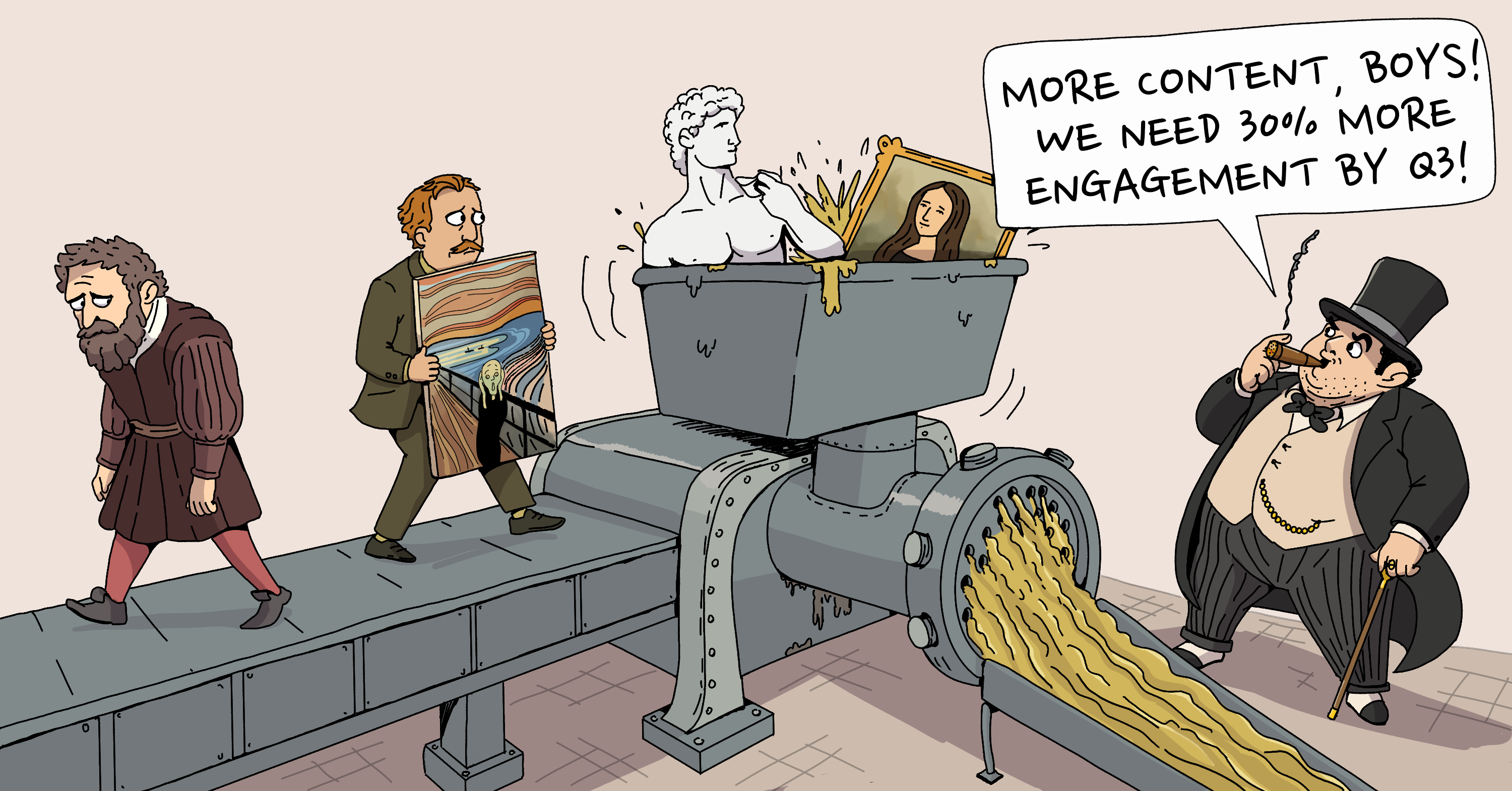
  • I believe there is a material difference between "content" and other modes of creative output: content is defined by a pipeline. It is desired for it's recurring revenue.

    You could make the tackiest, most commercial and derivative musical, but it's still not content because it's just one.

    You could make the most eloquent, poetic and inventive podcast in the world, but so long as you are still doing weekly releases (with ads, plus an ad free patreon, of course) it is content.

    The tragedy is that we want artists to have reliable income, but the business models, incentives and consumption habits that come with the reliable output to provide that reliable income lead us to the ugliness that people blame on "content".

  • > The tragedy is that we want artists to have reliable income

    If artists create art that people are willing to pay for, great!

    I don't really want to pay artists for art I don't like.

    I remember when Nirvana suddenly became successful. Many in the local community called them "sellouts", which is quite unfair.

  • This resonates with me. I’ve always found the term annoying, because it felt like it was distilling artistic expression down to its most abstract form: content. If all you’re producing is abstract “content,” why should I participate? What makes it special?
  • People seem to be content with content.
  • To be fair, the people who are producing capital-a Art are mostly producing crap as well.

    Whatever you call it, I participate to find out if it’s crap or not.

  • I see that abstraction as the purpose of the word when viewing it from a 'business' context: when assessing businesses of the same kind, the actual thing that's being produced matters a lot less.

    I'd suppose that blog writers and video producers have a lot of the same kinds of business problems: how people can discover [the thing they create] and spread awareness of it or make money off it.

    In order to be able to discuss this category of business, it's useful for writers and video producers to be able to relate to each other by abstracting out the thing that actually makes them distinct and particular.

    I see it less as devaluing that special thing and more as a lens to put on or take off when certain audiences are interested in the 'non-special' aspects of running businesses based on that special thing.

  • I feel the same way. I want to watch movies and listen to music and read books! I don't want to "consume content." That phrase feels like it reduces my role to just be a generic pac-man gobbling up whatever bland grays dots of vague content are "created" and set down in front of me. That's not what it should be.
  • Content used to be a bad word, now kids want to become content creators when they grow up.

    I was hired at a job the very same day Google released their first Panda update[0]. This was the update that nuked all content farmers from search results. It was complete chaos, I sat in an empty cubicle, not knowing if I should stay or leave while the manager cursed and paced. Our ad revenue went from millions to zero, overnight. Unfortunately, they figured out a trick to game google. Which I guess meant I remained employed.

    [0]: https://idiallo.com/blog/content-is-bad

  • "I want to be a Kardashian when I grow up..."
  • Truly curious - why did you choose to work at a content farm?
  • I appreciate this push-back. I keep a running list of words like this...content, product, device, experience, space, vehicle, resource, etc. I can't put my finger on why, but all of these make me distrust the speaker.
  • They're ambiguous words when there's no reason to not be more specific, so either the speaker is lazy or intentionally trying to muddy the waters.
  • For me, its "learnings" and "performant". We've had "lessons" and "fast"; what do those words not capture?
  • For me it's when companies talk about themselves as brands.
  • I don't know how common it is but I can't stand "consume" for "eat/drink". Especially when used in the first person. Why would anybody say that about what they eat?
  • All these words are too broad is why. It allows someone to say something without really knowing what they mean. But also they may know what they mean, so you are not sure!

    Device is a handy one though you often want to say "computer, laptop, tablet or phone" in one go. We could call them all computers but that would confuse people I think.

  • It’s a conflict of interest. When people organically create things online with no incentive except the love, you can give them a lot of trust. Once someone goes from that to manufacturing “content” (or even worse goes from nothing to “content”) there’s major incentive to either shill for some product for compensation, or to generate outlandish things that get more clicks, views, likes, subscribes. All of this is antithetical to creating about a subject because you enjoy the subject.

    From about 1998-2008 I ran one of the largest sites on the internet for a particular niche. Zero advertisers, no ads, no shady links, just content about a subject I loved. I worked hard to make sure it was accurate and up to date. Now someone creating the same site would be loads of referral links or paid ads, so no trust whatsoever in what’s being presented.

  • Yeah I have a similar list. Mine also includes "journey". As soon as a word gets adopted by MBAs to abstract away the real world, it gets added to my list. They're words that project the idea of a smart person but only to stupid people.
  • I actually really like the term content creator, because it removes the artificial boundaries that come with being a writer, photographer, filmmaker, etc. and just lets you make stuff. The medium doesn't matter if you're a content creator, to a large extent.

    The alternative is "art" but that comes with a lot of other baggage that often sounds unintentionally pretentious, especially if you aren't actually creating paintings/sculptures/traditional/contemporary studio art. The word creative used to serve a similar purpose, but nowadays I think it sounds both blasé and pretentious.

    Yes, content does come with an expectation that you're creating things for an commercial audience; however, I think content is tied to media, and not merely any sort of created object. And so by extension you are participating in the global media sphere by making content, and not just painting for your own enjoyment.

    It’s also worth pointing out that while Michelangelo did think of himself as an artist and a sculptor and painter, those professions were basically tradesmen at the time. The concept of high art, in the purely non-economic way we think of today, didn’t come for centuries after his life.

  • Perhaps it's pretentious because you're _not_ an artist. The labels matter, to an extent. I'd rather see a movie from a filmmaker over a movie from a content creator, for instance.