Join the discussion
Write your take first — we'll ask for email only when you're ready to publish.
- Hacker News
- I love the Chinese models.
I use DeepSeek exclusively and now Kimi K3 offers a great planning assistant for more advanced coding tasks.
DeepSeek v4 Flash is extremely fast and is able to handle pretty much anything I've thrown at it (I use mostly Rust, PSQL, Angular and Terraform).
I self host Bifrost as my LLM gateway, though I wish LLM vendors would do monthly/daily automatic billing (like VPS providers do) rather than prepaid + auto-top up.
It's annoying maintaining a non-refundable minimum balance across vendors, I would rather be billed for my exact usage.
OpenRouter helps, but I don't really like it as a service and not a fan of the mark up.
- I didn't realize that OpenRouter had a mark up. Is it a flat mark up across the board or depending on the model?
- Have you looked into OpenCode Zen or OpenCode Go?by ronsor
- What don't you like about the service, besides the mark up?by copperx
- As someone who is also eyeing Bifrost, I am curious to know what made you choose Bifrost at all / why you decided to use an LLM gateway. I also was considering OpenRouter, since it provides pretty much every model, with same-day releases for new models. One thing that is attractive to me about Bifrost is that if I decide to leave OpenRouter tomorrow, I can do so without touching any other part of my stack; I'm hoping self-hosting models becomes more viable, and then I can become less dependent on third party LLM providers like OpenAI/Anthropic/OpenRouter, and I would not need to worry about a model that I depend on suddenly being deprecated.by equinumerous
- Prepaid means someone can't sign up, use a bunch of inference, then cancel their card and disappear into the sunset. VPS is a more long term investment where it's harder to switch and it doesn't cost the provider much if a few users jump out without paying for a month.by skeledrew
- Yeah deepseek is my workhorse of choice these days, I mostly use pro because I do a lot of concurrent jobs so speed is less of a concern. When it falls over I change the model mid-chat to GPT5.5 and chuck a couple of tokens over to OpenAI and then once it's correctly found the problem I switch back to deepseek, keeping all the 5.5 analysis in context.
I have been a heavy user of k2.5/6 but they seem to have gotten slower and worse at their jobs (and the "engine overloaded" errors have increased ... ), and k3 spends a LOT of time thinking and doesn't produce noticeably better results. I do keep chucking some tasks over to moonshot every now and again to give it a chance. I figure they're under compute pressure and have probably quantised the models to cope temporarily.
But recently I've found myself mostly using deepseek v4 pro and gpt 5.5 when I need the big guns.
GLM 5.2 has been good at select tasks but really shit at others and given how sparingly I use GPT 5.5 I'm not that compelled to use it. I've yet to be impressed by any Google or Anthropic models!!
by dools - The best part is using harnesses like reasonix or whale make cache hit at a rate close to 98%, making requests converge to practically free. And that's with unsubsidized American providers like cloudflare or Digital Ocean.by arikrahman
- Genuine question: can these posts be paid to hype the open source models? If yes, what would be the purpose?
On my work tasks, FastAPI Python and Springboot Java on a modern SaaS product, the only open model that can do tasks well and efficiently is Qwen3.7-Max.
In all my experiments, both GLM-5.2 and Kimi are busy grepping around the codebase for ALMOST 70-80K tokens before writing anything and when they do it typically breaks the code… it feels to me that these models are good but only when you write out a super detailed spec of the task just like it was done a year ago… Qwen3.7 just… does it
by brunooliv - Have you tested Qwen3.8-Max yet?by arizen
- >the only open model that can do tasks well and efficiently is Qwen3.7-Max
Qwen3.7-Max is a proprietary, closed weight model.
- Lots of money in tech influencing - but most is from the big players (OpenAI buying tbpn, early access to select influencers etc).by chvid
- Fireworks is an inference provider that specializes in running open source models very fast and makes almost all of their margin on chinese models
So the economic incentive is literally their entire business model lol
by cuuupid - It's (good) content marketing. They sell access to Kimi K3. They're one of the biggest model inference providers out there.by ipsum2
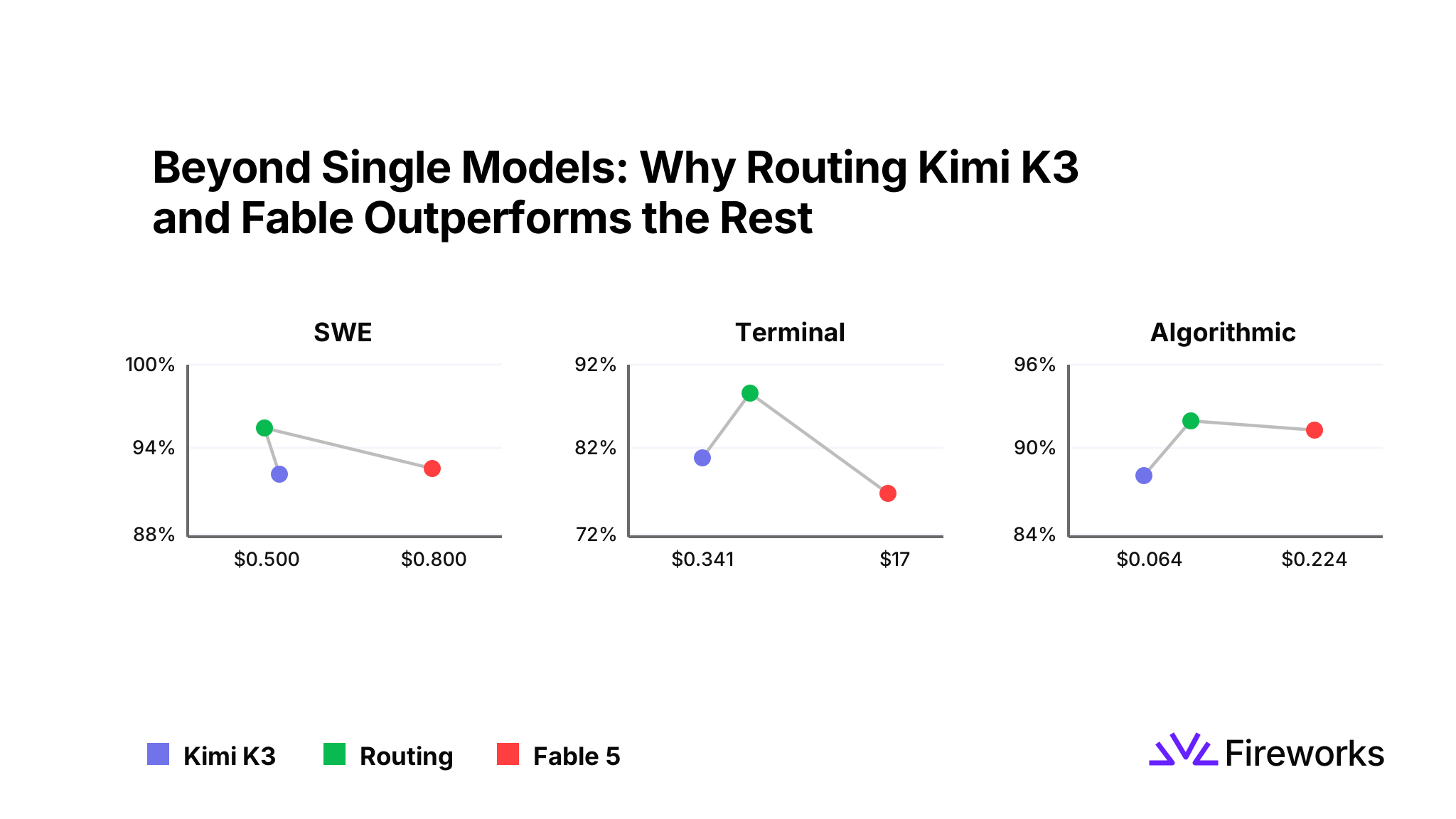
- Is there something specifically with Kimi that's better here? As far as I know Kimi pricing is about the same as Sonnet 5 -- what happens if you use that model and Fable instead? Or Grok 4.5 which is even cheaper?by nharada
- One benefit of an open source one is that you can, as a large corporation, run it "locally" within your own data center. Even fine tune it.by ralusek
- The article says Kimi is better at some things than Fable. That's probably not true of Sonnet.by DennisP
- Anthropic looks like Roman empire fast-farwarded, getting to the other side of the peak even before the IPO.by zkmon
- Yeah, I didn't get in either.by yid
- Nothing makes me happier than seeing AI becoming a commodity rather than the winner takes all bullshit Anthropic and OpenAI have been chasing with hundreds of billions of investor moneyby ulfw
- What's the data governance and privacy controls on using Kimi K3 if I subscribe to their coding plans? I want to migrate away from Anthropicby hmokiguess
- by yogthos
- > What's the data governance and privacy controls on using Kimi K3 if I subscribe to their coding plans?
If you can’t figure it out from their website, perhaps it is a red flag?
by andsoitis - Need to wait until "western" providers start hosting it.by cromka
- Simplest way is to signup to OpenRouter and filter out all non ZDR (zero data retention) providers. Paying "API rates" however can prove expensive compared to coding plans (for instance, MiniMax $20/mo coding plan allows 1.7b tokens; depending on input/output/cache ratio, it is worth $200 to $500+), except for Hy3, DeepSeek v4 Pro, and MiMo v2.5 Pro (whose API rates are cheap and/or discounted already).
If you're looking to not have to deal with Chinese providers, AtlasCode ($20/mo), OpenCode Go ($10/mo), and Cline Pass ($10/mo) provide 2x to 6x usage for some of the popular open weights (depending on the model).
Personally, I subscribe to Z.ai ($17/mo), and pay API rates for MiMo v2.5, Hy3, Qwen 3.7 Plus, & DeepSeek v4 to the original providers (Xiaomi, Tencent, Alibaba, & DeepSeek).
by ignoramous - From https://platform.kimi.ai/docs/agreement/modeluse
> We may use Content to provide, maintain, develop, support, and improve the Services, comply with applicable law, enforce our terms and policies, and keep the Services safe and secure. Customer who requires restrictions on the use of Customer Content for training or improving Moonshot AI models may contact Moonshot AI to discuss available enterprise arrangements or separate written agreements. Unless otherwise expressly agreed in writing, Customer Content may be used for the foregoing purposes.
Notably, unlike Claude, there is not an opt-out option for the model training part. The TOS explicitly allows Kimi to train on your code.
by qurren - I will accept a 5% drop in benchmarks for a model that talks to me like a human.
- Yeah. I've found that Opus by default outputs something I call "Claude-lang." It consists of oversimplified, grammatically incomplete sentences that I find painful to read.
Maybe it is something that is easy for it to read and write, but definitely not for humans.
For example,
(Yeah, Opus outputted it in one line)Skim once now; refer back while reading Part II. \*Every bold technical term in Part II is defined here\* — treat these as a dictionary, not a reading assignment. The first table covers the vocabulary of the *deck*; the three that follow cover the *methodology* vocabulary introduced in Part II, grouped so you can find a term fast: \*(A)\* the logic of rules, \*(B)\* the neural-network & training machinery, \*(C)\* the method-design ideas. JMRL is the paper the thesis instantiates, so this is the one to know cold. Its pitch is \*end-to-end\*: earlier rule methods (LogicRE, MILR) bolt a rule learner *onto a frozen* extractor in a pipeline and suffer \*error propagation\*; JMRL trains the rule module *jointly* with the extractor. **Identity.** Conformal prediction for NER producing **finite-sample-valid prediction sets** at two granularities: **full-sequence** sets over entire label sequences (capturing contextual dependence — "if Sarah=PER then NYC likely LOC") and **subsequence-level** (per-span, **class-conditional**) sets; an **integrated** method filters full-sequence predictions with entity-level sets. Adds **covariate-stratified calibration** by **sentence length and language** for valid multilingual coverage, and studies **combined nonconformity scores** (Naive / Conditional / RAPS). **Read in this order.** Abstract → §1 contributions (full-sequence / subsequence / integrated / **covariate (length + language) calibration** / combined scores) → §2 CP recap (inductive split-CP) → §3 NER formulation (IOB2, CRF) → the subsequence / entity-level set construction + class-conditional coverage → the language-stratified calibration results. **Why it matters here.** The **span-level construction** for **Topic 11**'s per-triple score, and — crucially — its **language-stratified calibration is exactly the EN↔zh case**: it shows how to keep conformal coverage valid across languages of differing length/script. Complements PASC (pipeline-level joint coverage) with the *NER-internal* set construction. **Caveat.** A heavy statistics paper (44 pp., *Annals of Applied Statistics* submission) with CRF-based NER; the project needs only the **inductive split-CP + subsequence/entity-level sets + language-stratified calibration**, not the full-sequence machinery (likely overkill for triple-confidence). Assumes exchangeability — borderline under the EN→zh shift, which is precisely why the PASC/ConformalNER *shift* analyses matter.by maxloh - You don't even need to pay a 5% hit. Just paste Fable output into Gemini Flash and it will rewrite it in more accessible language.by roncesvalles
- Why? LLMs are not humans.by semilin